
Showing posts with label safety. Show all posts

Friday, August 21, 2015

Letters to the Editor on Crude by Rail by Grays Harbor Residents

Updated: add'l letter added at end

Grays Harbor poor choice for locating crude oil terminals

BY LARRY THEVIK  Aug. 21, 2015    Special to The Olympian 

The dangers of oil trains have understandably dominated headlines about proposed oil terminals in Washington state. As a long-time crab fisherman out of Grays Harbor, I’m very concerned about another risk that has so far gotten far less attention yet deserves equal time in the public spotlight: the consequences of a major oil spill for our local economy, environment and way of life.

Grays Harbor is an essential fish habitat for many species and a major nursery area for Dungeness crab. The tribal and non-tribal average crab catch value, based on state and tribal estimates, is $44 million a year. The annual economic benefit is $80 million to $150 million, depending on the multiplier used.

In 2014 Washington residents took an estimated 4.1 million trips to the Washington Coast spending $481 million, according to a Surf Rider Foundation study. More than one-third of those visits were to Grays Harbor County to enjoy all our coastal waters have to offer.

The state is expected to soon release for public comment a draft environmental impact statement (DEIS) for the first two of three crude oil terminal proposals in Grays Harbor.

No crude oil presently moves through Grays Harbor. Yet, if the terminals are built, oil tanker and oil barge traffic is expected to increase vessel visits by 450 percent, adding 750 oil-vessel bar transits annually. The Grays Harbor shipping channel is narrow, shallow, subject to strong current flows, and has limited staging area for ships and tugs.

The Washington Department of Fish and Wildlife stated, “Grays Harbor is an area particularly sensitive to the adverse effects of oil spills.” The introduction of such huge volumes of oil transport and oil vessel traffic in an area not suited to them in the first place is inviting disaster. Grays Harbor is simply a poor choice for oil terminals.

Between trains, tanks, ships and barges, up to 115 million gallons of oil will be in Grays Harbor at any one time. We know from disasters like the Deepwater Horizon in the Gulf of Mexico and Exxon Valdez in Alaska that one major oil spill can be devastating: contaminating coastlines, killing fish and wildlife, destroying livelihoods and ruining property values. The damage can last for decades, even generations.

One major spill is one too many. The proposed oil terminals threaten not just Grays Harbor, but our state’s entire coast, a place cherished by millions. Those who care must engage in the DEIS comment process to tell our state leaders to put our waterways, our jobs, and our communities ahead of oil companies’ relentless pursuit of expanding markets and profits at our peril.

Larry Thevik has fished Grays Harbor and the coast for 45 years in pursuit of salmon, halibut, tuna, prawns and Dungeness crab. He is vice president of Washington Dungeness Crab Fishermen’s Association.

Margin of safety is thin


I am new to this area, so at the risk of sounding redundant, I’d like to address the problem with railroad tankers in general that are carrying crude oil every day and will be here unless we do more to stop it.
 
These antiquated DOT-111 tankers were built in the 1960s and are less than a half inch in thickness; 7/16 of an inch to be exact. There are approximately 200,000 of them out there and approximately 78,000 of them still hauling crude oil.

Safety flaws were vehemently pointed out in the early ’90s but fell upon deaf ears.
These railroad tankers are no joke. They are old, weak, poorly designed and are coming to our county unless we do something to stop it. Poorly designed vessels such as these cause people to die and communities to wither.
 
Senator Charles Schumer (D-N.Y.) has compared the car to “a ticking time bomb.”
The CPC-1232 is an upgraded car but certainly not by much. It still has the same thickness as the DOT-111, so no improvement there. It was one of the 105 cars in the CSX train derailment in Lynchburg, VA., April 2014 and ultimately spilled 30,000 gallons of Bakken crude oil into the James River. That same type of tanker apparently was leaking crude oil as it came across Idaho into Washington in January of this year.
 
There is a new tanker being built in Mexico which has a thickness of 9/16th of an inch. U.S. railroad corporations are not giving any indication they will even consider spending money to upgrade. Unless forced to by Congress to scrap the DOT-111 tanker, it will live on.
 
At this point railroads are being asked to upgrade but not forced to. So there are no new and improved rail tankers coming down the pike any time soon.
 
One can safely assume that the two 7/16 inch shelled tankers I spoke of are the ones that what will be carrying the crude through Grays Harbor County if big oil is allowed here. We will be living with them and their volatility every day. I don’t want to live here having to hold my breath because it really is a case of when (a spill or explosion will happen) not if.
 
This is my reason for writing today. Please voice your opposition before it’s too late.
Remember that Big Oil doesn’t know us as a community and doesn’t want to know us. They just want what we have. And in this case, it’s our backyards.

Joan Morabito
Ocean Shores


Update: this letter was published by the Daily World on 8/18/15 but not posted on their website

Editor:


I am writing to congratulate the City of Aberdeen on adopting a six month moratorium on crude oil storage, affirming the enormous risk and little gain associated with oil storage and transport in Grays Harbor. The Port of Grays Harbor is a poor choice for shipping Canadian tar-sands crude oil or US Bakken crude oil. The proposed crude oil trains would travel through Aberdeen and the terminals would be sited within the population center of Hoquiam, creating substantial risk from fire or explosions Tank overflows on average occur every 3,300 tank fillings causing several explosions and fires.  There is also the risk of spillage, accident, and fire with any train-to-tank transfer, which could occur at any of three locations within the city of Hoquiam.  The potential for disaster is real.

The Port is built on landfill in a tsunami alert zone, whose land and waters are battered by serious storms and subject to flooding.  The pilings supporting the terminals are unlikely to withstand a tsunami resulting in nearly certain tank rupture, fire, and explosions spreading to the entire complex.

Where is the gain to the communities of Grays Harbor?  The three companies who plan to build facilities to receive, store and ship crude oil from Hoquiam would create tank farms with over a 110 million gallon capacity. Initially, there would be jobs constructing the tank farms, but once completed, those in the longshore industry predict a net loss because the current more labor intensive work of handling commodities in the Port would be replaced by the largely automated work of unloading and loading oil.  There are other important economic impacts to consider, including the effects of steadily increasing heavy, slow and over one mile long 100 car trains, each carrying approximately 2.9 million gallons of volatile crude. Such long slow trains would interrupt the flow of traffic to businesses, homes, and schools, and would interfere with emergency responses.

Fishing and tourism industry are major components of the Twin Harbor’s economy.  The risk is high for leaks during transport, and spills during loading and unloading, contaminating our waters and devastating these industries for many years.  How can we run the risk of losing our thriving seafood industry jobs for a mere handful of crude oil jobs?

The chemical fumes (vapors and gases) vented from the oil storage tanks with floating lids, as well as fumes emitted during the loading and unloading of trains and tankers will impact Hoquiam and Aberdeen and  surrounding towns affecting citizen health and  diminishing property values. Exposure to this air pollution includes increased risks of cancers, stroke and heart attack, asthma, allergies, chronic obstructive pulmonary disease, and neuro-developmental and behavioral disorders in children.

I wish also to welcome Renewable Energy Group, the new owners of Imperium Renewables, with the sincere hope that they will hold as a priority the long-term welfare of the persons, economy, the bay and the beautiful surroundings of Grays Harbor.

Kathy Schaefer
 

Friday, December 5, 2014

US Oil Reserves Highest Since 1975/ CBR a Topic at Senate Hearing

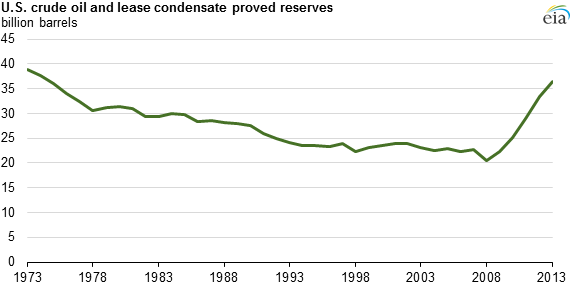
U.S. oil reserves continue rising, surpass 36 billion barrels for first time since 1975

graph of U.S. crude oil and lease condensate proved reserves, as explained in the article text
Source: U.S. Energy Information Administration, U.S. Crude Oil and Natural Gas Proved Reserves


U.S. crude oil and lease condensate proved reserves rose for the fifth consecutive year in 2013, increasing by 9% from the 2012 level to 36.5 billion barrels, according to the U.S. Crude Oil and Natural Gas Proved Reserves, 2013 report released yesterday by the U.S. Energy Information Administration (EIA). U.S. crude oil and lease condensate proved reserves surpassed 36 billion barrels for the first time since 1975.  .....

...Continued development of the Bakken/Three Forks play in North Dakota accounted for a large portion of the reserves additions, and overall, tight oil plays accounted for almost 30% of all U.S. crude oil and lease condensate proved reserves....   read more here


More on Secret CBR Routes From Pro-Publica:

Towns and cities across America are often unaware that crude oil is being transported across their borders, and ill-equipped to handle a potential crude oil fire. Though the routes taken by crude-bearing trains is hidden from the public, safety-incident data collected by the train companies and reported to the U.S. government reveals some of the routes.             Related Story »

A searchable database of incident reports can be found here: Pipeline and Hazardous Materials Safety Administration

Despite Price Drop, Crude-By-Rail Remains Big Issue

By Tom Curry     Roll Call    12/04/14

....At a Senate Commerce Committee hearing Wednesday that focused primarily on President Obama’s nominee to head the National Highway Traffic Safety Administration, Sen. Claire McCaskill, D- Mo., took time to question Carlos Monje, the nominee to be assistant secretary of transportation, about Bakken oil moving across her state.

“I think a pipeline is the safest way to move it, not rail,” she told Monje, noting that she voted to approve the Keystone XL pipeline, though which some Bakken crude would move, if it’s built.

“I have heard from local first responders both in Kansas City and St. Louis. While we’ve had some crude by rail accidents, they have primarily been in more rural locations,” she said. “Obviously if that were to occur in a major metropolitan area like Kansas City or St. Louis, we would have a much more significant problem to deal with.”

She said the urban first responders worry that “they’re not getting enough information about what is the right response, what is the best response. They fear that they’re not as trained and as knowledgeable as they need to be on this issue.” .....   read more here

Monday, August 25, 2014

Stabilizing Bakken crude; and plans for Short-Line safety institute


Does ND crude need to be stabilized?

What can be done to keep trains from becoming "Bakken bombs?"


8/25/14  April Baumgarten, Forum News Service  Prairie Business

DICKINSON, N.D. - What can be done to keep trains from becoming "Bakken bombs?"
It's a question on the minds of many North Dakota residents and leaders, so much that some are calling on the state Industrial Commission to require oil companies to use technology to reduce the crude's volatility. The words are less than kind.
"Every public official in America who doesn't want their citizens incinerated will be invited to Bismarck to chew on the commissioners of the NDIC for failing to regulate the industry they regulate," Ron Schalow of Fargo wrote in a Facebook message.
- See more at: http://www.prairiebizmag.com/event/article/id/20534/#sthash.n9NiIoPx.dpuf
DICKINSON, N.D. - What can be done to keep trains from becoming "Bakken bombs?"


It's a question on the minds of many North Dakota residents and leaders, so much that some are calling on the state Industrial Commission to require oil companies to use technology to reduce the crude's volatility. The words are less than kind.


"Every public official in America who doesn't want their citizens incinerated will be invited to Bismarck to chew on the commissioners of the NDIC for failing to regulate the industry they regulate," Ron Schalow of Fargo wrote in a Facebook message.... read more here


Rail News: Safety
FRA provides two grants to help develop a short-line safety institute


The Federal Railroad Administration (FRA) will award two grants totaling $350,000 to support the development of a Short Line Rail Safety Institute, U.S. Sens. Patty Murray (D-Wash.) and Susan Collins (R-Maine) announced late last week. The FRA confirmed the grants in a press release issued on Friday.

The senators earlier this year proposed the formation of a Short Line Rail Safety Institute to enhance short-line safety, including the transportation of crude oil and ethanol. On May 15, Murray and Collins sent a letter to U.S. Transportation Secretary Anthony Foxx expressing support for the institute, and in June they introduced legislation to authorize its formation.

The FRA will provide a $250,000 grant to the American Short Line and Regional Railroad Association to begin the pilot phase of safety culture assessments. Pilot testing will begin in January 2015 and initially will focus on the safety of crude by rail.

The association plans to use the grant to conduct a comprehensive review of short lines' existing safety programs; use tools developed by the University of Connecticut to identify areas of non-compliance and help small railroads develop a safety culture; provide access to effective safety training processes, programs and resources; and develop large libraries of training tools, technical materials and other educational resources to assist small railroads in instilling a safety culture.

The FRA also will provide a $100,000 grant to the University of Connecticut to conduct initial work focusing on the development, testing and validation of safety education, training and related programs for short-line managers and employees......more here


Does ND crude need to be stabilized?

DICKINSON, N.D. - What can be done to keep trains from becoming "Bakken bombs?" By: April Baumgarten, Forum News Service
- See more at: http://www.prairiebizmag.com/event/article/id/20534/#sthash.n9NiIoPx.dpuf

Sunday, August 24, 2014

Oregon Permits, Osama bin Laden & Pepsi Cans on Wheels


In our View: Skip This Slice of Oil Pie

North Dakota's Bakken boom could aid Clark County, but terminal wrong tack

Following a series of derailments and explosions throughout North America, the idea of transporting 15 million gallons of crude through Clark County each day has generated plenty of interest from local residents. Barry Cain, who is planning a multibillion-dollar waterfront development in Vancouver, has said the oil terminal would be incompatible with his project, and the Vancouver City Council has formally voted to oppose any project that would increase the amount of oil-bearing trains traveling through the city. The oil terminal plan is currently under review by the state Energy Facility Site Evaluation Council.All of that has been well-documented over the past year, but The Columbian's series — which was published Aug. 17 and Aug. 18 — helped bring the issues into sharp relief. And along the way, it did little to suggest that the benefits of an oil terminal would outweigh the drawbacks for Vancouver.
~HT Don Steinke

THE FIGHT FOR CLEAN AIR

Petition via EarthJustice
Explosions and chemical clouds have been a part of life for communities living in the shadow of oil refineries. The EPA has finally begun developing a plan to control these toxic time bombs—and you can help make the difference. Take action today!

Oil train terminal near Clatskanie gets key air pollution permit from Oregon Department of Environmental Quality

The terminal's new permit allows it to move 1.8 billion gallons of oil annually, enough to bring 50 oil trains per month through Portland and small Columbia River towns like Scappoose, Rainier and St. Helens. That's twice the number of trains it can currently handle.
....
"We are pleased to have received our permit, which is the next step toward infrastructure upgrades that will create hundreds of jobs during the construction phase and new permanent jobs when the facility is fully operational," Slifka said.
Massachusetts-based Global Partners blew past earlier permit limits, drawing a$117,292 fine from the DEQ in March. Though the state allowed the terminal to unload 50 million gallons annually, it moved 300 million gallons last year.
The facility began as a state-subsidized ethanol fuel terminal, but went bankrupt in 2009. In June 2012, the DEQ quickly approved a routine permit change that allowed it to start moving crude oil instead of ethanol from trains onto barges, saying the shift had an incidental effect on the site's air pollution.


Big Rail Cites Bin Laden, Al Qaeda to Fend Off Oil-by-Rail Route Transparency

 via desmogblog
While many states around the U.S. havereleased information to the public about the frequency and routes of trains carrying oil obtained from hydraulic fracturing (“fracking”) in North Dakota’sBakken Shale basin, holdouts still remain. Why the delay? Homeland security concerns, claim some companies. ....The most recent edition of Inspire magazine, March 2014, the online, English-language propaganda publication of [Al-Qaeda in the Arabian Peninsula], presents a full-page collage depicting varied images…in order to construct an explosive device,” reads Carbaugh’s affidavitAmong these images are a derailed passenger train and a partly covered note paper listing cities in the [U.S.] as well as the terms ‘Dakota’ and ‘Train crude oil.’” Carbaugh also cited Osama bin Laden, the late Al-Qaeda international ring-leader, in his affidavit.Among the materials seized in the May 1, 2011, raid on Osama bin Laden’s compound in Abbottabad, Pakistan, were notes indicating interest in ‘tipping’ or ‘toppling’ trains — that is causing their derailment,” Carbaugh wrote.

Pepsi Cans on Wheels: Stopping Explosive Oil Trains 


This problem has grown fast because of the expansion of fracking.  These rolling hazards spilt more flammable crude oil last year than in the previous forty. Records from the Pipelines and Hazardous Materials Safety Administration (PHMSA) reveal zero incidents in 2009 involving crude oil transportation by rail. By 2012, that number ballooned to 86. And halfway through 2013, PHMSA tracked 85. 
The Ford Pinto of Rail Cars 
The culprit in this sharp increase in rail car explosions is a type of legacy train car called the DOT-111. This train car, originally fashioned in the 1960s to haul commodities like corn syrup, has now, in light of the enormous demand, become the transit mode of choice for the oil and gas industry. The former mayor of the Village of Barrington Illinois- an upscale community north of Chicago- called the DOT-111s “the Ford Pinto of rail cars”. One Washington DC- based consultant for the rail industry described the DOT-111s as “Pepsi cans on wheels”.