Showing posts with label moratorium. Show all posts

Friday, August 21, 2015

Letters to the Editor on Crude by Rail by Grays Harbor Residents

Updated: add'l letter added at end

Grays Harbor poor choice for locating crude oil terminals

BY LARRY THEVIK  Aug. 21, 2015    Special to The Olympian 

The dangers of oil trains have understandably dominated headlines about proposed oil terminals in Washington state. As a long-time crab fisherman out of Grays Harbor, I’m very concerned about another risk that has so far gotten far less attention yet deserves equal time in the public spotlight: the consequences of a major oil spill for our local economy, environment and way of life.

Grays Harbor is an essential fish habitat for many species and a major nursery area for Dungeness crab. The tribal and non-tribal average crab catch value, based on state and tribal estimates, is $44 million a year. The annual economic benefit is $80 million to $150 million, depending on the multiplier used.

In 2014 Washington residents took an estimated 4.1 million trips to the Washington Coast spending $481 million, according to a Surf Rider Foundation study. More than one-third of those visits were to Grays Harbor County to enjoy all our coastal waters have to offer.

The state is expected to soon release for public comment a draft environmental impact statement (DEIS) for the first two of three crude oil terminal proposals in Grays Harbor.

No crude oil presently moves through Grays Harbor. Yet, if the terminals are built, oil tanker and oil barge traffic is expected to increase vessel visits by 450 percent, adding 750 oil-vessel bar transits annually. The Grays Harbor shipping channel is narrow, shallow, subject to strong current flows, and has limited staging area for ships and tugs.

The Washington Department of Fish and Wildlife stated, “Grays Harbor is an area particularly sensitive to the adverse effects of oil spills.” The introduction of such huge volumes of oil transport and oil vessel traffic in an area not suited to them in the first place is inviting disaster. Grays Harbor is simply a poor choice for oil terminals.

Between trains, tanks, ships and barges, up to 115 million gallons of oil will be in Grays Harbor at any one time. We know from disasters like the Deepwater Horizon in the Gulf of Mexico and Exxon Valdez in Alaska that one major oil spill can be devastating: contaminating coastlines, killing fish and wildlife, destroying livelihoods and ruining property values. The damage can last for decades, even generations.

One major spill is one too many. The proposed oil terminals threaten not just Grays Harbor, but our state’s entire coast, a place cherished by millions. Those who care must engage in the DEIS comment process to tell our state leaders to put our waterways, our jobs, and our communities ahead of oil companies’ relentless pursuit of expanding markets and profits at our peril.

Larry Thevik has fished Grays Harbor and the coast for 45 years in pursuit of salmon, halibut, tuna, prawns and Dungeness crab. He is vice president of Washington Dungeness Crab Fishermen’s Association.

Margin of safety is thin


I am new to this area, so at the risk of sounding redundant, I’d like to address the problem with railroad tankers in general that are carrying crude oil every day and will be here unless we do more to stop it.
 
These antiquated DOT-111 tankers were built in the 1960s and are less than a half inch in thickness; 7/16 of an inch to be exact. There are approximately 200,000 of them out there and approximately 78,000 of them still hauling crude oil.

Safety flaws were vehemently pointed out in the early ’90s but fell upon deaf ears.
These railroad tankers are no joke. They are old, weak, poorly designed and are coming to our county unless we do something to stop it. Poorly designed vessels such as these cause people to die and communities to wither.
 
Senator Charles Schumer (D-N.Y.) has compared the car to “a ticking time bomb.”
The CPC-1232 is an upgraded car but certainly not by much. It still has the same thickness as the DOT-111, so no improvement there. It was one of the 105 cars in the CSX train derailment in Lynchburg, VA., April 2014 and ultimately spilled 30,000 gallons of Bakken crude oil into the James River. That same type of tanker apparently was leaking crude oil as it came across Idaho into Washington in January of this year.
 
There is a new tanker being built in Mexico which has a thickness of 9/16th of an inch. U.S. railroad corporations are not giving any indication they will even consider spending money to upgrade. Unless forced to by Congress to scrap the DOT-111 tanker, it will live on.
 
At this point railroads are being asked to upgrade but not forced to. So there are no new and improved rail tankers coming down the pike any time soon.
 
One can safely assume that the two 7/16 inch shelled tankers I spoke of are the ones that what will be carrying the crude through Grays Harbor County if big oil is allowed here. We will be living with them and their volatility every day. I don’t want to live here having to hold my breath because it really is a case of when (a spill or explosion will happen) not if.
 
This is my reason for writing today. Please voice your opposition before it’s too late.
Remember that Big Oil doesn’t know us as a community and doesn’t want to know us. They just want what we have. And in this case, it’s our backyards.

Joan Morabito
Ocean Shores


Update: this letter was published by the Daily World on 8/18/15 but not posted on their website

Editor:


I am writing to congratulate the City of Aberdeen on adopting a six month moratorium on crude oil storage, affirming the enormous risk and little gain associated with oil storage and transport in Grays Harbor. The Port of Grays Harbor is a poor choice for shipping Canadian tar-sands crude oil or US Bakken crude oil. The proposed crude oil trains would travel through Aberdeen and the terminals would be sited within the population center of Hoquiam, creating substantial risk from fire or explosions Tank overflows on average occur every 3,300 tank fillings causing several explosions and fires.  There is also the risk of spillage, accident, and fire with any train-to-tank transfer, which could occur at any of three locations within the city of Hoquiam.  The potential for disaster is real.

The Port is built on landfill in a tsunami alert zone, whose land and waters are battered by serious storms and subject to flooding.  The pilings supporting the terminals are unlikely to withstand a tsunami resulting in nearly certain tank rupture, fire, and explosions spreading to the entire complex.

Where is the gain to the communities of Grays Harbor?  The three companies who plan to build facilities to receive, store and ship crude oil from Hoquiam would create tank farms with over a 110 million gallon capacity. Initially, there would be jobs constructing the tank farms, but once completed, those in the longshore industry predict a net loss because the current more labor intensive work of handling commodities in the Port would be replaced by the largely automated work of unloading and loading oil.  There are other important economic impacts to consider, including the effects of steadily increasing heavy, slow and over one mile long 100 car trains, each carrying approximately 2.9 million gallons of volatile crude. Such long slow trains would interrupt the flow of traffic to businesses, homes, and schools, and would interfere with emergency responses.

Fishing and tourism industry are major components of the Twin Harbor’s economy.  The risk is high for leaks during transport, and spills during loading and unloading, contaminating our waters and devastating these industries for many years.  How can we run the risk of losing our thriving seafood industry jobs for a mere handful of crude oil jobs?

The chemical fumes (vapors and gases) vented from the oil storage tanks with floating lids, as well as fumes emitted during the loading and unloading of trains and tankers will impact Hoquiam and Aberdeen and  surrounding towns affecting citizen health and  diminishing property values. Exposure to this air pollution includes increased risks of cancers, stroke and heart attack, asthma, allergies, chronic obstructive pulmonary disease, and neuro-developmental and behavioral disorders in children.

I wish also to welcome Renewable Energy Group, the new owners of Imperium Renewables, with the sincere hope that they will hold as a priority the long-term welfare of the persons, economy, the bay and the beautiful surroundings of Grays Harbor.

Kathy Schaefer
 

Thursday, March 5, 2015

Hoquiam Mayor calls for moratorium on all future oil facilities in city

By Kyle Mittan The Daily World
Hoquiam Mayor Jack Durney has asked the Hoquiam City Council to impose a moratorium on future oil facilities in the city, he announced in a memorandum on Wednesday afternoon. Durney also asks the council to consider an amendment to its land use plan “to forbid wholesale liquefied petroleum facilities in any zone within the city of Hoquiam.” The moratorium, which he implores the council to enact immediately, will apparently not affect planned facilities by Westway Terminals, Imperium Renewables and US Development Group LLC, allowing those port tenants’ applications to move forward. If those companies decided not to proceed with their current permitting process, however, they would not be able to establish oil facilities in the future.

Hoquiam may take the “safe route” on crude by rail

via KBKW
Durney said they cannot change the past, referring to the ongoing permit process of three proposed facilities at the Port, but he hopes to change the future by removing the current port properties from the “market for crude oil storage and sales.” adding that “Because Westways Terminals, Imperium Renewables, and US Development have vested rights in their applications for these facilities, we cannot change the past. We are required to evaluate these projects based upon the City, State and Federal laws, rules and regulations that were in place at the time the applications were submitted. However, we can change the future! ”
I sent a letter today from
Citizens for a Clean Harbor
P.O. Box 35
Hoquiam, WA 98550
Mayor Jack Durney
City Hall
608 8th Street
Hoquiam, WA 98550
Dear Mayor Durney:
We want to thank you and the city council for taking this stand against crude oil. 
Preventing future terminals on the harbor is something we all must do if we are to keep our people and the environment safe and healthy. Please extend our sincere thanks to the councilmen and to your staff! 
While we are very grateful for the stance you have taken, Citizens for a Clean Harbor will continue our work to prevent the three proposed terminals. We concur with the statement you made: “We have far too much to lose if we don’t”.
We will, as I'm sure you will, continue to strive to make Hoquiam and Grays Harbor a better place for all of us.
Once again, thank you! 
Sincerely, 
Tammy Domike, 
Field Coordinator 
Citizens for a Clean Harbor
www.cleanharbor.org                 info@cleanharbor.org.
If you'd like to send your own Thank You message to Mayor Durney:

Mayor Jack Durney
Phone: (360) 538-3979
Fax: (360) 532-4031

Tuesday, March 3, 2015

Vancouver extends moratorium, Rail CEO fears terrorism, Sen. Cantwell plans CBR safety bill

Vancouver extends moratorium on crude oil facilities

By Amy M.E. Fischer, Columbian City government reporter    The Columbian      03/02/15

The Vancouver City Council on Monday unanimously voted to extend a moratorium on expanding or establishing crude oil-handling facilities, prompting the audience to break into applause.

Moments earlier, roughly a dozen people took the microphone to praise the council's stance against oil terminals in Vancouver and voice support for continuation of the six-month moratorium adopted Sept. 11. No one spoke against the extension.

"Corporations do not care about you or me or our families or communities. But you do care. I trust YOU," Den Mark Wichar, a Hough neighborhood resident, told the council, referring to the companies interested in establishing crude oil facilities locally.

"Thanks for having our backs," said Cathryn Chudy of Vancouver.

The original moratorium was due to expire March 10. By continuing the moratorium for six months, city staff will have time to prepare a comprehensive review of current and potential new regulations to city code. Among other things, the staff's work will involve determining which agencies have authority over crude oil, identifying interested parties and their issues, and researching actions other municipalities have taken, according to city documents.

The moratorium doesn't affect the massive oil transfer terminal proposed by Tesoro Corp. and Savage Companies that's currently under review by the state. It would be the largest such terminal in the United States when operational, receiving an average of 360,000 barrels of crude oil per day by rail at the Port of Vancouver. The state Energy Facility Site Evaluation Council will make a recommendation to Gov. Jay Inslee regarding the Tesoro project, which the Vancouver City Council formally opposes.....    more here

CP CEO fears terrorism more than derailments

Hunter Harrison says attack ‘can be planned to do the worst possible damage.’

When it comes to shipping crude oil by rail, CP Rail CEO Hunter Harrison says he worries more about a possible terrorist attack than derailments.

“That’s what concerns me more,” he told reporters after a speech at the Canadian Club on Monday. “It can be planned to do the worst possible damage.”

Harrison, who took over CP in June 2012 after a bitter proxy fight, boasted that the company has made “quantum leaps” to reduce accidents based on severity and frequency.

However, he said he cannot promise there won’t be more accidents. 

But he says he actually worries more about third parties doing damage to a hazardous goods tank, or tampering with the railroads or rights of way.

“Everybody wants the products, but nobody wants the railroad by them or their backyard,” he said during his speech, citing logjams around Chicago, where railways pass busy areas such as the McCormick Place convention centre and Soldier Field, home of the National Football League’s Chicago Bears.

There’s huge exposure to potential accidents and we’re not addressing it like we should,” Harrison said, adding that routing protocols should be introduced to ensure the least exposure.....    more here

Cantwell to Introduce Bill on Safety Standards for Crude-by-Rail

Senator: USDOT rules don’t go far enough to protect cities and towns

kirotv.com   03/03/15
WASHINGTON, D.C. – In a Senate Commerce Committee hearing today, U.S. Senator Maria Cantwell (D-WA) announced plans to introduce legislation that would establish new, stronger safety standards for trains hauling flammable crude oil.

Cantwell told U.S. Department of Transportation Secretary Anthony Foxx that she didn’t think the Administration’s proposed rule under consideration would be strong enough and that legislation would be necessary to protect communities.....  more here 

Wednesday, December 3, 2014

Call for Suspension of Crude-by-Rail in Calif./ Appeal Filed to Ban DOT-111s

Call for Suspension of Crude-by-Rail Shipments After Feather River Derailment

KQED news    12/02/14

A prominent critic of the state’s readiness to respond to potential crude-by-rail accidents wants Gov. Jerry Brown to impose a moratorium on oil trains traveling through Northern California’s Feather River Canyon and more than a dozen other sections of railroad throughout the state.

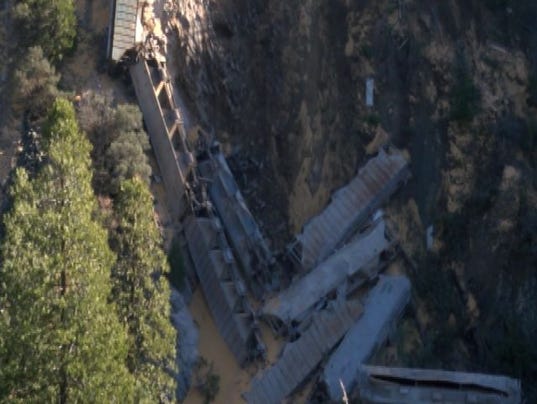
State Sen. Jerry Hill (D-San Mateo) made the request after a Union Pacific freight train derailed on the Feather River route northeast of Oroville last week. A dozen cars of the train, which was carrying grain, left the tracks; one car spilled corn into the river.

Hill’s letter (embedded below) reminded the governor the incident was a close call:
Your Office of Emergency Services (OES) was quoted as saying that “we dodged a bullet” because the train was carrying corn rather than oil. OES stated that each week a train carrying 1 million gallons of highly volatile crude oil from the Bakken oil field in Montana and North Dakota travels down the canyon and there are plans to add a second train shortly.....   read more here

U.S. Sued Over Refusal to Ban Older Rail Cars for Crude

December 02, 2014     Bloomberg
 
Earthjustice and other environmental groups asked a federal court to force the U.S. Transportation Department to reconsider its rejection of an immediate ban on the use of rail tank cars lacking updated safety features for shipping Bakken crude oil. 

The tank cars’ safety was questioned after a July 2013 explosion that killed 47 people when an unattended, runaway train hauling 72 carloads of Bakken crude derailed in Lac-Megantic, Quebec.

The transportation department is managing tank car safety issues through a series of directives, short of a ban, and rules are being drafted to phase out the older rolling stock, the agency said in November, declining the groups’ request for an emergency ban.

That response fails to consider the risks posed by the cars, including “past findings that the surge in crude-by-rail shipments of Bakken crude in dangerous tank cars poses imminent hazards and emergency unsafe conditions,” according to the complaint, filed today in federal appeals court in San Francisco.....     read more here

Wednesday, October 22, 2014

Vancouver reaffirms moratorium on new crude oil projects

 
By Stephanie Rice, Columbian   

The Vancouver City Council reaffirmed a six-month moratorium Monday on new or expanded facilities that would accept crude oil.

The council passed an emergency moratorium on Sept. 11, and had a public hearing on Monday to fulfill a legal requirement.

Last month’s emergency measure was an attempt to head off plans by NuStar Energy LP of San Antonio to apply to start storing crude oil at its two bulk tank terminals in Vancouver, one at the port and one at 5420 Fruit Valley Road. The meeting was announced Sept. 10 in accordance with a state law requiring 24-hour public notice, and NuStar submitted a preliminary application shortly after the city announced the meeting.

Assistant City Attorney Brent Boger said Monday that the pre-application qualifies the NuStar project as vested, and therefore exempt from the moratorium.

The moratorium also won’t affect the oil transfer terminal proposed by Tesoro Corp. and Savage Companies that’s currently under review by the state.....

.... Tesoro-Savage wants to build an oil-by-rail terminal that would receive an average of 360,000 barrels of crude per day at the port.

Eventually, the state evaluation council will make a recommendation to Gov. Jay Inslee, who will approve or deny the project.

Amendments possible
The moratorium, meanwhile, will give the city time to consider possible amendments to its land use and development codes concerning the transportation and storage of crude oil..... read more here

Thursday, October 16, 2014

Inslee's Draft Marine and Rail Oil Report: A Study in Mis-direction.


To: Interested Parties

Fr: Dan Leahy

Re: Inslee's Draft Marine and Rail Oil Report: A Study in Mis-direction.

I've waded through the October 1st draft of Governor Inslee's study. I do find it extremely insulting that there is no mention of the significant statewide municipal, community, farm, union and tribal opposition to his proposed oil terminals, expanding oil refineries, explosive oil trains and the misuse of our public ports.

I've come to believe that the only force capable of saving our land, labor and commonly held resources is an alliance of sovereign tribes, organized labor, farmer unions and community based resistance groups working in concert with their local governmental jurisdictions.

Hopefully the Spokane and Olympia hearings on the 28th and 30th will build toward this alliance.

How Can Inslee's Study be Used?

The study can be an opportunity to create a love fest for the “beleaguered green governor” who pleads that he has no authority to regulate rail and wants us to back a doomed legislative agenda to expand agency study budgets while oil terminals get approved, oil refineries get expanded, and our rail system is turned into a permanent carbon corridor for the export of Alberta tar sands and Bakken crude.

Or, the study can be an opportunity to present a sharp critique of Inslee's refusal to support community demands by opposing state sponsored oil terminals, expanding refineries and a state bureaucracy collaborating with BNSF's mission to export through our public ports global pollution from the broken earth of Northern Alberta and North Dakota.

What's the purpose of Inslee's Study?

Mis-direction. It defines the problem as a federal issue and calls upon the US Coast Guard and the Federal Railroad Administration to do something. The USCG actually regulates marine traffic, but the FRA is an industry dominated entity with the current capability of inspecting less than 1% of rail activity and a policy of imploring railroads rather than regulating them. Calling upon the FRA to regulate rail would be like calling upon BNSF's owner Warren Buffett to stop making money. It's not what they do.

Worse, the study's authors wait until the very end of the report (p. 82)to tell us that “... the potential ways in which the crude by rail system and the increase in port activities with new facilities affects tribal treaty rights, the environment and the regional economy” are “ancillary”and not the “direct topic” of the study.

This study process is attempting to cap the direction of our movement and trade our future for a false climate agenda based on mitigating at the margins.

Thursday, August 28, 2014

NEWS FROM QUINAULT: Concurring With Port of Olympia Resolution

For Immediate Release

QIN Concurs with Port of Olympia Resolution


            TAHOLAH, WA, (8/27/14)--The Quinault Indian Nation (QIN) commends the  Commission of the Port of Olympia for the wisdom and foresight reflected in the Bakken Oil Resolution it passed Monday night, said QIN Councilman Larry Ralston.

            The Port of Olympia has joined with a growing number of communities that are expressing serious concerns about the risks to the economy of Washington State as the oil companies push to use our rail lines and port facilities for moving this volatile and dangerous oil in train cars and Panamex oil tankers.

            The Quinault Nation is studying the potential impacts to the treaty fisheries. However, all fishermen in the Grays Harbor area are highly concerned with the risks posed by these proposed additional crude oil terminals, mile-long oil trains and huge oil tankers that will be added to the traffic along our rail lines and in our waters.

            Recent research shows that in the Northwest, on average, one freight train derailment occurs every three-and-a-half days. The communities in Washington State have a right to know more about the risks of the vast increases in the transportation of this volatile oil before any final decisions are made to allow the oil companies this access to our lands and waterways. We also stand together with the communities that will take on the risks caused by the passage of the unsafe rail cars through the center of their towns, placing schools and other populated areas within the blast zones of these explosive trains.

            We ask people from all walks of life to stand with us.

            The Northwest is still a beautiful place to live and raise our children. Let’s keep it that way.

#####
CONTACT:     Steve Robinson   (360) 951-2494 Water4fish@comcast.net