Showing posts with label DOT-111 replacement. Show all posts

Friday, August 21, 2015

Letters to the Editor on Crude by Rail by Grays Harbor Residents

Updated: add'l letter added at end

Grays Harbor poor choice for locating crude oil terminals

BY LARRY THEVIK  Aug. 21, 2015    Special to The Olympian 

The dangers of oil trains have understandably dominated headlines about proposed oil terminals in Washington state. As a long-time crab fisherman out of Grays Harbor, I’m very concerned about another risk that has so far gotten far less attention yet deserves equal time in the public spotlight: the consequences of a major oil spill for our local economy, environment and way of life.

Grays Harbor is an essential fish habitat for many species and a major nursery area for Dungeness crab. The tribal and non-tribal average crab catch value, based on state and tribal estimates, is $44 million a year. The annual economic benefit is $80 million to $150 million, depending on the multiplier used.

In 2014 Washington residents took an estimated 4.1 million trips to the Washington Coast spending $481 million, according to a Surf Rider Foundation study. More than one-third of those visits were to Grays Harbor County to enjoy all our coastal waters have to offer.

The state is expected to soon release for public comment a draft environmental impact statement (DEIS) for the first two of three crude oil terminal proposals in Grays Harbor.

No crude oil presently moves through Grays Harbor. Yet, if the terminals are built, oil tanker and oil barge traffic is expected to increase vessel visits by 450 percent, adding 750 oil-vessel bar transits annually. The Grays Harbor shipping channel is narrow, shallow, subject to strong current flows, and has limited staging area for ships and tugs.

The Washington Department of Fish and Wildlife stated, “Grays Harbor is an area particularly sensitive to the adverse effects of oil spills.” The introduction of such huge volumes of oil transport and oil vessel traffic in an area not suited to them in the first place is inviting disaster. Grays Harbor is simply a poor choice for oil terminals.

Between trains, tanks, ships and barges, up to 115 million gallons of oil will be in Grays Harbor at any one time. We know from disasters like the Deepwater Horizon in the Gulf of Mexico and Exxon Valdez in Alaska that one major oil spill can be devastating: contaminating coastlines, killing fish and wildlife, destroying livelihoods and ruining property values. The damage can last for decades, even generations.

One major spill is one too many. The proposed oil terminals threaten not just Grays Harbor, but our state’s entire coast, a place cherished by millions. Those who care must engage in the DEIS comment process to tell our state leaders to put our waterways, our jobs, and our communities ahead of oil companies’ relentless pursuit of expanding markets and profits at our peril.

Larry Thevik has fished Grays Harbor and the coast for 45 years in pursuit of salmon, halibut, tuna, prawns and Dungeness crab. He is vice president of Washington Dungeness Crab Fishermen’s Association.

Margin of safety is thin


I am new to this area, so at the risk of sounding redundant, I’d like to address the problem with railroad tankers in general that are carrying crude oil every day and will be here unless we do more to stop it.
 
These antiquated DOT-111 tankers were built in the 1960s and are less than a half inch in thickness; 7/16 of an inch to be exact. There are approximately 200,000 of them out there and approximately 78,000 of them still hauling crude oil.

Safety flaws were vehemently pointed out in the early ’90s but fell upon deaf ears.
These railroad tankers are no joke. They are old, weak, poorly designed and are coming to our county unless we do something to stop it. Poorly designed vessels such as these cause people to die and communities to wither.
 
Senator Charles Schumer (D-N.Y.) has compared the car to “a ticking time bomb.”
The CPC-1232 is an upgraded car but certainly not by much. It still has the same thickness as the DOT-111, so no improvement there. It was one of the 105 cars in the CSX train derailment in Lynchburg, VA., April 2014 and ultimately spilled 30,000 gallons of Bakken crude oil into the James River. That same type of tanker apparently was leaking crude oil as it came across Idaho into Washington in January of this year.
 
There is a new tanker being built in Mexico which has a thickness of 9/16th of an inch. U.S. railroad corporations are not giving any indication they will even consider spending money to upgrade. Unless forced to by Congress to scrap the DOT-111 tanker, it will live on.
 
At this point railroads are being asked to upgrade but not forced to. So there are no new and improved rail tankers coming down the pike any time soon.
 
One can safely assume that the two 7/16 inch shelled tankers I spoke of are the ones that what will be carrying the crude through Grays Harbor County if big oil is allowed here. We will be living with them and their volatility every day. I don’t want to live here having to hold my breath because it really is a case of when (a spill or explosion will happen) not if.
 
This is my reason for writing today. Please voice your opposition before it’s too late.
Remember that Big Oil doesn’t know us as a community and doesn’t want to know us. They just want what we have. And in this case, it’s our backyards.

Joan Morabito
Ocean Shores


Update: this letter was published by the Daily World on 8/18/15 but not posted on their website

Editor:


I am writing to congratulate the City of Aberdeen on adopting a six month moratorium on crude oil storage, affirming the enormous risk and little gain associated with oil storage and transport in Grays Harbor. The Port of Grays Harbor is a poor choice for shipping Canadian tar-sands crude oil or US Bakken crude oil. The proposed crude oil trains would travel through Aberdeen and the terminals would be sited within the population center of Hoquiam, creating substantial risk from fire or explosions Tank overflows on average occur every 3,300 tank fillings causing several explosions and fires.  There is also the risk of spillage, accident, and fire with any train-to-tank transfer, which could occur at any of three locations within the city of Hoquiam.  The potential for disaster is real.

The Port is built on landfill in a tsunami alert zone, whose land and waters are battered by serious storms and subject to flooding.  The pilings supporting the terminals are unlikely to withstand a tsunami resulting in nearly certain tank rupture, fire, and explosions spreading to the entire complex.

Where is the gain to the communities of Grays Harbor?  The three companies who plan to build facilities to receive, store and ship crude oil from Hoquiam would create tank farms with over a 110 million gallon capacity. Initially, there would be jobs constructing the tank farms, but once completed, those in the longshore industry predict a net loss because the current more labor intensive work of handling commodities in the Port would be replaced by the largely automated work of unloading and loading oil.  There are other important economic impacts to consider, including the effects of steadily increasing heavy, slow and over one mile long 100 car trains, each carrying approximately 2.9 million gallons of volatile crude. Such long slow trains would interrupt the flow of traffic to businesses, homes, and schools, and would interfere with emergency responses.

Fishing and tourism industry are major components of the Twin Harbor’s economy.  The risk is high for leaks during transport, and spills during loading and unloading, contaminating our waters and devastating these industries for many years.  How can we run the risk of losing our thriving seafood industry jobs for a mere handful of crude oil jobs?

The chemical fumes (vapors and gases) vented from the oil storage tanks with floating lids, as well as fumes emitted during the loading and unloading of trains and tankers will impact Hoquiam and Aberdeen and  surrounding towns affecting citizen health and  diminishing property values. Exposure to this air pollution includes increased risks of cancers, stroke and heart attack, asthma, allergies, chronic obstructive pulmonary disease, and neuro-developmental and behavioral disorders in children.

I wish also to welcome Renewable Energy Group, the new owners of Imperium Renewables, with the sincere hope that they will hold as a priority the long-term welfare of the persons, economy, the bay and the beautiful surroundings of Grays Harbor.

Kathy Schaefer
 

Friday, July 3, 2015

Fun and Games Friday: Ignoring public safety (for a small fee)


Using bad tank cars? Then pay a fee, Brown proposes 

By The Columbus Dispatch  • 

[Ed. note: this "pay a pittance" bill was sponsored by Sens. Ron Wyden, D-Ore., Chuck Schumer, D-N.Y., Dianne Feinstein, D-Calif., Bob Casey, D-Pa., Jeff Merkley, D-Ore., Sherrod Brown, D-Ohio, and Mark Warner, D-Va. who continue to promote it.]

Sen. Sherrod Brown wants shippers using tank cars that have been linked to fiery train derailments to pay fees that would be used to reroute train tracks, train first responders and clean up spills.

Brown has proposed fees that start at $175 per car for those using the DOT-11, a tank car that federal regulators have warned hazardous-material shippers against using.

The fees would pay to clean up hazardous-material spills, to move tracks that handle large volumes of hazardous material and to hire more railroad inspectors. Brown’s bill earmarks about $45 million over three years to train first responders near rail lines that carry large quantities of hazardous material.

Earlier this year, federal regulators tightened rules on newly manufactured tank cars but did not require shippers to immediately remove the old cars.

“(The rule) probably didn’t go far enough,” Brown said on Tuesday at the site of a 2012 derailment and explosion near the state fairgrounds. “If it’s a threat to public safety, they probably need to be off the rails.”

The federal rule will phase out or require retrofitting of thousands of the oldest tank cars that carry crude oil by 2018. Another wave of the oil-carrying tankers would have to change by 2020.

Some of the tank cars that aren’t carrying crude oil would not be replaced or retrofitted until 2025.

Brown’s proposal calls for a tax credit for companies that upgrade their tank cars to the new federal standard in the next three years.

Chet Thompson, president of the American Fuel & Petrochemical Manufacturers trade association, said his organization would oppose the fee structure Brown proposed.....  more here

The Making of an Energy Ghetto  

Utilities efforts to turn back the clean-energy revolution would block low-income communities from realizing the benefits


Earthtalk      

The clean-energy revolution is underway, and so is the war against it. As with every other major economic transition, this battle will have winners and losers. For low-income communities of color, the stakes are especially high: Will they reap the benefits of the emerging clean-energy economy or will they be locked into energy ghettos?

smoke stack 

Here’s the context. Renewable energy — solar and wind — is quickly replacing fossil fuels as the preferred energy source. It is now cheaper than coal and most other fossil fuels. Innovative financing mechanisms have eliminated out-of-pocket costs for installing these technologies, enabling homeowners to save and even earn money from energy production. For example, “net metering” lets solar-powered households sell their surplus energy back to the grid for a profit — sending their electric meters spinning counterclockwise.

The utility sector is not happy with these developments, and it is fighting back. A recent Washington Post article cites utilities’ efforts to influence legislators, state public service commissions and — of particular concern — minority organizations. They want to eliminate net metering and assess households with solar-power systems a monthly surcharge to offset the utilities’ sunk capital investments and maintenance costs. And they have convinced some minority organizations that, without the surcharge, the poor will pay more through rate hikes as clean-energy and net-metering schemes benefit only well-to-do families.

This is a specious argument with potentially dangerous and unfortunate consequences, particularly for low-income residents. Eliminating net metering or placing a surcharge on households that migrate off the grid would foster a two-tiered energy society. These steps would render solar power unaffordable for low-income households, locking in historical racial and class hierarchies. The problems are analogous to the forces that created and sustained central-city ghettos.....   more here

Friday, June 5, 2015

DOT-117 final specifications; Plumas Co alarmed at derailment possibilities

DOT-117 defined

Written by  David Thomas, Contributing Editor     June 5, 2015      Railway Age
 
The wait for a new tank car specification is over. Now comes the “fun” part: Retrofits to older cars, and potentially onerous operating rules.

The final spec for the now-official DOT-117 (TC-117 in Canada) non-pressurized tank car adopts the most demanding of the technical requirements first offered for comment in the notice of rulemaking: jacketed and thermally insulated shells of 9/16-inch steel, full-height half-inch-thick head shields, sturdier, re-closeable pressure relief valves, and rollover protection for top fittings.

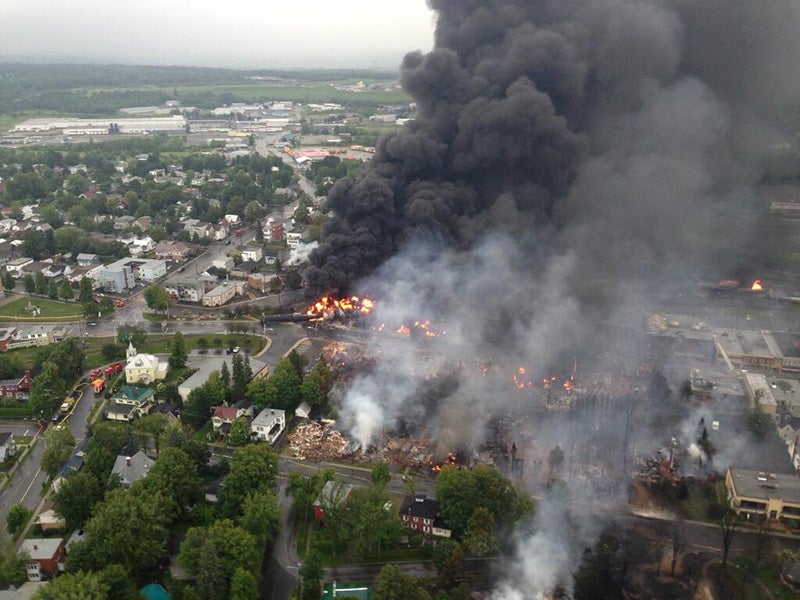
Of most concern to carbuilders and buyers is the tight timeline for the retrofitting or retirement of existing DOT-111s and the newer industry-sponsored CPC-1232 cars constructed since 2011, before the 2013 disaster at Lac-Mégantic forced regulators to finally heed years of warnings by accident investigators in the U.S. and Canada. Those “good faith” cars now need to be upgraded to meet DOT-117 standards by May 1, 2025.

The phaseout/retrofit schedule will see unjacketed DOT-111s removed from the most-volatile Packing Group I crude oil service by January 2018, jacketed DOT-111s by March 2018, unjacketed CPC-1232s by April 2020. For Packing Group II, jacketed and non-jacketed DOT-111s may remain in service until May 2023, non-jacketed CPC-1232s until July 2023, and jacketed CPC-1232s until May 2025.

To enforce the timeline, the regulations require stricter testing and classification of crude oil offered for transport.

The regulatory package is to be enforced by the USDOT’s sibling regulators, the Federal Railroad Administration (FRA) and the Pipeline and Hazardous Materials Safety Administration (PHMSA).
Cost of fleet renewal is estimated by regulators to be about $1.7 billion. Total costs for the entire regulatory package, including train routing and speed restrictions, is projected to be $2.5 billion......   more here


Spilled corn covers a hillside in the Feather River canyon after a derailment

Plumas Co. Grand Jury: Scathing indictment of hazardous material transportation through Feather River Canyon

June 5, 2015  Plumas County News
 

[Roger Straw comments:  This Grand Jury report is thorough and well written - an excellent resource and alarming in its analysis.  Its findings and recommendations (near the end of the report) might be a valuable resource for communities everywhere.  There are a number of references to "after-action reports."   Question for our research: how can concerned citizens obtain such reports?]

Editor’s note: This is the fourth in a series of midterm reports submitted by the 2014-15 Plumas County Civil Grand Jury.

SUMMARY
Early in the morning Nov. 25, 2014, a Union Pacific freight train derailed in the Feather River Canyon just east of Belden, sending 11 railcars full of corn off the tracks and down the steep embankment. In a press statement shortly afterward, a State Office of Emergency Services official was quoted as saying, “We dodged a bullet” because the train was only carrying corn.

Based on a rash of recent derailments and spills of hazardous materials happening throughout the United States and Canada, “a bullet” in fact grossly underestimates the potential devastation, magnitude and scope of the consequences left from these horrific incidents. Luckily, it was only corn that spilled. With the recent surge in crude-by-rail domestic crude oil transports between oil fields in North Dakota, Texas, Colorado and Pennsylvania and Bay Area refineries through the Feather River Canyon, the aftermath could have wrought far-reaching disaster had it been the high-flammable Bakken crude in the tanker cars.

According to sources, the number of crude-by-rail trains passing through the Feather River Canyon has tripled in number within the past three years. With developments in hydraulic fracking technology coming about in domestic oil fields, the petroleum market has seen a profound shift from importing foreign oil to extracting it in domestic oil fields in the United States. As a result, thousands of jobs have been created and oil prices have plummeted since this recent boon in domestic oil production. In addition, other hazardous chemicals are transported throughout the United States by rail and by truck. According to the Federal Railroad Administration, only the railroads are required to know what’s in the cars they’re shipping.

The grand jury found it extremely important to examine the recent corn derailment other recent crude-by-rail disasters in the U.S. and Canada to determine whether Plumas County agencies and private transportation operators are adequately prepared in “worst-case” scenarios. In respect to the Plumas County corn derailment, because the corn was relatively harmless and could be immediately dealt with without invoking hazardous material protocols, local, state and railroad officials and crews did an excellent job in containment of the spill and clearing and repairing the tracks within the impact area.

As a result of a quick and well-coordinated response, the Feather River Canyon rail route was restored and passing rail traffic three days after the initial derailment. Nonetheless, the grand jury has found the incident to be a practical review for a county hazardous material spill and useful opportunity to compare and contrast the corn spill with other recent more disastrous spills. Plumas County did indeed “dodge the bullet,” and from this incident the grand jury believes it will provide valuable findings and recommendations which may in turn act as a catalyst and cast fresh perspectives and insights on dealing with future potential spills and hazardous material disasters.......  continued here


Saturday, May 23, 2015

New oil train safety rules spell delay, leaving citizens at risk

New oil train safety rules spell delay, leaving citizens at risk

The Hill    By Jayni Hein, contributor      May 18, 2015


Chicago, Philadelphia and Sacramento, Calif.: These are just a few of the cities within the “blast zones” of mile-long trains carrying flammable crude oil across the country. Twenty-five million Americans live in these vulnerable areas; yet it will be years until dangerous tank cars are retrofitted or retired from the rails, based on the U.S. Department of Transportation’s new safety standards.

The standards, released on May 1, cover railcars that carry the nation’s growing supply of volatile crude oil produced in the Bakken region of the northern United States and the Canadian tar sands.

While the new rules mark incremental progress, they give residents little reason to rest easy. And more implementation delays could be coming — the American Petroleum Institute filed a petition in federal court on Monday challenging the new rules, and other legal challenges may be on the horizon.

When it comes to oil train derailments, it’s no longer a question of “if,” but “when.”.....    more here

Highlighted by hazards, new rules aim to tackle the safety of oil trains

PBS NewsHour   May 23, 2015       video at site

TRANSCRIPT

STEPHEN FEE: It was just after 2pm on December 30, 2013 when the calls began streaming in. Two trains had collided just half a mile outside Casselton, North Dakota, one loaded with grain, the other with crude oil.

Volunteer fire chief Tim McLean headed straight to the scene.

TIM MCLEAN, CASSELTON FIRE CHIEF: Then I kind of knew, this was going to be a big one, the way it was described on the pagers.

STEPHEN FEE: Community banker Bernie Sinner was meeting with a client in his office. His window is just 50 feet from the rail track.

BERNIE SINNER, FIRST STATE BANK OF NORTH DAKOTA: You could see plumes of black smoke rising pretty high above the tree line, above the buildings that are across the street from us.

STEPHEN FEE: From the town’s main intersection, witnesses could hear explosions as the railcars blew apart, sending fireballs into the sky. Ed McConnell was mayor at the time.

CASSELTON, N.D. MAYOR ED MCCONNELL: They evacuated the southwest corner of town, the part of the town that was most affected by it.

STEPHEN FEE: But once the wind turned, officials put the entire town of 2,500 under a voluntary evacuation order. Some 400 thousand gallons of crude leaked from 18 ruptured cars. The fire burned for a full day.

TIM MCLEAN, CASSELTON FIRE CHIEF: There’d be no battling this fire. Even if you had an endless supply of water......    more here