Affiliated with: AFL-CIO
International Association of Fire Fighters Washington State Labor Council | ||
June 8, 2016
The Honorable Jay Inslee Washington State Governor P.O. Box 40002 Olympia, WA 98504 Dear Governor Inslee: Last Friday's oil train derailment and fire in Mosier, Oregon, is a stark reminder that first responders, rail workers, communities, waterways and pristine lands remain in harm's way from Bakken oil train traffic through our state. The account given by firefighters of the Mosier response and by others who have responded to similar incidents across North America make it clear these fires are exceedingly difficult to extinguish, even under unusually ideal circumstances. What happened in Mosier could have just as easily happened in a population center like Spokane or Seattle, resulting in even greater tragedy. You know our position on these matters. In June 2014, delegates at our statewide convention called for an immediate halt to the movement of Bakken crude by rail until there has been a determination that it is safe to transport. Clearly, given the Mosier incident, there has been no such determination. The upcoming summer fire season is shaping up to be another dry and dangerous one. Resources will be stretched thin, and evidence keeps growing that there is no safe way to transport Bakken crude. A derailment and fire in dry wildfire fuels with high winds could easily overwhelm available personnel and equipment in many parts of our state and grow into a conflagration of immense proportions. We urge you to make a request similar to Oregon Governor Brown's by asking the U.S. Department of Transportation to use its authority to prohibit rail transport of Bakken crude through our state until there has been a full investigation into the cause of the Mosier oil train derailment. In addition, please consider the use of your executive authority to reject plans for oil terminals now under review and ask your legal staff to investigate the proclamation of a state of emergency under RCW 43.06.220(l)(i), allowing you to prohibit the continued rail transportation of this dangerous fuel. We appreciate the efforts you have made to date on this subject and stand ready to meet with you, as do other members of our Solidarity Roundtable on Oil, to work toward solutions to this on-going environmental and community crisis. Sincerely, Dennis Lawson, President. Washington State Council of Fire Fighters opeiu8/aflcio/dag | ||
Dennis J. Lawson, President • Greg B. Markley, Secretary-Treasurer
1069 Adams Street Southeast, Olympia, WA 98501 • 1-800-572-5762 • (360) 943-3030 Fax (360) 943-2333 • E-mail: wscff@wscff.org • Website: www.wscff.org | ||
Showing posts with label first responders. Show all posts
Showing posts with label first responders. Show all posts
Thursday, June 9, 2016
Fire Fighters send letter to Gov. Inslee
Friday, June 3, 2016
Derailments and Disasters

Rail Cars derail in Central Park
The Daily World, Doug Barker
A train carrying grain to the Port of Grays Harbor derailed Tuesday afternoon in the Central Park area. There were no injuries and the train wasn’t in the immediate area of homes.
Thursday afternoon, workers were hauling rock to the site so that equipment could be brought in to lift the cars, said Josh Connell, general manager of the Puget Sound & Pacific Railroad. Eight of the 100 cars in the train derailed, he said, with six on their sides and two still standing. The site, which is about a half mile south of Central Park Drive and two miles east of the Grays Harbor Country Club, is not accessible by road and rail officials would not allow the press to walk on the rail right of way to reach the scene, saying it was dangerous while crews were working.
Connell said they expect to have track open sometime Sunday.
The posted train speed on that stretch of tracks is 20 mph and the train was travelling 17 mph when it derailed, he said. “There was no human error, the crew was doing what it was supposed to be doing according to our procedures,” he said.
Connell said cars used to inspect the condition of the track had been through the area recently, and the ties were replaced in that area in 2014. Once the cars are lifted off the track, the company will inspect the track and that might help determine the cause, he said.
The last derailment on the line was in December, caused by two teenagers playing “chicken” at rail crossings in Montesano.
There were 10 loaded grain cars at the tail end of the train that were not affected by the derailment. The 80-some cars to west of the derailment were taken to the Port and unloaded, Connell said.
Connell said rail officials immediately notified state officials, who notified federal officials. There was no issue of hazardous materials being spilled, he said.

Oregon train derailment spills oil, sparks fire
PORTLAND, Ore. (KOIN) — An oil train has derailed near the Columbia River Gorge town of Mosier.
Aaron Hunt with Union Pacific Railroad says 11 of the cars derailed. Oil spilled from at least one car and caught fire. It is still burning.
The 96-car train was carrying Bakken crude oil to Tacoma, from Eastport, Idaho. Bakken crude is known for being highly volatile.

A train that size weighs 13,000 tons and is 6,200 feet long, according to sources. No one was injured.
Silas Bleakley was working at his restaurant in Mosier when the train derailed.
“You could feel it through the ground. It was more of a feeling than a noise,” he said as smoke continued to billow from the tankers.
Bleakley said he went outside, saw the smoke and got in his truck and drove about 2,000 feet to a bridge that crosses the railroad tracks. There, he said he saw tanker cars “accordioned” across the tracks.

More links:
Seattle Times: Tacoma bound Oil train derails
KOMO News:
Oil train derailment, fire in Columbia Gorge evacuates Mosier schools; I-84 shut down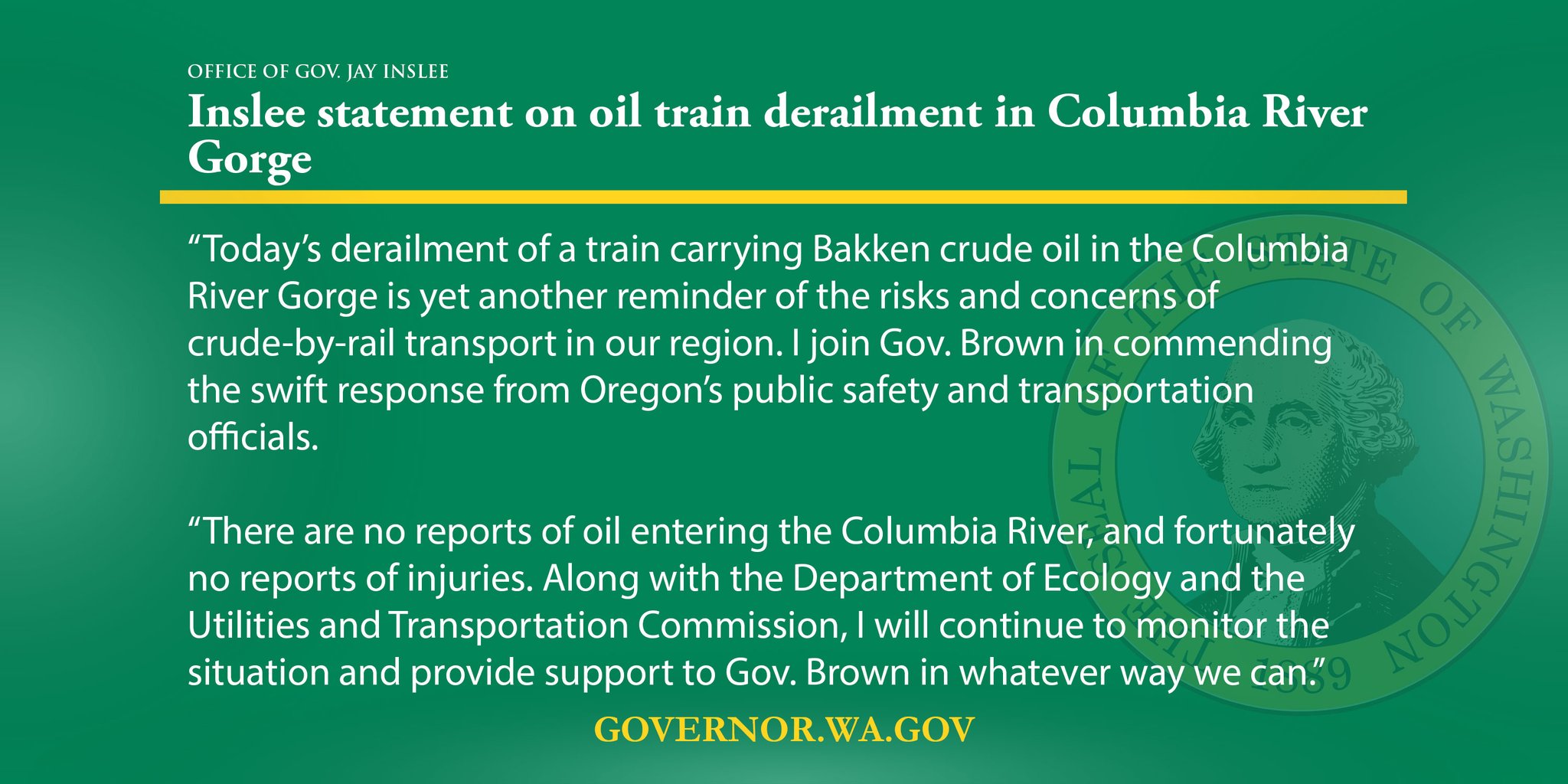
Thursday, April 28, 2016
Oil Spills in Practice Drills and in Ocean Shores
The following article contains a timeline of the hypothetical response to a oil tanker spill. While this spill was make-believe, they could have easily come out to Ocean Shores and worked on an actual oil spill. Read on for what is happening on our shoreline this month.

Is Washington ready for the next big oil spill?
Samantha Larson April 25, 2016 via Crosscut
The drill scenario: It’s 5:45 a.m., and a boat has just left anchor off the coast of Vendovi Island, located between Lummi Island and Anacortes. But someone’s not paying attention, and so it crashes into another nearby ship. Both vessels are damaged; thick, heavy fuel oil begins to ooze into the water. By the time the crews have secured the leaks, about 2,100 gallons have leaked out of each boat. Now 6:30am, it’s time to launch the response plan
“They’re well-equipped to handle a 4,000-gallon spill,” Eric Nalder, an investigative journalist who won two Pulitzer Prizes for his reporting on oil transportation, told Crosscut. But while the spill scenario practiced in the drill is certainly far bigger than most of the more than 4,000 oil spills reported to the Department of Ecology every year, it pales in comparison the Arco Anchorage’s 239,000 gallons, which itself is a fraction of the 11 million gallons spilled in the pristine Prince William Sound from the Exxon Valdez in 1989, or the 130 million gallons spilled into the Gulf of Mexico in 2010.
Sure, things have changed since then, but we’re not seeing less oil move through our waters – in fact, a report that came out last year predicts we’ll see 2,000 new oil tankers and barges in the Pacific Northwest, thanks to the expansion of rail-terminals and pipelines. Oil tankers carry as much as 55 million gallons of crude. While barges carry less — at most 14 million gallons — they still carry a lot, and they are far less regulated. A report released this month by Friends of the Earth, written by environmental consultant and recently elected Port of Seattle Commissioner Fred Fellman, highlights the risks associated with the transport of Canadian tar sands oil across the Salish Sea.
 |
| photo via Dept of Ecology flickr page |
On April 15th, Fishing Vessel Privateer ran aground and sank, just off the breakers at Ocean Shores. After calling in a 8 to 12 inch gash to the boat, 3 crew members were rescued by the Coast Guard.
The 75 foot fishing boat had a capacity for 5,500 gallons of deisel fuel.
April 16, 2016 12:30 p.m.Today the F/V Privateer remains aground, still intact although the hull is damaged and breached. It is estimated that 2,500 gallons of diesel, 500 gallons of lube/motor oil and 6 55-gallon drums (including waste oil) were on board. One drum has been recovered so far.
By Saturday, local residents were reporting a diesel smell, but no sheening or oil was seen on the beach. Choppy seas and a strong surf have prevented the salvage company from defueling and securing the boat.
A local commercial fisherman tells us that the barrels of used oils were on board the boat because The Port of Grays Harbor recently stopped accepting the used oil from out-going boats for secure disposal on land. This cost cutting move forces boats to store these barrels on board until a friendlier Port gives them a disposal option.
April 20, 2016 9 a.m.
The U.S. Coast Guard and Ecology are continuing to respond to the F/V Privateer, which is aground on the outer beach at Ocean Shores, just north of the north jetty. The vessel owner's spill response contractor/salvage company, Global Diving and Salvage, is still on scene picking up debris when it comes ashore. Periodic reports of diesel odors in the area north and east of the vessels location persist, but the odor is considered a nuisance only.
Estimates for the potential to be released remain the same -- 2,500 gallons of diesel, 500 gallons of lube oil and six drums (including waste oil). One drum has been recovered so far. No estimate is available for the volume of oil that may have been spilled because of the inability to safely access the vessel.

According to the Department of Ecology, approximately 3,000 gallons of oil are lost,
April 25, 2016 11:30 a.m.
Ecology and the U.S. Coast Guard continue to monitor the situation in Ocean Shores where the F/V Privateer remains grounded.
Due to safety concerns, gaining access to, defueling, and/or salvaging the vessel may is delayed until early May (6, 7, or 8) when tidal conditions are more favorable.
Since last week the diesel odor has lessened, along with the amount of boat debris being washed ashore.
But Hey! The smell is gone, so the oils must be gone too!
At least one weekend Razor Clam dig has been cancelled, presumably the beaches won't re-open until the ship is removed.
We are currently in a 30 day comment period, for the renewal of REG's 5 year permit. We are asked to comment on the current permit, while REG continues to ask for a massive expansion to its operations, without adequite Environmental Impact Studies examinations.
You might want to point out the ongoing sinking and oil spill that can't be addressed until the first week of May in your comment.
Ask them why if The Port of Grays Harbor doesn't want to handle this small ammount of used waste fuel from ships, they are eager to sign off on permits allowing 2.7 billion gallons of Crude Oil storage here.
Ecology invites public review and comment on updated oil spill prevention plans.
Interested public, local and tribal governments are invited to review and comment on required 5 year updates to industry oil spill plans. These updates are required by the state’s oil spill planning regulations.
Washington Administration Code (WAC) 173-180 requires oil handling facilities to have a state-approved plan for prevention of oil spills from the facility into waters of the state, and for the protection of fisheries and wildlife, other natural resources, and public or private property from oil spills.
The following plan is now available for public review:
Name of company: REG Grays Harbor LLC Review starts: April 21, 2016
Review Ends: May 23, 2016 at the close of business (5 p.m.)
Provide comments by email to steven.ogle@ecy.wa.gov, or by regular mail:
Steve Ogle
Spill Prevention, Preparedness, and Response Program
Department of Ecology
PO Box 47600
Olympia, WA 98504-7600
Find more information about oil spill prevention regulations in Washington, visit: http://www.ecy.wa.gov/programs/spills/prevention/prevention_section.htm
For more information on plans open for public comment, visit:
http://www.ecy.wa.gov/programs/spills/about_us/publiccomment.html
To review the plan, visit:
ftp://ecy.wa.gov/spills/PreventionPlans/REGGraysHarbor/REGGraysHarborPreventionPlan.pdf
Thank you for taking the time to provide us with your comments. We will consider all comments and complete the review no later than 30 days after the close of the public review period.
Wednesday, October 14, 2015
Vancouver firefighters oppose oil terminal at port- media links
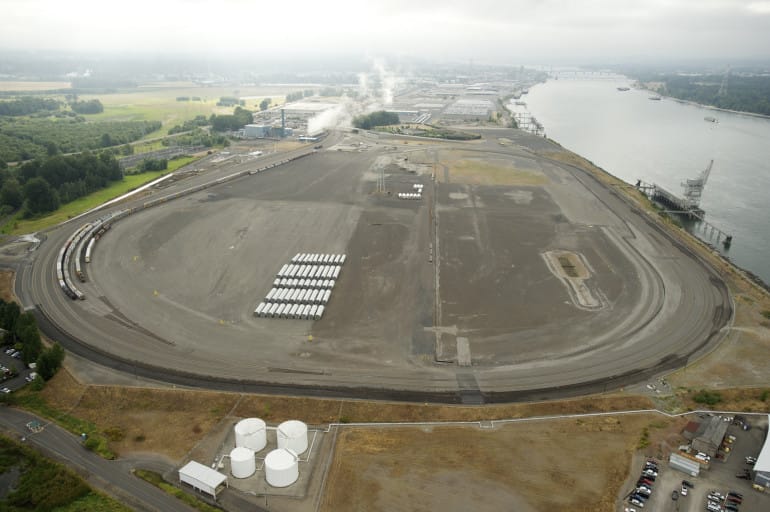
The Port of Vancouver, looking east from Terminal 5
Incredible testimony from the firefighter union at the Port of Vancouver. The ILWU president also
testified against oil in front of a packed house opposed to oil.
Vancouver firefighters oppose oil terminal at port
KOIN- Port of Vancouver terminal would be nation's largest oil-by-rail terminal
Firefighters: Oil train terminal would put too many lives at risk KGW - video
Vancouver firefighters union opposes oil terminal at port
The Columbian- It cites threats to public safety posed by project proposed at Port of Vancouver
Saturday, July 18, 2015
Timeline of Recent Oil Train Crashes in the US and Canada
[Ed note: nine of the twelve incidents below involved fires and explosions.]
A Timeline Recent Oil Train Crashes in the US and Canada
Sunday, July 5, 2015
The ties that bind: A special report two years after the Lac-Mégantic tragedy

Lucas Oleniuk/Getty Images
The ties that bind: A special report two years after the Lac-Mégantic tragedy
Jesse Feith, Montreal Gazette July 3, 2015Two years after the train derailment that killed 47 people, Lac-Mégantic’s relationship with the railroad it was built around is complicated.
The town’s fate has always been intertwined with that
of the railroad. Lac-Mégantic was founded after the tracks were
put down in the late 1880s, and has relied on the rails for survival
ever since.
Families moved ever closer to the railroad, and grew
to trust it. Even as town officials lodged complaints about the
decaying tracks over the last 20 years, that trust remained.
The importance of the tracks to this Eastern
Townships municipality is such that they were repaired before many of
the buildings that were destroyed when the crude-carrying tank cars
exploded in the heart of town.
Despite the destruction now associated with the railroad, when
the first train came through town five months after the disaster, many
people saw it as the beginning of Lac-Mégantic’s rebirth.
Residents knew they had to set aside their fear and
anger if the town was to survive economically. One out of six jobs in
town still has ties to the railroad.
“We had no choice,
really,” town councillor Richard Michaud says. “Hundreds of jobs depend
on (the railroad) here, and we couldn’t risk losing them.”
But the trust is gone.
........Montreal Gazette reporter Jesse Feith and
photojournalist John Kenney visited towns along the route linking the
Bakken oil formation and Lac-Mégantic to explore the relationships
between people and their railroads. Here are the stories they’ve brought
back..... more here
Tuesday, May 26, 2015
Port of Longview May Vote Soon on Crude Refinery and Terminal

Refinery Details Emerge: Port of Longview May Vote Soon
May 26, 2015 (Longview, WA) Columbia Riverkeeper– A letter from Riverside Refining LLC to state officials shows, for the first time, a complete picture of the crude oil refinery and crude-by-rail terminal proposed at the Port of Longview. Riverside Refining would bring Bakken crude to Longview by rail, refine 30,000 barrels daily, and send tankers carrying both refined and un-refined petroleum products through the environmentally sensitive Columbia River estuary. Columbia Riverkeeper obtained the letter through a public records request.
This would be the first west coast refinery constructed in over 25 years and the largest new refinery in the continental United States since 1976.
While the Port of Longview has known about the oil refinery proposal for a year, the Port may acknowledge the project publicly for the first time today, and possibly vote to approve the project. Diane Dick, a Longview resident and President of Landowners and Citizens for a Safe Community, is upset by the Port’s secrecy and lack of foresight. “Oil trains are exploding nearly once a month and emergency responders and local governments are struggling to get proper training and response equipment,” said Dick. “The Port of Longview is ignoring this serious issue and instead choosing to do business with this dangerous industry.”
The prospect of a refinery has Longview school teacher Krista Mead worried for the kids in her classroom. “I’ve lived near an oil refinery,” said Mead. “The fumes, noise and health impacts aren’t worth it. The toxic fumes from the refinery often prevented people from being outside. I don’t want to see Longview’s children impacted like that.”
Beyond dirtying the air, there’s crude-by-rail’s poor safety record. “Oil train derailments are a serious risk; five oil trains have exploded this year alone,” said local firefighter Glen Hudson. “Oil trains supplying oil to a refinery in Longview makes those fiery images I’ve seen on the news seem even closer to home. It seems the oil companies should make sure they have provided sufficient coverage in case of accidents, such as depositing in advance into the accounts of all the local fire departments and county enough money to pay for the additional training of local responders, equipment, cleanup and repair costs anticipated for a worst case scenario. In no case should our community have to bear these expenses.”
Riverside Refining’s letter says it intends to produce biofuel, using imported international feedstocks, as well crude oil. “You don’t need an oil refinery to make biofuel,” stated Brett VandenHeuvel, Executive Director of Columbia Riverkeeper. “Adding some palm oil or ethanol to the oil doesn’t make the refinery or the oil trains any less dangerous.”
Residents are skeptical of the biofuel claim. The Columbia Pacific Bio-Refinery across the river in Clatskanie, Oregon, went bankrupt and now functions entirely as a crude oil terminal.
There is an ongoing lawsuit against the principal backers of Riverside Refining LLC for a biofuels venture in Odessa, Washington. The lawsuit alleges that some of the Riverside leaders lied on credit applications, under-capitalized their business, and lined their own pockets instead of paying more than $1.5 million in outstanding debts after their biofuels-related business in Odessa tanked.
The following documents obtained by Columbia Riverkeeper are available here:
- March 18, 2015 Letter to the Washington Energy Facility Site Evaluation Council from Riverside Refining LLC.
- Complaint in Wolfkill Feed and Fertilizer v. Transmessis Columbia Plateau, Louis Soumas, Damon Pistulka, Christopher Efrid, et. al.
###
Supporting Documents:
- Key Facts on Riverside Oil Refinery and Crude-by-Rail Terminal
- March 18, 2015 Letter to the Washington Energy Facility Site Evaluation Council from Riverside Refining LLC
- Complaint in Wolfkill Feed and Fertilizer v. Transmessis Columbia Plateau, Louis Soumas, Damon Pistulka, Christopher Efrid, et. al.
- PDF of Press Release, Longview to vote on Riverside Refinery
- 2014.12.15 Public Records Request from Columbia Riverkeeper to Port of Longview
- 2015.2.13 Public Records Response Cover Letter from Port of Longview
- Documents obtained by Columbia Riverkeeper, shared in April 15, 2015 Press Release:
- Riverside Refining PowerPoint Presentation
- Memorandum of Understanding between Riverside and the Port of Longview
- Riverside Energy Port of Longview Discussion Points
Monday, May 25, 2015
Russian roulette on the railways
Russian roulette on the railways
Butte County train tracks are Bakken-free for now, but emergency responders fear a return of the volatile fuel
By Evan Tuchinsky, 05.21.15 ChicoNewsReview.com
Cal Fire Battalion Chief
Russ Fowler says the Department of Transportation’s new rules regarding
traincar safety are insufficient.
PHOTO COURTESY OF CAL FIRE
The light crude oil known as Bakken comes from fracking a geologic formation of that name under North Dakota, Montana and Canada. Less dense and with less carbon, light crudes yield more gasoline than heavier crudes, but also are more volatile.
Trains crash. That fact hit home last week when a passenger train derailed in Philadelphia and also last year, on Nov. 26, when a cargo train derailed in the Feather River Canyon.
The risk of devastation multiplies when the derailed train carries volatile crude oil. A recent spate of those accidents has garnered national attention, too, prompting the U.S. Department of Transportation (DoT) to release new regulations governing the conveyance of flammable liquids. The measures have drawn near-unanimous opposition, though, and done little to assuage lingering local fears.
“My constituents have raised concerns and the Board [of Supervisors] is concerned,” said Butte County Supervisor Maureen Kirk, who represents Chico. “We’re hoping that some of the legislation and some of the discussion that comes forward will make even stiffer requirements on the transport of this Bakken oil.”
The DoT regulations came out May 1. Five days later, another oil train crashed, in North Dakota. By last Friday (May 15), both the petroleum industry and environmentalists had filed legal challenges to the DoT’s so-called “final rule.”
The International Association of Fire Fighters also has voiced objections. Representing more than 300,000 firefighters in North America, the IAFF protested a provision that allows railroads to keep the contents of their trains confidential—under the banner of national security.
Russ Fowler, battalion chief with Cal Fire Butte County and coordinator of the local Interagency Hazardous Materials Team, has additional concerns. DoT regulations phase out tank cars that are not up to the current safety standard, rather than pull them off the rails for retrofitting or retirement. Transportation Secretary Anthony Foxx has argued that the alternative would result in increased oil-tanker traffic on highways.
Fowler says one particular railcar commonly used to carry volatile Bakken crude oil, the DOT-111, “just [wasn’t] designed for that product.” Since railroads have until 2018 to get those cars up to standard, “we have three years of potential Russian roulette on our hands if light crude oil is transported down the Feather River Canyon like it was done last fall.”
Cal Fire has communicated with BNSF Railway, Fowler said, and has been told no crude oil deliveries have come through Butte County this year. “I have no reason not to believe them,” he added, though he’s seen DOT-111s riding on Chico tracks.
Lena Kent, BNSF’s spokeswoman for California, confirmed by email that “we are not currently transporting Bakken crude in your county.” She also wrote: “We do provide information to the Office of Emergency Services in California.”
That’s in contrast with last year, when train cars carrying millions of gallons of the explosive oil, reportedly around one shipment per week, did make their way way along the Feather River Canyon. Experts tie the reduction of imports to a reduced demand for the fuel, a lighter type that’s similar to gasoline and thus extremely volatile.
While Cal Fire dreads the prospect of an urban crash, the Feather River Canyon presents a distinct set of frets.
Train tracks head into remote areas that are difficult for emergency responders to reach. Access roads don’t always run adjacent to the rail route—not even parallel in certain spots. Depending on where a crash occurred, spilled oil could contaminate the Feather River and Lake Oroville—a major source of water for California—or could start a forest fire should it ignite.
Even without a blaze or river release, “it would make an ugly, oily mess in the canyon,” Fowler said. “It would be a terrible environmental disaster.”
Butte County supervisors articulated such concerns to the California Public Utility Commission and the Governor’s Office of Emergency Services, before the DoT released its regulations. OES responded by saying the state is investing in “purchasing new Type II hazardous material emergency response units” and in “local training specific to … rail safety incidents.”
For Supervisor Doug Teeter, the board chair who represents the Ridge, that’s little assurance. He has a powerless feeling—believing “it’s just a matter of time” before an accident happens locally, yet knowing “as a county we have no control” over the rails.
“We’re at the mercy of the federal regulators,” he continued. “All we’re really getting is a little response on improved training and equipment. That is not nearly enough to handle a 100-car spill.”
Either in populated or unpopulated areas.
“We as a hazmat team plan for worst-case scenarios,” Fowler said. “Just because you plan for a worst-case scenario doesn’t mean you can mitigate the worst-case scenario, because there are things that can happen that are so catastrophic that it would overwhelm local resources until more regional or statewide resources could come in to help.”
Should legal challenges fail, and in the absence of local authority, a remedy to the DoT regulations remains: Congress. Teeter recently met with a representative of Sen. Barbara Boxer. Meanwhile, North State Congressman John Garamendi has introduced legislation to make light crude safer for rail transport.
Teeter encourages constituents to write congressional representatives and senators. He finds encouragement even in the controversial DoT regulations, which arose amid an uproar.
“Maybe now we’ll have a voice,” Teeter said. “Maybe something can happen.”
Sunday, May 17, 2015
Railroads required to plan for a worst-case oil train spill in WA state

Willamette River as part of an oil-spill training exercise in Portland
Railroads required to plan for a worst-case oil train spill in Washington state
By Samantha Wohlfeil The Bellingham Herald May 17, 2015
The law requires railroads to plan for the “largest foreseeable spill in adverse weather conditions,” but doesn’t define “largest foreseeable spill.”
In April, BNSF railway employees told Washington emergency responders that the company currently considers 150,000 gallons of crude oil – enough to fill five rail tank cars – its worst-case scenario when planning for spills into waterways. Crude oil trains usually carry about 100 rail tank cars.
“We’ve already seen worse than that though, haven’t we?” asked Roger Christensen, Bellingham’s interim emergency manager,....
...The amount is lower than what has been spilled and partially burned off in several high-profile crude oil train derailments in the last three years: ....
...“Until we have further regulatory clarity from the U.S. Department of Transportation on how the agency will require railroads to calculate ‘worst-case discharges’ to waterways, BNSF is considering using 150,000 gallons,” Melonas wrote. “BNSF is open to discussing the justification of this quantity with Federal or State environmental agencies.”....
... The new law tasks the state Department of Ecology with crafting the worst-case scenario for railroad contingency plans in a process that could take a year or longer, and will include input from the railroads and the public, said Linda Pilkey-Jarvis, preparedness section manager for Ecology.... more here
Oklahoma oil billionaire demanded university fire scientists studying dangers of fracking
RawStory Tom Boggioni May 16, 2015
A billionaire oil tycoon, who is a major donor to the University of
Oklahoma, approached a dean at the school demanding that the university
fire scientists who were studying the link between fracking and the increase of earthquakes in the oil-rich state.
“Mr. Hamm is very upset at some of the earthquake reporting to the point that he would like to see select OGS staff dismissed,” Grillot wrote to Dammy Hilliard, University Vice President for External Relations and Planning.
In the email, Grillot noted that Hamm had made a veiled threat to the university, telling the dean, “he would be visiting with Governor [Mary] Fallin on the topic of moving the OGS out of the University of Oklahoma.”.... more here
Thursday, May 7, 2015
NY Rep to Introduce Bill to Ban Unstabilized Bakken Crude

Tacoma refinery fire spews huge column of black smoke
Lowey: Ban explosive crude from rail
Journal News
WEST NYACK – Moments before U.S. Rep. Nita Lowey was preparing to talk about her latest oil train safety initiative, she received word that a 109-car oil train had derailed in North Dakota, with several of the tank cars exploding and catching fire, leading to the evacuation of a town of about 35 residents."Can you imagine if it happened here?" Lowey said Wednesday morning at a CSX rail crossing in West Nyack used by 15 to 30 oil trains a week.....
With improved tank cars set to be phased in over the next decade, Lowey said the oil placed inside them also had to be made less dangerous. On Monday, she plans to introduce a bill banning all interstate rail shipments of Bakken crude oil if they are not first treated to remove explosive gases....
...Asked if a ban would be perceived as too drastic, Lowey, D-Harrison, said strong action was needed on oil trains.
"If they go up in flames, that's even more drastic and think of the lives that are lost," Lowey told The Journal News after a news conference featuring a number of local officials. "It's essential that the companies who produce the Bakken oil understand that this volatility is a matter of life and death.".... more here
BNSF crude train derails in N.D.; senators call on Foxx to issue emergency order
Progressive Railroading May 7, 2015
Investigators from the National Transportation Safety
Board (NTSB) and Federal Railroad Administration (FRA) are on the scene today
of a BNSF Railway Co. crude-oil train that derailed
and caught fire yesterday morning in Heimdal, N.D.....
.... The tank cars involved in the incident were the
unjacketed CPC-1232 models, which are among the tank-car models slated for
retrofits or phasing out under new federal rules governing the safety of
crude-by-rail transportation.....
..... Meanwhile, eight U.S. senators yesterday sent a letter urging U.S. Transportation
Secretary Anthony Foxx to immediately enact stronger disclosure requirements
regarding shipments of Bakken crude oil. The U.S. Department of
Transportation announced new regulations last week that included requiring
railroads to share information on the shipment of crude oil with emergency
responders.
"We call upon you to issue an emergency order that improves the process for providing detailed information on crude-by-rail movements and volumes to first responders, shifts the onus for information sharing onto the railroads and not communities, and allows for the continued public availability of broader crude-by-rail data on movements and routes,” the senators wrote.
"The final rule constitutes a setback on disclosure requirements that could hamper our first responders and negatively impact the safety of our communities. We urge you to promptly address these shortfalls, and look forward to your response,” the senators continued.
"We call upon you to issue an emergency order that improves the process for providing detailed information on crude-by-rail movements and volumes to first responders, shifts the onus for information sharing onto the railroads and not communities, and allows for the continued public availability of broader crude-by-rail data on movements and routes,” the senators wrote.
"The final rule constitutes a setback on disclosure requirements that could hamper our first responders and negatively impact the safety of our communities. We urge you to promptly address these shortfalls, and look forward to your response,” the senators continued.
The
letter was signed by U.S. Sens. Tammy Baldwin (D-Wis.), Maria Cantwell
(D-Wash.), Chuck Schumer (D-N.Y.), Robert P. Casey, Jr. (D-Pa.), Richard Durbin
(D-Ill.), Al Franken (D-Minn.), Patty Murray (D-Wash.) and Kirsten Gillibrand
(D-N.Y.).
Preventing derailments is the key to crude oil shipment safety
By Chet Thompson The Hill May 7, 2015
..... The refining industry, DOT, and the rail industry have a common goal of
ensuring the safe transport of crude oil and other flammable liquids.
According to DOT, the principal causes of derailments are track
integrity and human factors. The Department, however, chose to forego
establishing measures designed to prevent derailments, and instead
focused almost exclusively on tank car standards and other mitigation
measures. This was a missed opportunity to improve public safety.
The National Transportation Safety Board (NTSB) previously tried to strike the right balance between tank car mitigation and derailment prevention through a recommendation to DOT that would obligate the rail industry to enhance its maintenance and inspection programs. That recommendation was rejected by both DOT and the railroads. .... more here
Crews better-prepared for derailment since 2013 Casselton accident
05/07/15
Fire at Washington State Oil Refinery Sends Smoke Across Sky
ABC News TACOMA, Wash. — May 6, 2015
Subscribe to:
Posts (Atom)