Showing posts with label blast zone. Show all posts

Friday, June 3, 2016

Derailments and Disasters


Rail Cars derail in Central Park
The Daily World, Doug Barker
A train carrying grain to the Port of Grays Harbor derailed Tuesday afternoon in the Central Park area. There were no injuries and the train wasn’t in the immediate area of homes.
Thursday afternoon, workers were hauling rock to the site so that equipment could be brought in to lift the cars, said Josh Connell, general manager of the Puget Sound & Pacific Railroad. Eight of the 100 cars in the train derailed, he said, with six on their sides and two still standing. The site, which is about a half mile south of Central Park Drive and two miles east of the Grays Harbor Country Club, is not accessible by road and rail officials would not allow the press to walk on the rail right of way to reach the scene, saying it was dangerous while crews were working.
Connell said they expect to have track open sometime Sunday.
The posted train speed on that stretch of tracks is 20 mph and the train was travelling 17 mph when it derailed, he said. “There was no human error, the crew was doing what it was supposed to be doing according to our procedures,” he said.
Connell said cars used to inspect the condition of the track had been through the area recently, and the ties were replaced in that area in 2014. Once the cars are lifted off the track, the company will inspect the track and that might help determine the cause, he said.
The last derailment on the line was in December, caused by two teenagers playing “chicken” at rail crossings in Montesano.
There were 10 loaded grain cars at the tail end of the train that were not affected by the derailment. The 80-some cars to west of the derailment were taken to the Port and unloaded, Connell said.
Connell said rail officials immediately notified state officials, who notified federal officials. There was no issue of hazardous materials being spilled, he said.


Oregon train derailment spills oil, sparks fire

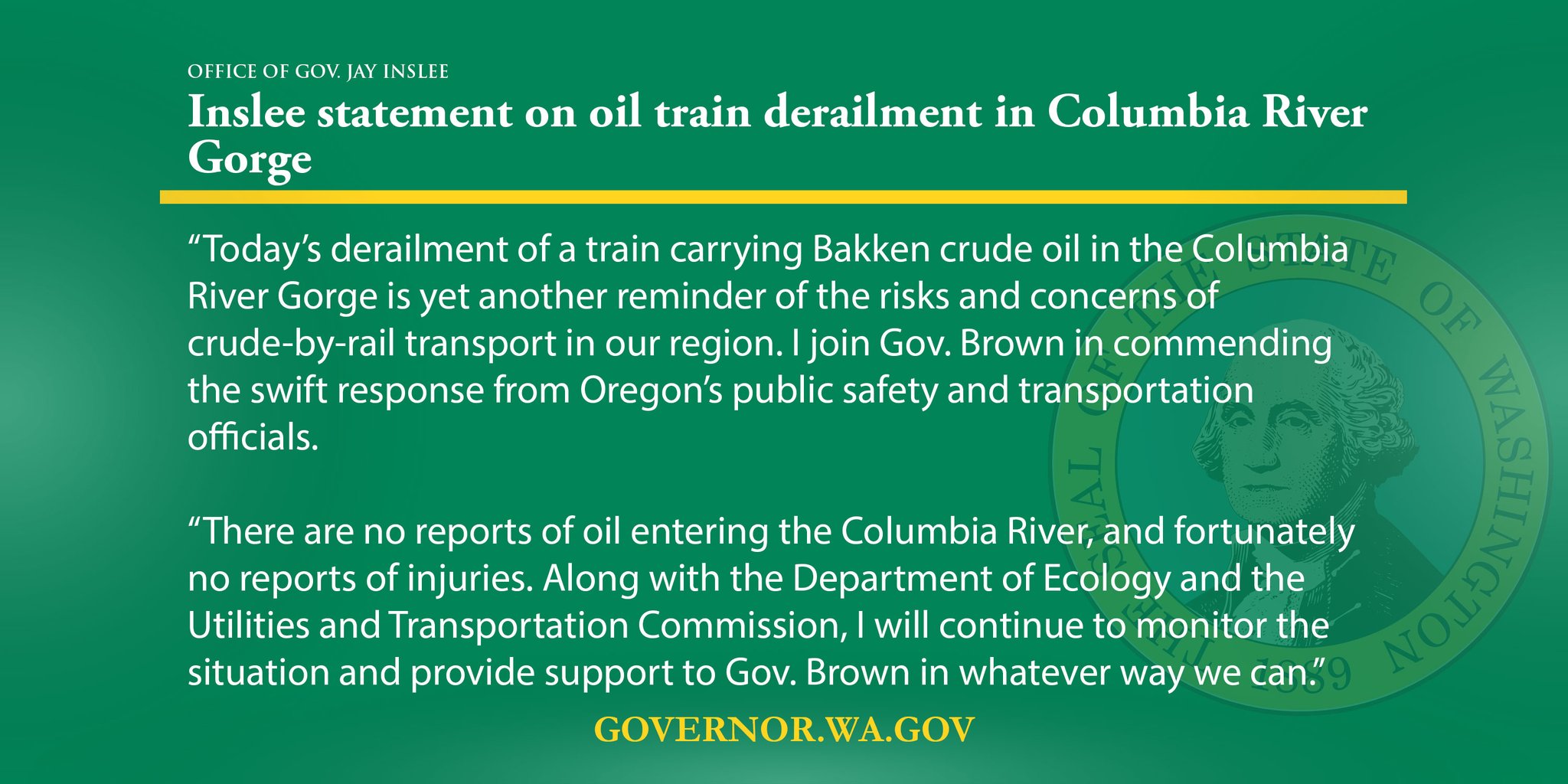
PORTLAND, Ore. (KOIN) — An oil train has derailed near the Columbia River Gorge town of Mosier.
Aaron Hunt with Union Pacific Railroad says 11 of the cars derailed. Oil spilled from at least one car and caught fire. It is still burning.
The 96-car train was carrying Bakken crude oil to Tacoma, from Eastport, Idaho. Bakken crude is known for being highly volatile.

An aerial view of the smoke and fire from an oil train derailment in Mosier in the Columbia River Gorge, June 3, 2016 (KOIN)

A train that size weighs 13,000 tons and is 6,200 feet long, according to sources. No one was injured.
Silas Bleakley was working at his restaurant in Mosier when the train derailed.
“You could feel it through the ground. It was more of a feeling than a noise,” he said as smoke continued to billow from the tankers.
Bleakley said he went outside, saw the smoke and got in his truck and drove about 2,000 feet to a bridge that crosses the railroad tracks. There, he said he saw tanker cars “accordioned” across the tracks.

More links:
KOMO News: 
Oil train derailment, fire in Columbia Gorge evacuates Mosier schools; I-84 shut down

Monday, February 15, 2016

New Rule: You Need to Pay for That.

Washington asks if railroads could afford $700M oil train spill


Sunday, October 25, 2015

For Big Railroads, a Carload of Whistleblower Complaints


For Big Railroads, a Carload of Whistleblower Complaints


By Stuart Silverstein and Brian Joseph     October 21, 2015   FairWarning


As both a veteran railroad worker and union official responsible for safety, Mike Elliott became alarmed when he learned of trouble-plagued train signals in his home state of Washington.


Signals, he said, at times would inexplicably switch from red to yellow to green – potentially creating confusion that could lead to a crash. Elliott raised that and other signal issues repeatedly with his managers at BNSF Railway Co. But eventually, Elliott concluded that “these guys are running me around in circles.”


So Elliott, 57, of Tacoma, Wash., pressed his concerns with the Federal Railroad Administration, summarizing the matter in a January 2011 letter. The FRA investigated, and discovered 357 safety violations, including 112 signal system defects.


 Speaking up for safety, though, only made matters worse for Elliott at BNSF, where he already had clashed with managers. Within weeks the company fired Elliott from his job as a locomotive engineer – an act that a federal jury this summer ruled was illegal retaliation by BNSF against a whistleblower.


The June 30 decision by the Tacoma jury, which awarded Elliott $1.25 million but is being appealed, spotlights the unjust punishment that critics say sometimes is meted out to railroad workers who report injuries or safety problems. These critics, including plaintiff lawyers and union officials, along with others who have examined railroad practices, say the harsh treatment reflects old, hard-line management tactics that persist in corners of the industry…..


…. an administrative law judge in 2013 ruled against Union Pacific, declaring: “The actions by Union Pacific have been so egregious in this case, and Union Pacific has been so openly blatant in ignoring the provisions of [federal law], that I find punitive damages are necessary to ensure that this reprehensible conduct is not repeated.” …..


…. Joseph C. Szabo, who headed the FRA from 2009 until this January, said industry supervisors often are under “immense pressure” to curb costs by moving trains quickly out of rail yards. That, in turn, translates into pressure on rank-and-file workers “to ignore safety protocols and to just get the damn train out of town.” That’s why, Szabo said, it’s “critically important” that railroad workers are “very comfortable in doing the right thing without any fear of retribution.” ….   More here


Other News:

WHAT TO LOOK FOR AS CONGRESS SETS A SIX-YEAR AGENDA FOR DANGEROUS GOODS TRANSPORT  - Bloomberg


Dayton says oil-by-rail shipments through Twin Cities puts thousands of Minnesotans at risk


Grand Forks Herald  - ‎Oct 21, 2015‎
In the letter to BNSF president and CEO Carl Ice, Dayton says nearly 100,000 more people are within the ½ mile evacuation zone of crude oil rail shipping routes in Minnesota now that BNSF is shipping Bakken crude oil along a rail line through downtown ...

Thursday, September 17, 2015

Government, Industry Ignore Scientific Case For Improving Crude By Rail Safety

VIDEO: Government, Industry Ignore Scientific Case For Improving Crude By Rail Safety, Let Bomb Trains Roll On 


By Brendan DeMelle • Thursday, September 17, 2015    DeSmogBlog


Oil train in Seattle by Brendan DeMelle

** video link below**

Since the tragic Bakken oil train accident that extinguished 47 lives in Lac-Megantic, Quebec in July 2013, seven more Bakken oil trains have derailed, resulting in accidents involving large fires and explosions. We now know that oil produced in North Dakota's Bakken Shale formation is extremely volatile due to its high natural gas liquid content — resulting in the “bomb train” phenomenon.

DeSmog’s new investigative video, written and produced by Justin Mikulka, details a coordinated effort by the oil industry, members of the U.S. Congress, regulators and the Department of Energy to challenge the known science of crude oil characteristics with the goal of delaying or avoiding any regulatory changes requiring Bakken crude oil stabilization, a safety measure that would protect the millions of people currently living in bomb train blast zones.

Stabilization is the process that removes the volatile natural gas liquids from the crude oil, resulting in a “stable” petroleum product with greatly reduced volatility and flammability.

DeSmog has reported extensively on the oil-by-rail policy battle, including an investigation that revealed the direct role of the White House in working with North Dakota regulators to avoid any requirements for oil stabilization for the Bakken crude.

The success of their misdirection campaign is evident — the mainstream media is largely overlooking this critical issue when the public needs referees to ask the tough questions on this vulnerability in our crude oil by rail protocols. Yet a Wall Street Journal article this week on how to make oil safe to transport didn’t even mention stabilization.

The video uses archival information from American Petroleum Institute videos, Congressional hearing testimony, news clips and more to reveal how the oil industry has avoided regulation in order to continue transporting dangerous Bakken crude by rail at maximum profit.

Warning: This video contains science, humor and political theater all in one — a volatile mix indeed!

WATCH:

Tuesday, September 8, 2015

Buffett Bluffs Feds- Threatens Shut-down


Regulators blink in standoff with Buffett over shipping oil by rail

Reuters    September 8, 2015

NTSB may let Buffett’s trains keep shipping oil after Jan. 1 deadline for installing better safety controls.


U.S. railroads may not be obligated under federal law to carry freight including crude oil and hazardous materials from Jan. 1 if they fail to meet a year-end deadline for implementing new train safety technology, according to a top federal regulator.

In a Sept. 3 letter to the Senate Commerce Committee, U.S. Surface Transportation Board Chairman Daniel Elliott says the common carrier obligation requiring freight railroads to honor reasonable requests for service from shippers “is not absolute, and railroads can suspend service for various reasons, including safety.”....

.....The approaching deadline has prompted at least one major railroad company to look seriously at suspending service: BNSF Railway Co, the No. 2 freight railroad operator and the leading carrier in the $2.8 billion U.S. crude-by-rail market, which is part of billionaire investor Warren Buffett’s Berkshire Hathaway Inc .

“BNSF confirmed that it will not meet the deadline and offered the possibility that neither passenger nor freight traffic would operate on BNSF lines,” Elliott said in the letter, which was addressed to the committee’s Republican chairman, Senator John Thune of South Dakota.

In a July 24 letter provided to Reuters by BNSF, railroad president and chief executive Carl Ice informed Elliott that BNSF is analyzing the possibility of a service shutdown and actively consulting with customers.....

.....Railroad officials in June raised the possibility of shutting down service as a way to avoid potential legal liabilities and fines for operating outside the law.....    

Railroad officials have complained about the cost and complexity of adopting PTC and have produced freight and commuter rail estimates showing full implementation could cost the industry nearly $13 billion.

A six-year transportation bill approved by the Senate last month would allow the Obama administration to extend the deadline for up to three years....  more here


Oil train risks affect many U.S. schools, group says

Reuters   Sept. 8, 2015

Thousands of U.S. schools sit along rail corridors used to carry toxic substances such as crude oil and would be at risk in the event of a derailment, an environmental group said on Tuesday as it called for a temporary halt on oil trains.

ForestEthics said its analysis of U.S. Department of Education data show nearly 15,000 schools with 5.7 million students sit inside the so-called 'blast zone', the one-mile area along railroad tracks the U.S. Department of Transportation (DoT) recommends be evacuated in case of crashes.....    more here


Update: better article here

Learning 'Inside the Blast Zone': Oil Trains Put Millions of Children at Risk

"Railroad disasters shouldn’t be one of the 'three Rs' on the minds of school kids and their parents."   - CommonDreams