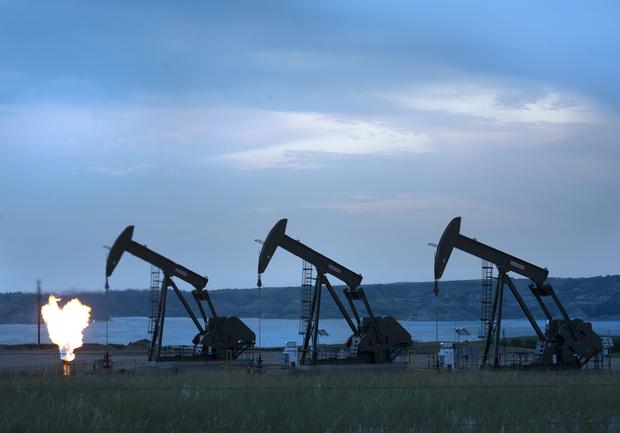
A gas flare is seen at an oil well site on July 26, 2013 outside Williston, North Dakota.
(Andrew Burton/Getty)
Over the last decade, the United States has undergone an economic
transformation in energy production. As President Obama told Congress in
his
2014 State of the Union address, "Today America is closer to energy independence than we have been in decades."
The United States has surpassed even Saudi Arabia in oil and gas
production, in part because of fracking technology, which allows energy
companies to reach oil and gas deposits they could never access
previously.
One of those deposits lies in the Bakken oil fields, which stretches
170 square miles from North Dakota to Montana and into Canada. An
estimated 7.4 billion barrels of undiscovered oil are sitting under the
U.S. portion of the Bakken, and thanks to fracking, the industry now has
the technology extract that oil.
Workers have flocked to the Bakken for jobs with six-figure salaries that don't require advanced degrees. But a new
investigation from
Reveal, a public radio program from the Center for Investigative Reporting, finds that those high-paying jobs come with a high price.
In the first comprehensive analysis of its kind, Reveal found that,
on average, a worker dies about every six weeks from an accident in the
Bakken, with at least 74 deaths in the oil fields since 2006.
Jennifer Gollan, a reporter with Reveal, led the
investigation. She says that
the top energy firms may be championing
speed over safety—something that was seen in September 2011 after a well
owned by Oasis Petroleum exploded in North Dakota.
“The supervisor on this well was congratulated for working quickly
and setting a new drilling record” months before the explosion, says
Gollan. “She went on to call this record-holding well a 'pace-setter.'"
Oasis offered workers daily bonuses of $150 for drilling quickly—those who drill slower and safer are only offered $40 a day.
“Safety is tantamount at Oasis,” spokesman Brian Kennedy told Gollan.
“Bonuses should not have been paid, and we regret that they were.”
The day before the explosion in 2011, Gollan says that a crew of four
men were brought on site to get the well to produce more oil.
According to documents from the Occupational Safety and Health
Administration (OSHA), a supervisor had pumped heavy salt water into the
well to prevent volatile gases from escaping before the crew set to
work the next day. But the well wound up erupting into a fireball.
Jebadiah “Jesse” Stanfill bared witness to the events of the day.
“They were beyond burned. Nothing but char. The smell of flesh burning. … It smelled of crude oil.” — Jebadiah Stanfill, oil worker
“He was working on an oil rig less than a mile away,” says Gollan.
“He was near the top of the rig when he heard this boom. He spun around,
grabbed a fire extinguisher and first aid kit, and jumped in this truck
with two co-workers.”
But Stanfill and his friends were too late—two men had died and two others were injured.
“As Jesse was helping to pick up some of these men to load them into
the bed of this pick up truck to bring them to the ambulance, some of
the men’s skin came off in his hands,” says Gollan. “That is a feeling
that, to this day, he just can’t shake.”
Gollan says that Stanfill has gear to protect himself from that
horrific memory—he is usually wearing gloves, even when he’s playing
with his children or cooking in the kitchen.
“How can a simple thing like looking at your hands or washing your
hands send you completely enveloped back to that day,” Stanfill told
Gollan. “The scenery changes. It’s as if I’m there. It rules my life.”
Brendan Wegner was one of the men who died in the well explosion.
“He was just 21. It was his first day on a rig,” says Gollan. “He was
scrambling down the derrick ladder when the well exploded. It consumed
him in this fiery tornado of oil and petroleum vapors. Rescuers later
found his body pinned under this heap of twisted metal. His charred
hands were recovered later still gripping the derrick ladder.”
Another man named Ray Hardy died the next day from his injuries.
Michael Twinn had his lower legs amputated after the explosion. He
committed suicide two years later.
“There was just one lone survivor who was burned over half of his body,” Gollan says of a man named Doug Hysjulien.
It appears that the victims of this explosion are the casualties of a flawed system.
“OSHA regulators will tell you that they often have to rely on a part of the law called the
general duty clause,”
says Gollan. “Basically, it makes it very difficult for them to hold
top energy producers accountable because they typically don’t have
direct employees on these well sites. As a result, in many of these
cases, the top energy producers are not fined. It’s the
subcontractor—typically the company that employs these workers—that get
fined.”
Four of America’s largest energy-producing states—Texas, Louisiana,
New Mexico and Wyoming—have adopted statutes that prevent or limit oil
companies from shifting liability to smaller contractors.
Wyoming set up a task force to address worker safety back in 2008, a
move that started the Wyoming Oil and Gas Industry Safety Alliance.
Between 2008 and 2012, the state saw a 45 percent decrease in the number
of worker deaths in the oil and gas industry.
Click on the audio player at the site to hear
Jack Bedessem,
the past president and advisor to the board of the Alliance, explain
how Wyoming is working to improve worker safety, especially in the oil
and gas industry.
By
Justin Mikulka • Sunday, June 21, 2015
DeSmogBlog
Although insisting the industry is not to blame, several of the oil
companies involved in the fatal Lac-Megantic oil train accident in 2013
have agreed to contribute to a fund to compensate the families of the 47
victims in that accident.
The Wall Street Journal
reported recently that oil companies Shell, ConocoPhillips,
Marathon and Irving have all agreed to contribute to the fund to avoid future litigation, along with General Electric and the Canadian government.
While the actual amounts contributed by most companies involved are not
available, the total fund is reportedly at $345 million. That sounds
like a lot of money but still is less than the $400 million retirement package for Exxon’s last CEO, for example.
Canadian Pacific Railway Ltd. hasn't agreed to the settlement, according to the
Bangor Daily News,
which reports that the judge in the case has delayed his decision on
the settlement. Canadian Pacific has asked the court to shield it from
future litigation and challenged the Quebec provincial
court’s jurisdiction.
It is no surprise that oil companies would prefer to pay fines of
tens of millions of dollars to avoid future litigation as well as duck
responsibility for the full cost of the cleanup. Rebuilding the
destroyed Lac Megantic property is expected to take as long as eight
years and
as much as $2.7 billion......
more here