Showing posts with label perception management. Show all posts

Sunday, December 14, 2014

ND's Meaningless New Bakken Oil Regs Will Keep Bomb Trains Rolling

North Dakota's Meaningless New Bakken Oil Regulations Will Keep Bomb Trains Rolling


Justin Mikulka  DeSmogBlog.com        12/11/14

New regulations purported to make Bakken crude safer for transport instead allow business as usual for the oil and rail industries moving explosive Bakken crude oil in unsafe DOT-111 rail cars.

The regulations announced Tuesday by the North Dakota Industrial Commission state that: “The goal is to produce crude oil that does not exceed a vapor pressure of 13.7 pounds per square inch (psi).”

There are two important things to note about this goal.

The first is that the vapor pressure of the oil that exploded in Lac-Megantic, Quebec, resulting in the death of 47 people, was under 10 psi and was described as being “as volatile as gasoline.” So the new regulations will permit oil that is significantly more volatile than the oil in the Lac-Megantic disaster to continue to be shipped by rail.

The second important thing to note is that almost all of the oil that the industry and regulators have sampled in the past year has been well below 13.7 psi. Of 99 samples taken in the Pipeline and Hazardous Materials Safety Administration’s sampling study, 94 were below 13.7 psi and the average psi for that study was 12.3 psi....

....[also]... the North Dakota Industrial Commission is aware that Bakken producers have not only been shipping dangerous oil that has high levels of natural gas liquids (NGLs), such as butane, that are part of the crude oil mixture as it comes out of the ground but that they have been actively adding such explosive NGLs to the oil prior to shipping it by rail.....  read more here

Informed comment by Ron Schalow:     [same link]

Railway Age called it on September 26th...
"The state’s (North Dakota) three-person Industrial Commission seems likely to adopt a set of industry-designed best practices. Simply put, North Dakotan crude will have to be lightly pressure-cooked to boil off a fraction of the volatile “light ends” before shipment."

This conditioning lowers the ignition temperature of crude oil—but not by much. It leaves in solution most of the culprit gases, including butane and propane.

Even the industry itself says conditioning would not make Bakken crude meaningfully safer for transportation, though it would make the state’s crude more consistent from one well to another.
The only solution for safety is stabilization, which evaporates and re-liquefies nearly all of the petroleum gases for separate delivery to refiners. Stabilization is voluntarily and uniformly practiced in the Eagle Ford formation in Texas..."--Railway Age
Ron Schalow
Fargo, North Dakota
The Coalition for Bakken Crude Oil Stabilization

Tuesday, December 9, 2014

ND plays crude PR game while WA citizens are chumped (are you dizzy yet?)


North Dakota to require every barrel of crude oil be filtered


The new requirements come as federal, state and local officials grapple with how best to ensure the safe transport of North Dakota's crude oil, which has been linked to a string of fiery crude-by-rail explosions, including one last year in Quebec that killed 47 people....

....the standards will require crude extracted from the state's shale formations - more than 1.1 million barrels per day - to be processed through machinery set at mandated temperatures and pressures, which the NDIC believes will remove the most amounts of propane, butane and other volatile natural gas liquids (NGLs) naturally found in oil.

Some producers do this now; the NDIC aims to make all comply.

The goal would be to produce a barrel of North Dakota crude oil with vapor pressure of no more than 13.7 pounds per square inch (psi), similar to the 13.5 psi for most automobile gasoline.....  read more here
 

[Ed note: don't take the above at face value. See this previous post for more information]

The Big Difference Between Oil "Condtioning" and "Stabilization"


Editorial: As oil train shipments increase, talks needed in Olympia 

Spokesman Review  Dec. 9, 2014

Last spring, Washington lawmakers couldn’t agree on what to do about the increase in oil trains, but they did call for a study. Last week, key legislative leaders learned via a Department of Ecology draft report that the challenge arrived with astonishing speed.

“In Washington, crude oil shipments went from zero in 2011 to 714 million gallons in 2013, and could reach nearly 3 billion gallons by the end of this year or in 2015,” the Associated Press reported....  read more here   (if you are ready for blah-blah.... reads like they wanted to say something but couldn't get it past the muzzle.)


Friday, November 28, 2014

The Big Difference Between Oil "Condtioning" and "Stabilization"- and other news

Speak Your Piece: N.D.'s Other Oil Boom

By Ron Schalow    Daily Yonder   11/24/14

.... Bakken crude needs to be “stabilized,” to remove all explosive “natural gas liquids” such as ethane, propane and butane. That requires billions of dollars in additional equipment and infrastructure, and the oil companies don’t want to pay for it.

Stabilization is a standard practice in many other parts of the United States. And it’s a required part of preparing crude for shipment via pipelines. The explosion risk North Dakota’s lack of regulation imposes on railroad communities all over North America is completely unnecessary. And requiring stabilization would a further boost to the state’s economy. But that’s not enough for the commission.

Instead, the commission is going to sell a different process called “conditioning,” which the oil companies have been doing all along. And conditioning doesn’t do the job, unless you think that job should include towering fireballs, mushroom clouds, charred buildings and graves.

Railway Age explains the difference well:

This conditioning lowers the ignition temperature of crude oil—but not by much. It leaves in solution most of the culprit gases, including butane and propane. Even the industry itself says conditioning would not make Bakken crude meaningfully safer for transportation, though it would make the state’s crude more consistent from one well to another.

The only solution for safety is stabilization, which evaporates and re-liquefies nearly all of the petroleum gases for separate delivery to refiners. Stabilization is voluntarily and uniformly practiced in the Eagle Ford formation in Texas.

... read more here

ddpp-us-dpp-mixed-case-wedges

How various reductions stack up in the Mixed Case:

Yes, the U.S. can reduce emissions 80% by 2050 — in 6 graphs


So, I’ve got good news and bad news.

The good news: There is no substantial technical or economic barrier that would prevent the U.S. from reducing its greenhouse gas emissions 80 percent below 1990 levels by 2050, a target that would help put the world on track to limit global average temperature rise to 2 degrees Celsius. In fact, there are multiple pathways to that target, each involving a different mix of technologies. Achieving the goal would cost only around 1 percent of GDP a year out through 2050, and if we started now, we could allow infrastructure to turn over at its natural rate, avoiding stranded assets.

The bad news: Pulling it off would require immediate, intelligent, coordinated, vigorously executed policies that sustain themselves over decades. Y’know, like how America does. [cough]

These are the conclusions of a new report on U.S. decarbonization from the Deep Decarbonization Pathways Project, to which I drew your attention yesterday..... read more here


Lac-Mégantic property owners receive compensation instalment from Quebec

 Montreal Gazette  11/24/14

The provincial government announced Monday that the first instalment of money set aside to compensate owners of buildings destroyed in the explosion and fire in Lac Mégantic has been transferred.

A total of $1.8 million has been sent to the town. A notary will disburse the funds to nine owners. Others will be paid later.....  read more here

Thursday, November 27, 2014

Vancouver Energy: A History Of Subterfuge


  In Our View: A History Of Subterfuge

Typo on mailer may be honest mistake, but oil terminal backers fail to inspire trust


The Columbian  November 23, 2014

As anybody in the newspaper business can attest, typos happen.
Those would be typographical errors, and they have been around essentially since the advent of written languages. A dropped letter here, an added word there, and a reporter or editor could find themselves in a difficult situation....

... Propaganda is part of the game, and the parties that make up Vancouver Energy — Tesoro Corp. and Savage Companies — have every right to try to sway public opinion. But, in the process, they managed to obfuscate the facts. The flier boasts that the projected annual tax revenue generated by the terminal would be $2 billion. That is more than a bit misleading, considering that annual tax revenue is projected to be $7.8 million — or roughly 0.4 percent of $2 billion. The $2 billion, it turns out, is the projected economic value of the terminal during construction and the first 15 years of operation....

... the companies involved with Vancouver Energy have demonstrated a long history of subterfuge. And it didn't take a typo on a mailer to reveal that.    read article here

Thursday, November 20, 2014

What Railway Workers Think about Oil Trains/ Big Oil Funds NW 'astroturf' groups

What Railway Workers Think about Oil Trains

Train engineers argue rail industry is putting health and safety at risk. 

Eric de Place  Sightline Institute  11/20/14

If you’re following the debate about the development of large-scale crude oil-by-rail sites in Washington, you should be paying close attention to what labor unions are saying.

Sightline has cataloged a range of serious concerns about the rise of oil trains— from lax tank car safety standards to industry intransigence to severe under-insurance—but the perspective of actual rail workers is even more troubling. In response to a recently published Washington Department of Ecology study on rail oil transport, the Brotherhood of Locomotive Engineers and Trainmen submitted formal comments to the State that are frankly damning.The remarks illustrate an industry prioritizing profits and efficiency over health and safety and, by doing so, jeopardizing the very workers we rely on to  move 15,000-ton trains of hazardous goods through our communities safely.

Ecology will not be making the comments publicly available until March 2015, but with permission from the union I’m publishing portions of them here. What follows are direct excerpts from  Chairman Sharaim C. Allen’s letter to the Department of Ecology: ...... read article here
   
 also see:   Railroad Engineers Warnings Ignored In Inslee's Oil Report

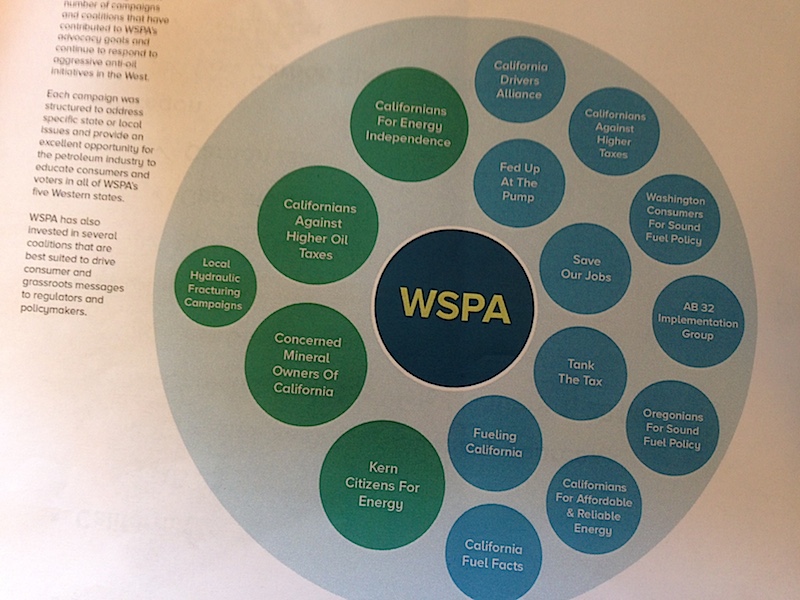
Oil Interests Fund 'Astroturf' Groups In Washington, Oregon 

nw news network 

Astroturfing is when interest groups run a campaign that’s designed to look like it’s grassroots in nature.
This PowerPoint slide shows the campaigns and coalitions that the Western States Petroleum Association has 'activated' to combat what it calls 'aggressive anti-oil initiatives in the West.'
A document obtained by public radio shows the oil industry is at the center of more than a dozen Astroturf groups in Washington, Oregon and California....  read more here

Monday, November 3, 2014

Public deception, lazy journalism, and other Oil news

Sunday, November 02, 2014 by Marc Eliesen  Dogwood Initiative

Energy executive blasts Kinder Morgan review as “fraudulent,” quits

Marc Eliesen has withdrawn as an intervenor in the federal government’s review of Kinder Morgan’s Trans Mountain pipeline and oil tanker expansion project, detailing his reasons for quitting in a scathing 1,500 word letter to the National Energy Board.

Eliesen is the former CEO of B.C. Hydro and the former Chair of Manitoba Hydro. A deputy minister in seven different federal and provincial governments, Eliesen has forty years’ executive experience in the energy sector, including as a board member at Suncor.

Here is the full text of his letter to the secretary of the NEB:
 
Dear Ms. Young:

The Intervenor, Marc Eliesen, wishes to withdraw from the National Energy Board hearing on the Trans Mountain Expansion Project (TMEP).

I applied as an intervenor with expertise to offer the Board in good faith that my time and personally incurred costs would be well spent in evaluating Trans Mountain’s proposal, questioning the Proponent, preparing evidence commensurate with my expertise, answering questions on that evidence, and providing final argument. Unfortunately, I have come to the conclusion that the Board, through its decisions, is engaged in a public deception. Continued involvement with this process is a waste of time and effort, and represents a disservice to the public interest because it endorses a fraudulent process.....  read more here
 

The Steyer story: Election coverage gone bad 

By Peter Dykstra   The Daily Climate   11/03/14

 ....This year, Tom Steyer has been portrayed as an "oligarch," or a "billionaire environmentalist," whose electoral philanthropy is a "crusade."

As billionaires go, he's barely scraping by. He has a billion in the bank, give or take. He hovers somewhere around 1,150th on the Forbes list of the world's richest people. He'd need to roughly triple his wealth to make the vaunted Forbes 400.


Lazy journalism


So No. 1,150 ends up paired with the Koch Brothers (tied for fourth on the Forbes list) in stories that suggest that Big Oil and Big Recycling have reached political parity. This is lazy journalism, and a disservice that invites delusion on the environmental side..... read more here

At least 1,250 square miles of ocean floor in the Gulf of Mexico is coated with oil:   VICE News


North Dakota man relentless in push for safer oil by rail shipping

Billings Gazette - ‎Nov 2, 2014‎
....More recently, the Fargo man, a frequent writer of letters to the editor, has focused his attention on explosive Bakken crude oil and rail safety - an issue that has drawn national attention after a series of fiery train derailments.....    

.... [Ron Schalow]  has assembled a loose network of people concerned about the crude oil stabilization issue....


Oil boom spurs need to restore rail cars

Hutchinson News - ‎Nov 1, 2014‎
The Illinois-based, family-owned scrap metal and recycling company plans to build a $35 million plant on 100 acres in the Kansas Enterprise Industrial Park to refurbish rail cars. The focus will be tank cars designed to carry crude oil and other ... 

Our opinion: Global Partners has rid itself of the weakest crude oil rail tanker cars. But crude transportation overall isn’t yet anywhere close to being safe.

As promised, Global Partners has weeded out any of the weaker freight rail cars that have been involved in the most significant crude oil accidents since the Lac-Megantic, Quebec, disaster in July 2013, which took 47 lives and flattened a town.

The reasons this has import are many, but this may be the most notable: An entity in the oil and rail industries involved in crude oil transportation has said it would take steps to make that process safer, identified a timeline within which to accomplish that goal and made it happen.....