Showing posts with label marine ecosystems. Show all posts

Thursday, February 25, 2016

Oceanic Climate Change & OPEC Efficiency


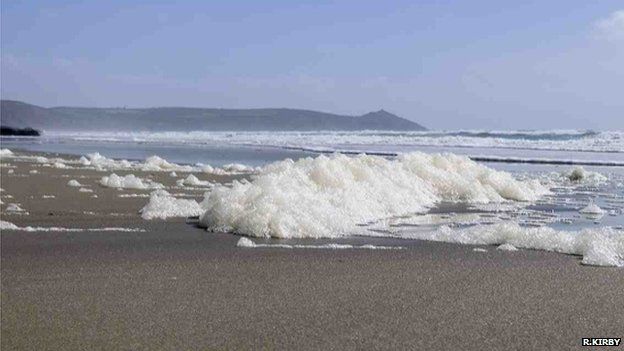
Decaying algal foam on a beach (Image courtesy of Dr Richard Kirby)
Often mistaken for pollution, foam found on beaches is the decaying remains of vast colonies of phytoplankton commonly known as foam algae.

Climate stirring change beneath the waves

Environment reporter, BBC News 

Human-induced climate change is triggering changes beneath the waves that could have a long-term effect on marine food webs, a study suggests.
An assessment of phytoplankton in the North Atlantic found the microscopic organisms' pole-ward shift was faster than previously reported.
It observed that the ocean's tiny plant community was "poised for marked shift and shuffle".
The findings appear in the Proceedings of the National Academy of Sciences.

"Marine phytoplankton are crucial in marine food webs and global biogeochemical cycles and they are incredibly diverse but we don't really have a sense of what all the different organisms do when you modify climate, or even through natural climate variability," explained co-author Andrew Barton, a researcher at Princeton University, working at the US National Oceanic and Atmospheric Administration's Geophysical Fluid Dynamics Laboratory.
He told BBC News: "This study attempted to get a handle on how all these different kinds of organisms may respond to anthropogenic climate change over the coming century."

Climate change takes from the poor, gives to the rich, study finds


February 24, 2016 via phys.org

Fish and other important resources are moving toward the Earth's poles as the climate warms, and wealth is moving with them, according to a new paper by scientists at Rutgers, Princeton, Yale, and Arizona State universities. 


Climate change is forcing some species of migrating fish to shift their range toward the poles, which means big changes for people whose livelihoods depend on those fish.
"What we find is that natural resources like fish are being pushed around by climate change, and that changes who gets access to them," said Malin Pinsky, professor of ecology & evolution in the School of Environmental and Biological Sciences.
The stronger and more conservation-oriented the  management in a community, the higher the value that community places on its natural resources, whether those resources are increasing or diminishing, Pinsky reports. If wealthier communities and countries are more likely to have strong resource management, then these wealthy groups are more likely to benefit, thus exacerbating inequality.
Pinsky and his co-authors have published their findings in the journal Nature Climate Change.

Saudi Arabia's Oil Minister Suggests Canada, Others Will Have To 'Get Out' Of Oil

via Huffington Post Canada , video at link
Saudi Arabia’s oil minister has a solution for the global oil glut: Instead of cutting oil production, wait for the world’s most expensive producers to go bust.
Ali Al-Naimi didn’t specifically single out the U.S.’s shale oil fields and Canada’s oilsands as the targets of his comments at an oil industry conference in Houston, Tex., on Tuesday. But as those two are among the most expensive oil plays in the world today, the target of his comments was clear.
“Efficient markets will determine where on the cost curve the marginal barrel resides,” Al-Naimi said, as quoted at Forbes. He added later: “Inefficient producers will have to get out.”
Al-Naimi rejected the idea of an OPEC production cut, saying they won't work to boost oil prices. Cutting production would mean low-cost producers like Saudi Arabia would be subsidizing higher-cost ones.
Low-cost producers cutting their own production “only delays an inevitable reckoning," he said.
Saturday, January 16, 2016

Northwest Tribes unite against giant coal, oil projects

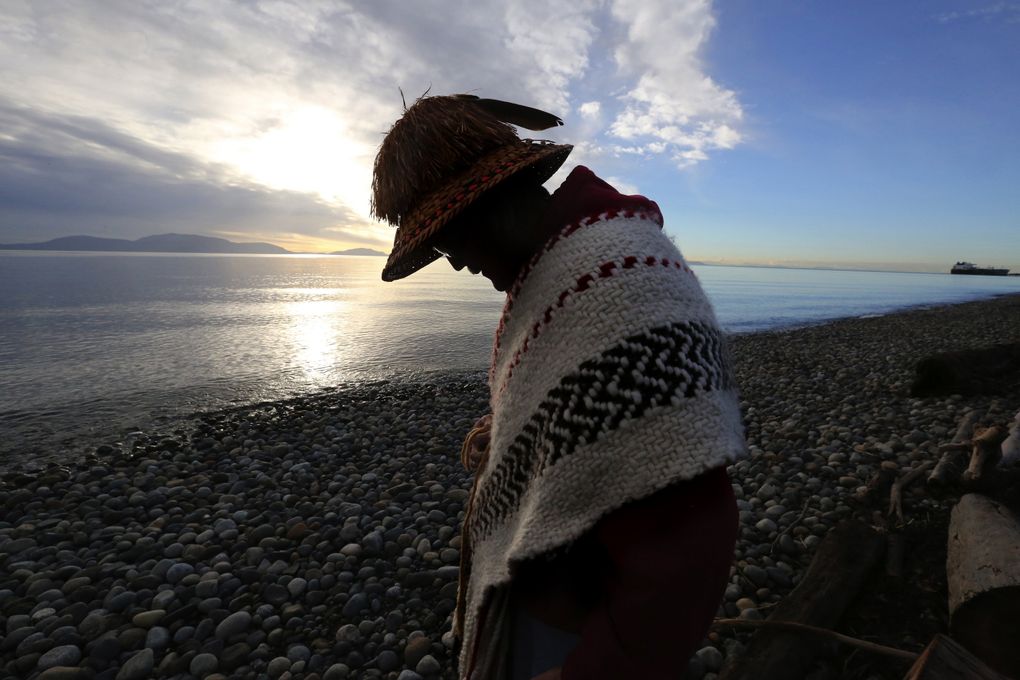
Lummi hereditary chief Bill James, on the beach at Cherry Point, says saving it is to preserve “the tribe’s very way of life.” It’s the site of an ancient Lummi village. (Alan Berner/The Seattle Times)

Northwest Tribes unite against giant coal, oil projects

As governments, tribal nations are uniquely empowered in some of the biggest environmental fights in Washington and willing to use that power.

Seattle Times  January 16, 2016  By
CHERRY POINT, Whatcom County — On this last bit of undeveloped coast between a smelter and two oil refineries, SSA Marine wants to build the biggest coal export terminal in North America, to load up some of the largest ships afloat arriving up to 487 times a year, mostly from Asian ports.

The blockbuster $665 million proposal is one of many fossil fuel transport projects under review in the region — from oil pipeline expansions in B.C., to oil-by-rail facilities in Southwest Washington and another coal port in Longview.

And while thousands of people have turned out to protest Washington turning into one of the largest fossil fuel hubs in the country, Northwest tribes appear best positioned to win the fight.

“This is different from an environmental group coming in and saying ‘you shouldn’t do this.’ Here, agencies’ discretion is limited,” said Robert Anderson, director of the Native American Law Center at the University of Washington School of Law. “Tribes have treaty rights and the U.S. has trust responsibility to uphold those rights. That is the game-changing possibility here.”

It’s a high-stakes power play. There’s already been blowback in Congress from Republican lawmakers and, if the tribes lose, that could create a bad precedent for them in future battles.

But tribes are standing together against the projects.

“Coal is black death,” said Brian Cladoosby, chairman at the Swinomish Indian Tribal Community near La Conner who, as president of the National Congress of American Indians, has brought a national voice to the opposition.

“There is no mitigation,” Cladoosby said. “We have to make a stand before this very destructive poison they want to introduce into our backyards. We say no.”

The Lummi Nation has demanded the U.S. Army Corps of Engineers, which is reviewing the so-called Gateway Pacific Terminal project, deny SSA’s permit application because it endangers the tribe’s treaty-protected fishing rights.

The Swinomish and Tulalip Tribes have sent similar letters to the Corps, and the Suquamish Tribe also is weighing in. “We have the same amount of commitment to treaty rights protection,” said Leonard Forsman chairman of the Suquamish tribe. “We are a team and we are working with them. We are very concerned about impacts on our fishery.”

The project is proposed in a state aquatic reserve and treaty protected fishing areas of five Washington Tribes. The uplands and waters are utilized by a menagerie of state and federally protected species, and what was once the best herring run in Puget Sound, already imperiled and targeted for recovery. The project also overlaps Xwe’chi’eXen, a village site and cemetery for at least 3,500 years and thousands of ancestors of the Lummi Nation.
Video at site: Bill James discusses the Lummi Nation’s opposition to the development of a coal port at Cherry Point. The Lummi are one of several Northwest tribes fighting the transport of fossil fuel through their lands. (Alan Berner / The Seattle Times)
But Cherry Point near Bellingham is regarded by the industry as a prime location for a new coal port. Already home to wharves for oil refineries and an aluminum smelter, the area’s deep water close to shore can accept the biggest ships afloat with no dredging, and has nearby rail access.

The Gateway terminal would move up to 48 million metric tons of coal a year — enough to cover 80 acres in five open stockpiles by the water, each 2,100 feet long and up to 70 feet high. As many as nine trains a day more than a mile and a half long would travel to and from the terminal, all the way from Montana and Wyoming. Every 18 hours, ships, many nearly three football fields long, would load up on coal at the 3,000-foot-long wharf.

Booming across the water in a tribal fishing boat toward Cherry Point, Lummi carver Jewell Praying Wolf James said he traces his lineage to some of the first sockeye fishers with reef net sites here.

To him, and to tribal cultural leader Al Scott Johnnie, the fishery means more than money. “There is a sense of place, a sense of belonging and a culture of the water, the air, the plants, the fish, and how you conduct your relationships,” Johnnie said.
      continued below~

Friday, September 25, 2015

Local Voices: Standing Up To Oil

Quinault Indian Nation: Standing Up To Oil

Tyson Johnston, the Vice President of the Quinault Indian Nation, knows there's so much at risk to his community by the proposed oil terminals. The Quinault people seek their livelihoods from the natural resources, in addition to the cultural and spiritual relationship with their lands.

Don't let oil terminals threaten the Quinault Indian Nation - stand up to oil today!

Mayor of Ocean Shores: Standing Up To Oil 

Mayor Dingler of Ocean Shores opposes oil trains coming through Southwest Washington and is standing out in front to say oil does not belong in Grays Harbor County.

Don't let oil terminals ruin the beaches of Ocean Shores - stand up to oil today!

Thursday, September 17, 2015

Impacts of Crude Oil on the Grays Harbor Economy and the Quinault Nation


Friends of Grays Harbor has just released an important study on the economic impacts of crude oil transport to Grays Harbor.   
The report can be accessed by visiting http://fogh.org and click on IMPACTS OF CRUDE OIL ON GRAYS HARBOR’S ECONOMY to download the PDF.

This study confirms that the risk of bringing crude oil to the Harbor, will jeopardize Washington’s Coast and devastate the estuary and impact the livelihoods and quality of life of thousands of residents.  We hope you will comment on the Draft EIS.  Please come to one of the public hearings to be held on this project.  October 1, 2015 at the Satsop Business Park, Flextech Building, (Building 100), 150 Technology Way, Elma Washington or October 8, 2015 at the D & R Threatre 205 South I Street, Aberdeen, Washington.  Each hearing will take public testimony from 1:30pm - 4:30pm and again at 6:00pm - 9:00pm.  The doors are open from 1:00pm - 9:00pm on those two days.  You can learn more at http://www.ecy.wa.gov/geographic/graysharbor/terminals.html  

Update:  (new location) There will be a rally of citizens on October 8 on the Heron side of I Street, near the D&R Theater  in Aberdeen beginning at 5:00pm on October 8th.

Please attend and bring a few hundred of your closest friends.  Crude oil cannot be mitigated. 

Two other recent studies are discussed below:

The Impacts of a Grays Harbor Oil Spill, in 13 Slides

How Big Oil jeopardizes Washington coastal tourism and the Quinault Nation.


Tarika Powell and Eric de Place  September 17, 2015    Sightline Institute

Three large oil terminals proposed for Grays Harbor could undermine the region’s economy and local culture. That’s the takeaway from two recent economic analyses: first, a study on coastal recreation in Washington from the Surfrider Foundation and marine technology firm Point 97; then, Economic Impacts of Crude Oil Transportation on the Quinault Indian Nation and the Local Economy, published by economic consulting firm Resource Dimensions.

These reports help clarify the real threat that oil transport poses to Grays Harbor. But since most people don’t have time to thumb through such detailed findings, Sightline commissioned the following graphics to sum up the key points.

Over forty percent of Washington residents travel to the coast each year; their top recreational activities are beachgoing, scenic enjoyment, wildlife viewing, photography, and hiking/biking.

Original Sightline Institute graphic, available under our free use policy. Data Source: Surfrider Foundation.

Coastal visitors spend an estimated $481 million dollars per year on recreation and tourism trips. An oil spill in the bay could do tremendous harm to businesses that are dependent on tourism dollars.


Original Sightline Institute graphic, available under our free use policy. Data Source: Surfrider Foundation.

The proposed oil projects could also have a devastating impact on fishing and tourism for the Quinault Indian Nation, as they have in the past: Quinault lands were oiled during the 1988 Nestucca oil spill at the mouth of Grays Harbor.

Original Sightline Institute graphic, available under our free use policy. Data Source: Resource Dimensions.

An increased volume of oil going into and out of Grays Harbor would increase the risk of spills, so Resource Dimensions studied three oil spill scenarios.

Original Sightline Institute graphic, available under our free use policy. Data Source: Resource Dimensions.

Original Sightline Institute graphic, available under our free use policy. Data Source: Resource Dimensions.
      
*** continued below***

Wednesday, August 26, 2015

Community Action: No Oil Terminals in Grays Harbor!

 
Please come help spread the word in Grays Harbor!    Updated below
 We'll see the DEIS announcement for the proposed Westway and Imperium oil terminals in the Vidette this week (Aug 26th), now is the time to hit the ground running!

Thurs, Aug 27th, Doorbelling in Aberdeen. We'll meet at the Furford Gathering Center (behind former Baskin Robins), 104 S Chehalis St., Aberdeen at 5pm -finish by 7:30pm

Running the Risk: Washington's Fight Against Crude By Rail
Thursday, Sept 3, 6:30pm
222 Columbia St NW, Olympia
Join us for a free community forum and discussion on the oil industry’s plan to build five new processing facilities in our state, and how oil transport threatens our community, our waterways, and our livelihoods.

Speakers:
Eric de Place, Sightline Institute, The Thin Green Line
Arthur R.D. Grunbaum, Friends of Grays Harbor, Talking Crude
Arnie Martin, Grays Harbor Audubon Society, Talking Crude
(Email cleangraysharbor@gmail.com  if you need a ride, or can give a ride)​


The DEIS will be released on August 31st.
Open houses and public hearings will be held on October 1 in Elma and October 8 in Aberdeen. Additional details will be released August 31 on the project website,  www.ecy.wa.gov/GraysHarbor .

Look for more details on Monday, August 31 through the LISTSERV on www.ecy.wa.gov/GraysHarbor or the legal notice published in the Montesano Vidette on Thursday, August 27.

Updated- We will be holding 2 Workshops on writing your best comment:
 
Sept 16th Wed 6pm How to Craft an Effective Comment WorkShop. (Furford Gathering Center 104 So Chehalis St, Aberdeen) Led by Jessie Dye & Jessica Zimmerle of Earth Ministries. Jessie was a speaker at our June 10th Forum and has participated in many EIS precedures.

Sept 19th Sat 1:30pm-3:30pm How to Craft an Effective Comment WorkShop. (Hoquiam Timberland Library Meeting Room, downstairs 429 7th St, Hoquiam) Led by Dan Serres of Columbia River Keepers.


Learn how to craft your best message for your comment!

Please share this on Facebook and with your friends and neighbors!