 |
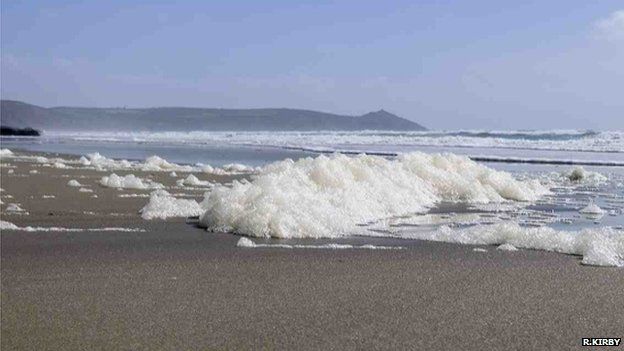
| Often mistaken for pollution, foam found on beaches is the decaying remains of vast colonies of phytoplankton commonly known as foam algae. |
Climate stirring change beneath the waves
Environment reporter, BBC News
Human-induced climate change is triggering changes beneath the waves that could have a long-term effect on marine food webs, a study suggests.
An assessment of phytoplankton in the North Atlantic found the microscopic organisms' pole-ward shift was faster than previously reported.
It observed that the ocean's tiny plant community was "poised for marked shift and shuffle".
The findings appear in the Proceedings of the National Academy of Sciences.
An assessment of phytoplankton in the North Atlantic found the microscopic organisms' pole-ward shift was faster than previously reported.
It observed that the ocean's tiny plant community was "poised for marked shift and shuffle".
The findings appear in the Proceedings of the National Academy of Sciences.
"Marine phytoplankton are crucial in marine food webs and global biogeochemical cycles and they are incredibly diverse but we don't really have a sense of what all the different organisms do when you modify climate, or even through natural climate variability," explained co-author Andrew Barton, a researcher at Princeton University, working at the US National Oceanic and Atmospheric Administration's Geophysical Fluid Dynamics Laboratory.
He told BBC News: "This study attempted to get a handle on how all these different kinds of organisms may respond to anthropogenic climate change over the coming century."
He told BBC News: "This study attempted to get a handle on how all these different kinds of organisms may respond to anthropogenic climate change over the coming century."
Climate change takes from the poor, gives to the rich, study finds
February 24, 2016 via phys.org
Fish and other important resources are moving toward the Earth's poles as the climate warms, and wealth is moving with them, according to a new paper by scientists at Rutgers, Princeton, Yale, and Arizona State universities.
Climate change is forcing some species of migrating fish to shift their range toward the poles, which means big changes for people whose livelihoods depend on those fish.
"What we find is that natural resources like fish are being pushed around by climate change, and that changes who gets access to them," said Malin Pinsky, professor of ecology & evolution in the School of Environmental and Biological Sciences.
The stronger and more conservation-oriented the natural resource management in a community, the higher the value that community places on its natural resources, whether those resources are increasing or diminishing, Pinsky reports. If wealthier communities and countries are more likely to have strong resource management, then these wealthy groups are more likely to benefit, thus exacerbating inequality.
Pinsky and his co-authors have published their findings in the journal Nature Climate Change.
Saudi Arabia's Oil Minister Suggests Canada, Others Will Have To 'Get Out' Of Oil
via Huffington Post Canada , video at link
Saudi Arabia’s oil minister has a solution for the global oil glut: Instead of cutting oil production, wait for the world’s most expensive producers to go bust.
Ali Al-Naimi didn’t specifically single out the U.S.’s shale oil fields and Canada’s oilsands as the targets of his comments at an oil industry conference in Houston, Tex., on Tuesday. But as those two are among the most expensive oil plays in the world today, the target of his comments was clear.
“Efficient markets will determine where on the cost curve the marginal barrel resides,” Al-Naimi said, as quoted at Forbes. He added later: “Inefficient producers will have to get out.”
Al-Naimi rejected the idea of an OPEC production cut, saying they won't work to boost oil prices. Cutting production would mean low-cost producers like Saudi Arabia would be subsidizing higher-cost ones.
Low-cost producers cutting their own production “only delays an inevitable reckoning," he said.
