Showing posts with label ethanol. Show all posts

Tuesday, January 26, 2016

Hearing Added and Deadline Extended for Tacoma Methanol Plant


Please attend the scoping meetings and add your questions/comments regarding the refinery to the city's scoping document, this is how to make your voice heard: 

The second EIS Public Scoping Meeting is scheduled to begin at 6:30 p.m. on Wednesday, February 10, 2016, in the 5th Floor Exhibit Hall at the City Convention Center, 1500 Broadway (doors will open at 5:00 p.m. for speaker sign-up; speakers will be called upon in order of sign-up). 


The third EIS Public Scoping Meeting is scheduled for February 16at Meeker Middle School in NE Tacoma. Doors will open at 5:00 p.m.for speaker sign-up; the meeting will begin at 6:30 p.m. We are locating the third meeting to make it easier for NE Tacoma residents to attend. 
City staff plan to have a draft Scope of Work available and posted on the project web page no later than February 5, 2016. As much as possible, the second and third hearings should focus on the details of the Scope of Work 

NEW Scoping comment period deadline
March 4, 2016, 5 pm

Email your comment to

Please attend this week's Port of Tacoma Commission meeting:
Port Commission Meeting is this THURSDAY, the 28th, at noon. At The Fabulich Center, Room 104,3600 Port of Tacoma Road,Tacoma, WA 98421

Sign the MoveOn petition


via Citizens For A Healthy Bay


Sunday, November 8, 2015

BNSF Train Derails in Alma, WI, Voluntary Evacuation Lifted, Ethanol Spills in River

UPDATE: Train Derails in Alma, WI, Voluntary Evacuation Lifted, BNSF Working to Clean Up Leaks 

Updated: 11/07/2015 11:22 PM    KAALtv.com     video at site

(KSTP) -- UPDATE: Emergency crews were on the scene of a train derailment in western Wisconsin that closed highways and prompted a voluntary evacuation of nearby residents.

"Truthfully, I've always been concerned something like this might happen," said Patti Stinson of Buffalo City who was taking pictures of the train on Saturday.

A statement from BNSF Railway said 25 cars derailed roughly two miles north of Alma, Wisconsin, at approximately 8:45 a.m. Saturday.

"You assume the worst. You never know when it involves the water either," said Chief Deputy Colin Severson from the Buffalo County Sheriff's Office.

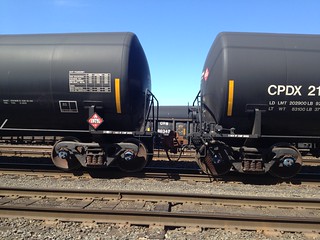
The cars included empty auto racks and tanker cars of denatured alcohol, more commonly known as ethanol, according to the statement.

"They're working on stabilizing the cars and cleaning them up," Severson said.

BNSF said there are no reports of fire, smoke or injuries. Parts of two state highways were closed due to the incident, but were then re-opened in the afternoon.

"In this case everybody responded very quickly," Severson said.

The Buffalo County Sheriff's office said the Alma American Legion was set up for those who left their homes.

Many locals say they had no idea there was potential for a serious threat, therefore staying put, disregarding the voluntary evacuation......   more here


Witness describes Alma train derailment

Five tankers leaked unknown amount of ethanol into Mississippi River

Updated On: Nov 08 2015   News8000.com      video at site


ALMA, Wis. (WKBT) -  No one is injured after a train derailed in Buffalo County Saturday morning.

Just before 9 a.m, the Buffalo County Sheriff's Department said 32 cars fell off the tracks near Highway 35 and County Road I, about 2 miles north of Alma.

The Sheriff's Department said five of the cars were carrying ethanol that leaked into the Mississippi River. The leaks have been contained, but officials are not sure how much ethanol entered the water........   more here


Saturday, February 7, 2015

Can you write a comment or 3?

Action Alert! Thanks Don!
Hello friends,
There are three important bills in the legislature that reduce the risk of oil trains. 
These bills will be opposed by industry and will need a very strong push from us.  Please submit comments of support for the following three bills, one at a time.

A note from Laura (who testified in Olympia last week), on what our focus should be here:
I was specifically told, by two RR union members who are lobbyists, NOT to mention environmental concerns, don't mention carbon, don't mention your opposition to coal and oil trains.  Don't even bring up the "E" word.
This is a safety issue for the railroaders and nothing else. We can blow it for them by going beyond safety when we contact our legislators in writing or in person about these bills.

HB 1809  Requires more crewmembers on hazardous trains.
Encourage your legislator to require 4 crew members on unit oil trains. 

HB 1284  Addresses yardmaster fatigue
Encourage your legislator to protect yardmasters from overwork and fatigue by placing those on Class I railroads under Federal hours of service regulation.


HB 1808 places everyone who transports train crews under UTC.
Several years ago, two people were killed in an accident related to an unregulated shuttle driver.  Require the Utilities and Transportation Commission in Olympia to regulate these charter shuttle companies.

Easy Peasy!

Back in 2012 the number of rail shipments of ethanol were 30 percent greater than the number of carloads of crude oil shipped by rail.
But according to AAR president Edward Hamberger’s  testimony at Tuesday’s House hearing, about 500,000 carloads of oil were shipped by rail last year, so oil by rail has now surpassed ethanol by rail.
Hamberger also noted that “exactly seven cars were in an accident that released crude oil out of about 500,000. That’s 99.999 percent safety.”
But Jared Margolis, a staff attorney for the Center for Biological Diversity, said in response to Wednesday’s ethanol spill, “The train derailment and ethanol spill now affecting the Mississippi River is just the latest reminder that the Department of Transportation is not taking aggressive enough steps to protect us from the growing threat posed by use of out-dated DOT-111 tank cars.”

BNSF plans $189M in rail work across state

By Eric Florip, Columbian transportation & environment reporter, The Columbian
BNSF Railway will spend $189 million toward maintenance and improvements on its track system in Washington this year, the company announced Friday.
The work will include more than 1,000 miles of track surfacing and undercutting, the replacement of almost 50 miles of rail and 200,000 railroad ties, among other fixes. Areas of focus will include BNSF’s Columbia River Gorge main line east of Vancouver and the route between Vancouver and Seattle, said BNSF spokesman Gus Melonas. BNSF also expects to start construction this year on the replacement of a railroad bridge over the Washougal River in Camas.

Sunday, July 27, 2014

Rail shipping disruptions, fees and flammable materials- new stories

Oil trains crowd out grain shipments to NW ports

Seattle Times  July 26, 2014

As oil trains hauling North Dakota crude delay rail transport of grain to Pacific Northwest ports, the prospect of growing fossil-fuel traffic has some fearing that such shipping disruptions will become a long-term problem impeding exports and the regional economy.....

2014-06-18 15.58.56

Oregon Oil Train Safety Report Calls For More Rail Inspectors, Fees

Daily Astorian    July 26, 2014

A statewide rail safety report released today identifies gaps in the resources Oregon needs to prevent and respond to an oil train derailment.

The report, ordered by Gov. John Kitzhaber in February, calls for more rail safety personnel and more funds to pay for training emergency responders for an oil train derailment. To help pay for both of those needs, the report recommends charging fees for transporting crude oil by rail through the state.....


Proposed rail transportation safety rules will impact ethanol industry 


Last week the U.S. Department of Transportation released details of its rulemaking proposal to improve the safe transportation of large quantities of flammable materials by rail — particularly crude oil and ethanol.,,,

.... Dinneen expressed concern that the rule paints with too broad a brush and fails to distinguish between products with an admirable safety record — ethanol — and those for which legitimate and serious concerns have been raised — highly volatile crude oil from the Bakken.....