Showing posts with label profit. Show all posts

Thursday, September 17, 2015

Government, Industry Ignore Scientific Case For Improving Crude By Rail Safety

VIDEO: Government, Industry Ignore Scientific Case For Improving Crude By Rail Safety, Let Bomb Trains Roll On 


By Brendan DeMelle • Thursday, September 17, 2015    DeSmogBlog


Oil train in Seattle by Brendan DeMelle

** video link below**

Since the tragic Bakken oil train accident that extinguished 47 lives in Lac-Megantic, Quebec in July 2013, seven more Bakken oil trains have derailed, resulting in accidents involving large fires and explosions. We now know that oil produced in North Dakota's Bakken Shale formation is extremely volatile due to its high natural gas liquid content — resulting in the “bomb train” phenomenon.

DeSmog’s new investigative video, written and produced by Justin Mikulka, details a coordinated effort by the oil industry, members of the U.S. Congress, regulators and the Department of Energy to challenge the known science of crude oil characteristics with the goal of delaying or avoiding any regulatory changes requiring Bakken crude oil stabilization, a safety measure that would protect the millions of people currently living in bomb train blast zones.

Stabilization is the process that removes the volatile natural gas liquids from the crude oil, resulting in a “stable” petroleum product with greatly reduced volatility and flammability.

DeSmog has reported extensively on the oil-by-rail policy battle, including an investigation that revealed the direct role of the White House in working with North Dakota regulators to avoid any requirements for oil stabilization for the Bakken crude.

The success of their misdirection campaign is evident — the mainstream media is largely overlooking this critical issue when the public needs referees to ask the tough questions on this vulnerability in our crude oil by rail protocols. Yet a Wall Street Journal article this week on how to make oil safe to transport didn’t even mention stabilization.

The video uses archival information from American Petroleum Institute videos, Congressional hearing testimony, news clips and more to reveal how the oil industry has avoided regulation in order to continue transporting dangerous Bakken crude by rail at maximum profit.

Warning: This video contains science, humor and political theater all in one — a volatile mix indeed!

WATCH:

Saturday, July 25, 2015

Letter to Warren Buffett: Put Public Safety Before Profit!

Oil train derails under Seattle's Magnolia Bridge
Oil train derailed under Seattle's Magnolia bridge- July, 2014

An Open Letter to Warren Buffett: Put Public Safety Before Profit and Prioritize Oil Train Regulation


Mike O'Brien,  Seattle City Councilmember     HuffPost    July 22, 2015

Dear Mr. Buffett,

One year ago this week, an oil train passing through Seattle ran off the tracks underneath the Magnolia Bridge, derailing three of its 100 tank cars carrying Bakken crude oil from North Dakota. Considering that unrefined Bakken crude is highly volatile, we count ourselves lucky to have avoided the catastrophic impacts these tank cars could have brought upon this city.

Today I write to you inviting an action that supports the best interest of Seattle and furthers your legacy as a leader of integrity for your generation. As local and federal policymakers grapple with the increasing risks oil trains pose to our communities, you are faced with a watershed moment. You can use your influence as the largest shareholder of Berkshire Hathaway, which owns not only Burlington Northern Santa Fe Railroad (BNSF), but also Union Tank Car, to minimize the risk to life, property, and the environment from oil trains.

An oil spill in Seattle so close to Puget Sound could take millions of dollars to clean up and a generation to recover. Or worse, an explosion in Seattle could result in an untold loss of human life and property damage if it were to occur downtown along the railroad tracks that run a stone's throw away from the stadiums where the Mariners and Seahawks play. Frighteningly, these scenarios are well within the realm of possibility, as we have already seen five fiery oil train derailments in North America this year. Something must be done to protect Seattle and countless other cities across the country that bear the risk that your deadly oil trains pose.

I've done everything I know how to do as a citizen, an activist, and as a City Councilmember to try and stop an inevitable disaster from happening. But cities are severely limited in our ability to impose regulatory measures on oil trains. The federal government has primary jurisdiction to regulate railroad use and therefore has the most authority to mitigate the potential for tragic consequences associated with oil train accidents.

Burlington Northern Santa Fe and railroad industry representatives have used their influence to routinely oppose federal and state safety regulations such as speed limits, public information disclosure, liability coverage for catastrophic incidents, minimum staffing requirements on trains, and electronically controlled pneumatic braking systems. And as a result of industry pressure, Model DOT-111 tank cars full of crude oil will still be allowed on rail lines passing through Seattle for at least two more years, despite the fact that they have a "high incidence of failure during accidents" and "can almost always be expected to breach in derailments that involved multiple car-to-car impacts," according to a 2012 Railroad Accident Report from the National Transportation Safety Board.

This industry opposition poses disastrous consequences for which railroad companies are not prepared. The Bakken crude-filled oil train that derailed and exploded in Lac-Mégantic, Quebec vaporized 47 people instantly. In addition to the terrible loss of life, liabilities totaled upwards of $2 billion and forced the railroad company into bankruptcy. Yet, as the Wall Street Journal reports, there is not enough commercial insurance coverage in the world to adequately cover the costs that would be associated with a worst-case oil train derailment in a major city like Seattle. 

Lac Megantic after oil train explosion, July 2013
Oil trains are ticking time bombs on rails, and each one passing through a small town in North Dakota or a large city like Seattle is a risk to the people and the environment of that community. We urgently need stronger federal protections against these dangerous oil trains rolling through our communities. So I urge you to use your immense influence in Washington, DC and around the country to call for the immediate passage of the Crude-by-Rail Safety Act.

This Act, sponsored by Senators Maria Cantwell (WA-D), Tammy Baldwin (WI-D), Diane Feinstein (CA-D) and Patty Murray (WA-D), would strengthen notification and disclosure requirements regarding oil by rail shipments, require refinement of volatile Bakken crude prior to transport, improve oil tank car safety, and establish comprehensive emergency response plans in the event of large oil train accidents. These regulations will provide far greater assurances than those given by BNSF or Berkshire Hathaway thus far.

On the one-year anniversary of Seattle's own oil train accident, I implore to you join me in calling for public safety over profit. I ask that Berkshire Hathaway and BNSF take full responsibility for the risks they impose on Seattle and other cities across the country. I call on you to use the full force of your influence to support the federal regulations necessary for the oil and rail industries to bear the costs and risks of safe oil production and transport. Doing nothing -- or worse, continuing opposition to new safety regulations -- puts the lives of the millions of people living and working along these railways in danger, jeopardizes your legacy, and could leave you with blood (and oil) on your hands.
Please join with Seattle and cities around the country in calling for the safe, responsible transport of oil by rail, and help us get out of this unjust situation where you make all the profit while we bear all the risk.

Sincerely,
Mike O'Brien
Seattle City Councilmember

Sunday, June 21, 2015

The Human Cost of America's Energy Boom


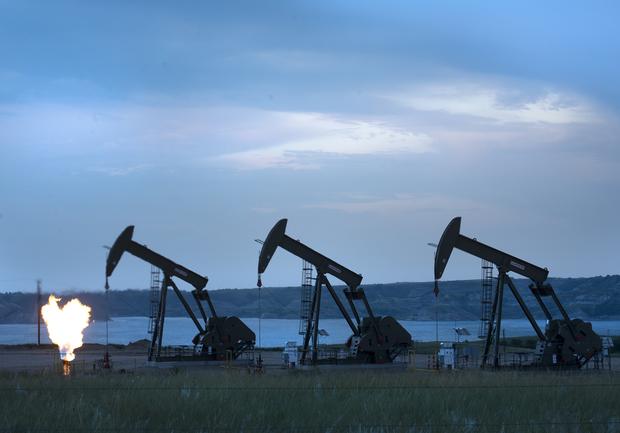
A gas flare is seen at an oil well site on July 26, 2013 outside Williston, North Dakota. (Andrew Burton/Getty)

The Human Cost of America's Energy Boom

The Takeaway  WNYC   June 15, 2015

for full report from The Center for Investigative Reporting,  see:  In North Dakota’s Bakken oil boom, there will be blood Reveal


Over the last decade, the United States has undergone an economic transformation in energy production. As President Obama told Congress in his 2014 State of the Union address, "Today America is closer to energy independence than we have been in decades."

The United States has surpassed even Saudi Arabia in oil and gas production, in part because of fracking technology, which allows energy companies to reach oil and gas deposits they could never access previously.

One of those deposits lies in the Bakken oil fields, which stretches 170 square miles from North Dakota to Montana and into Canada. An estimated 7.4 billion barrels of undiscovered oil are sitting under the U.S. portion of the Bakken, and thanks to fracking, the industry now has the technology extract that oil.

Workers have flocked to the Bakken for jobs with six-figure salaries that don't require advanced degrees. But a new investigation from Reveal, a public radio program from the Center for Investigative Reporting, finds that those high-paying jobs come with a high price.

In the first comprehensive analysis of its kind, Reveal found that, on average, a worker dies about every six weeks from an accident in the Bakken, with at least 74 deaths in the oil fields since 2006.

Jennifer Gollan, a reporter with Reveal, led the investigation. She says that the top energy firms may be championing speed over safety—something that was seen in September 2011 after a well owned by Oasis Petroleum exploded in North Dakota.

“The supervisor on this well was congratulated for working quickly and setting a new drilling record” months before the explosion, says Gollan. “She went on to call this record-holding well a 'pace-setter.'"

Oasis offered workers daily bonuses of $150 for drilling quickly—those who drill slower and safer are only offered $40 a day.

“Safety is tantamount at Oasis,” spokesman Brian Kennedy told Gollan. “Bonuses should not have been paid, and we regret that they were.”

The day before the explosion in 2011, Gollan says that a crew of four men were brought on site to get the well to produce more oil.

According to documents from the Occupational Safety and Health Administration (OSHA), a supervisor had pumped heavy salt water into the well to prevent volatile gases from escaping before the crew set to work the next day. But the well wound up erupting into a fireball.


Jebadiah “Jesse” Stanfill bared witness to the events of the day.

“They were beyond burned. Nothing but char. The smell of flesh burning. … It smelled of crude oil.” — Jebadiah Stanfill, oil worker

“He was working on an oil rig less than a mile away,” says Gollan. “He was near the top of the rig when he heard this boom. He spun around, grabbed a fire extinguisher and first aid kit, and jumped in this truck with two co-workers.”

But Stanfill and his friends were too late—two men had died and two others were injured.

“As Jesse was helping to pick up some of these men to load them into the bed of this pick up truck to bring them to the ambulance, some of the men’s skin came off in his hands,” says Gollan. “That is a feeling that, to this day, he just can’t shake.”

Gollan says that Stanfill has gear to protect himself from that horrific memory—he is usually wearing gloves, even when he’s playing with his children or cooking in the kitchen.

“How can a simple thing like looking at your hands or washing your hands send you completely enveloped back to that day,” Stanfill told Gollan. “The scenery changes. It’s as if I’m there. It rules my life.”

Brendan Wegner was one of the men who died in the well explosion.

“He was just 21. It was his first day on a rig,” says Gollan. “He was scrambling down the derrick ladder when the well exploded. It consumed him in this fiery tornado of oil and petroleum vapors. Rescuers later found his body pinned under this heap of twisted metal. His charred hands were recovered later still gripping the derrick ladder.”

Another man named Ray Hardy died the next day from his injuries. Michael Twinn had his lower legs amputated after the explosion. He committed suicide two years later.

“There was just one lone survivor who was burned over half of his body,” Gollan says of a man named Doug Hysjulien.

It appears that the victims of this explosion are the casualties of a flawed system.

“OSHA regulators will tell you that they often have to rely on a part of the law called the general duty clause,” says Gollan. “Basically, it makes it very difficult for them to hold top energy producers accountable because they typically don’t have direct employees on these well sites. As a result, in many of these cases, the top energy producers are not fined. It’s the subcontractor—typically the company that employs these workers—that get fined.”

Four of America’s largest energy-producing states—Texas, Louisiana, New Mexico and Wyoming—have adopted statutes that prevent or limit oil companies from shifting liability to smaller contractors.

Wyoming set up a task force to address worker safety back in 2008, a move that started the Wyoming Oil and Gas Industry Safety Alliance. Between 2008 and 2012, the state saw a 45 percent decrease in the number of worker deaths in the oil and gas industry.

Click on the audio player at the site to hear Jack Bedessem, the past president and advisor to the board of the Alliance, explain how Wyoming is working to improve worker safety, especially in the oil and gas industry.

Cost of Doing Business? Oil Companies Agree To Pay For Some of Lac-Megantic Damages, But Not to Solve the Real Problems

By Justin Mikulka • Sunday, June 21, 2015    DeSmogBlog

Although insisting the industry is not to blame, several of the oil companies involved in the fatal Lac-Megantic oil train accident in 2013 have agreed to contribute to a fund to compensate the families of the 47 victims in that accident.

The Wall Street Journal reported recently that oil companies Shell, ConocoPhillips, Marathon and Irving have all agreed to contribute to the fund to avoid future litigation, along with General Electric and the Canadian government. While the actual amounts contributed by most companies involved are not available, the total fund is reportedly at $345 million. That sounds like a lot of money but still is less than the $400 million retirement package for Exxon’s last CEO, for example.

Canadian Pacific Railway Ltd. hasn't agreed to the settlement, according to the Bangor Daily News, which reports that the judge in the case has delayed his decision on the settlement. Canadian Pacific has asked the court to shield it from future litigation and challenged the Quebec provincial court’s jurisdiction.
It is no surprise that oil companies would prefer to pay fines of tens of millions of dollars to avoid future litigation as well as duck responsibility for the full cost of the cleanup. Rebuilding the destroyed Lac Megantic property is expected to take as long as eight years and as much as $2.7 billion......    more here