Showing posts with label Pollution. Show all posts

Thursday, November 12, 2015

Oil Industry Turns to Pacific NW Oil Train Terminals in Wake of KXL Rejection


Oil Industry Turns to Pacific Northwest Oil Train Terminals in Wake of Keystone Rejection

New report shows controversial facilities would boost oil extraction and climate-warming pollution.

Last week, President Obama rejected the Keystone XL pipeline, a strong stand for climate protection. Yet a new report shows that the oil industry will now turn to massive oil-by-rail terminals proposed in the Pacific Northwest as a second-best alternative to Keystone. In fact, in the absence of new pipelines serving the Canadian oil sands fields, the fiercely debated Northwest rail terminals would be the sole driver of new extraction there.

That’s according to a new Sightline-commissioned analysis by independent research group Oil Change International (OCI). Taken together, the proposed Northwest oil-by-rail terminals would be the climate pollution equivalent of adding more than 28 million cars to the road.
 

Tracking Emissions

The climate impact of the proposed crude-by-rail terminals in the Pacific Northwest.


The Pacific Northwest states of Oregon and Washington are facing a quadrupling of their crude-by-rail terminal capacity to over a million barrels a day. Sightline Institute commissioned this report from Oil Change International (OCI) to examine the impact that expansion would have on climate change.

In Tracking Emissions: The Climate Impacts of the Proposed Crude-by-Rail Terminals in the Pacific Northwest, OCI deploys the oil industry’s own forecasting and modeling tools together with a detailed examination of the Northwest facilities’ configurations. Key findings in the report concern:
  • Propping up Canadian tar sands: In the absence of new pipelines, Northwest rail terminals would be the sole driver of new growth in Canadian tar sands oil.
  • Multiplying oil extraction and climate pollution: Oil train facilities in the Northwest could unlock as much as 382,000 barrels per day of new tar sands production that would otherwise not be extracted. The resulting greenhouse gas pollution from extra tar sands production could be as much as 106 million metric tons per year of carbon dioxide—the equivalent of doubling the total greenhouse gas pollution of Washington state.
  • Feeding the Bakken beast: Northwest oil train terminals could also lead to more oil drilling in the Bakken formation, as much as 114,000 barrels per day beyond what would be produced without the terminals. The resulting greenhouse gas pollution from this extra production could be as much as 30 million tons per year of carbon dioxide—the equivalent of doubling the number of cars on the road in Oregon and Washington.

 Contact:          Eric de Place, eric@sightline.org, 206-447-1880 x105


Sunday, August 30, 2015

A Smart, Green City: what it takes

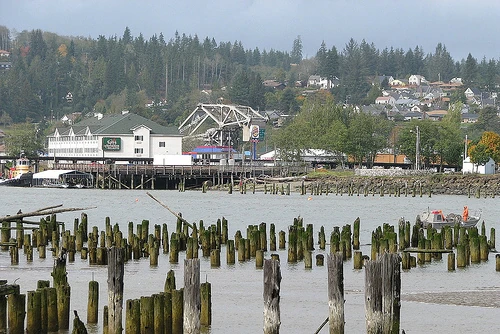
The Chehalis River mouth is in Grays Harbor, near Aberdeen.

Grant Cooke: Benicia: Not exactly a smart, green city

 
By Grant Cooke, August 28, 2015 
P1010301

THOMAS HOBBES, THE GREAT 16TH-CENTURY British political philosopher, wrote in “Leviathan” that humans living without legitimate government would eventually dissolve into a “state of nature.” This state of nature was brutish with violent chaos, evil discord and civil war. Legitimate government, Hobbes believed, had a “social contract” to wield power and authority.

Hobbes’ vision that governmental power be used for the moral good evolved into our current view that government, particularly on the local level, has a responsibility and obligation to protect and maintain the safety of its citizens. Which brings us to present-day Benicia and the return of the Valero Crude-by-Rail Project as we anticipate the Recirculated Draft Environmental Impact Report (RDEIR).

Under Hobbes’ social contract, it is the obligation of local government to maintain public safety. Anything that presents a known risk of explosion or other significant health risk is not something that city government should tolerate. To willingly allow a project that presents a public danger to move forward is ridiculous. And to argue that the Crude-by-Rail Project (CBR) is safe is equally ridiculous. A quick Internet search reveals numerous examples of trains carrying Bakken crude derailing or exploding.

The fossil fuel industry has a clear record of putting profits above safety. We have ample local examples, from the Chevron fire in Richmond to the San Bruno natural gas explosion. With tens of thousands of oil cars carrying volatile crude into the Bay Area, one or more explosions is all but guaranteed to occur. We all know it’s just a role of the dice whether the explosion happens in Benicia or another town along the line.

The conversation will probably build with the release Monday of the RDEIR. No doubt, the discussion will be as heated as ever. Regardless, let’s put some broad strokes on the situation, as there are several factors to consider:
  • Firstly, the CBR is an effort by Valero to increase its business and, therefore, its profits. Unfortunately, for that to happen the city must risk its residents’ health and well-being. This is not in your interest.
  • Valero, an oil company, benefits from the CBR; the city doesn’t. The idea that Valero, or any for-profit fossil fuel company, is a “Good Neighbor” to Benicia is silly and naïve.
  • Benicia’s future, and the city’s future tax base, can no longer be dependent on heavy-carbon industries. The current tax revenue from the refinery is not sustainable, or even desirable.
  • The decline in costs for renewable energy will create an energy price deflation that will make oil non-competitive. Ali Al-Naimi, Saudis Arabia’s oil minister, told a climate conference in Paris in June that the world’s largest crude exporter will eventually sell solar power instead of crude. He also renewed the kingdom’s commitment to current levels of production, putting more pressure on U.S. oil producers and refiners.
  • Besides the global switch to renewable energy, our local refineries will be under growing pressure from regional air quality regulators to clean up their emissions. And as the international effort to make large emitters pay for their carbon releases grows, carbon taxes or offsets will cut into refinery profits.
  • Within a decade or so, Valero and most Bay Area refineries will be shuttered. We need to begin discussions with Valero about what happens when they shut down. How will the refinery pay for the site cleanup and residual hazardous waste?
  • Even as the tax stream from Valero declines, Benicia, like most California cities, is also facing exponentially rising retiree benefit costs. The revenue decline cannot be made up with increased resident taxes (as the base gets older, it is harder to raise taxes) — so Benicia will be forced to cut services.
  • Also likely: Benicia’s municipal services and government will merge with Vallejo’s or go to a regional model. The era of small, local government is ending for numerous reasons. Small city governments can’t achieve the cost efficiencies or employee productivity needed to keep pace with rising costs and retiree benefit obligations. Large organizations can make better use of technology and smart systems to improve productivity and increase efficiency.
  • Small city governments don’t have the resources needed to deal with the future’s looming problems. Valero’s CBR clearly shows how ineffective small cities like Benicia are in dealing with problems that overlap. The same is true as small cities are forced to confront the future’s critical problems of mitigating climate change, wealth inequality (poverty, homelessness, gang violence and terrorism), and restraining agglomeration and urban sprawl. For example, Benicia city government’s ongoing struggles to convert to a new information technology package. Or the City Council’s inability to address even simple environmental issues like eliminating the use of plastic bags, promoting renewable energy or endorsing a pro-environmental or sustainability position. If a city government can’t agree that reducing the number of plastic bags clogging up our landfills is a good thing, how can it promote community respect for the environment — or more complicated values like decency, tolerance or a respect for others?
* * *
FOR MANY REASONS, BENICIA IS AT A CROSSROADS, and its future is worrisome. As a city, we need to come to grips with the reality that the fossil fuel/carbon era is ending, and we have to turn to a pro-environmental, knowledge-based and sustainable economy.

For the past several months, I’ve been researching the world’s smart and green cities. Despite the heroic efforts of Benicia’s Community Sustainability Commission, I’m sad to say that my lovely hometown is neither.

I was reminded of this the other evening at a friend’s house that overlooked our bay. The view was beautiful, with the silvery-gray straits glowing in the declining sunlight. But when I looked closer, I saw trash along the waterline, and the water showed traces of oil and pollution in the shallows.

It was so much different than Copenhagen’s harbor. Did you know that the citizens of Copenhagen had the wherewithal a few years ago to clean centuries of pollution and trash out of their harbor? And that every summer, four major swimming areas along that city’s waterfront attract thousands of Danes and other Europeans to bask in the northern sun and swim in the harbor’s clean waters?

Can you imagine going for a swim in Benicia’s harbor?

Copenhagen’s clean harbor points to the sharp contrast in attitudes about the environment held by Europeans and Americans. After decades of neglect, Europe has come around and now takes pride in cleaning up its environment. Most European nations, reflecting the will of their citizens, are mindful of waste and diligently work to reduce carbon emissions. Hamburg, for example, is deeply worried that global warming will raise sea levels and create havoc with their harbor and lowlands. The city has carved out several green zones, added trees to absorb carbon and reduced auto traffic. In Scotland, over 40 percent of the country’s domestic energy use is supplied by renewable energy. Germany is striving for 100-percent renewable energy by mid-century.

But Benicia — a city that sits on the water — doesn’t seem to give a flip about potential flooding from warming seas, or the steady degradation of its remarkably beautiful environment. The lack of concern underscores the general sense shared by far too many Americans — particularly those involved in the carbon industries — who view our environment and atmosphere as one large garbage can.
 
Grant Cooke is a long-time Benicia resident and owner of Sustainable Energy Associates. He is also co-author of “The Green Industrial Revolution: Energy, Engineering and Economics.” His new book, “Smart Green Cities” will be published in 2016.


Friday, August 14, 2015

The Thin Green Line Is Stopping Coal and Oil in Their Tracks

The Thin Green Line Is Stopping Coal and Oil in Their Tracks

Northwest communities have won key battles. Can they win the war?

This post is part of the research project: Northwest Coal & Oil Exports

“Everybody outside the Northwest thinks that’s where energy projects go to die.”Tweet this

“Everybody outside the Northwest thinks that’s where energy projects go to die.” That’s the reputation our region has earned as an increasing number of proposed coal and oil export projects have encountered ferocious opposition. It’s what the backer of a proposed oil refinery in Longview, Washington, told reporters earlier this year after his company’s stealth proposal was outed by environmental groups.

The Cascadia region has proven to be extraordinarily challenging for those who would turn it into a major carbon energy export hub—so much so that Sightline has taken to calling it the Thin Green Line.

Since 2012, a staggering number of schemes have proposed to move large volumes of carbon-intense fuels through Oregon, Washington, and British Columbia to Asian markets. A recent Sightline analysis shows that proposed and newly permitted energy projects in the region would amount to the carbon equivalent of more than five Keystone XL Pipelines.

But in big ways and small—from Coos Bay, Oregon, to Prince Rupert, British Columbia—the Thin Green Line has held fast. Big energy projects have faced delays, uncertainty, mounting costs…and then failure. A review of these projects makes clear just how successful the region has been in denying permission to dirty energy companies as it stays true to its heritage as a center of clean energy, sustainability, and forward thinking.

continued below...   

Thursday, August 6, 2015

Oil Industry's devastating alternative to the Clean Power Plan


Nick Abraham editor Oil Check Northwest 
 
August 6th - Earlier this week, President Obama announced its long awaited Clean Power Plan, and the new rules were met with plenty of fanfare from all of us that want clean air to breathe and a healthy climate to live in.

Unsurprisingly, oil and coal companies were not as pleased. They’ve organized an army of front groups, pseudo-think tanks and bought off organizations to attack and cripple the plan.

Locally, “astro-turf” groups like Oregonians for Sound Fuel Policy and the Washington Climate Collaborative are not just attacking action like the Clean Power Plan. They have a widespread agenda to prevent new environmental protections and undercut the Northwest’s progress.

They’ve laid out an alternative to a clean energy future, a Dirty Power Plan, for the Northwest. You won’t see them announcing it from podiums or siting down with Katie Couric to talk it over. But make no mistake the fossil fuel industry has a plan for our corner of the world.

1. Sinking Clean Fuels

No surprise here. With a virtual monopoly on what we can fuel up with, oil companies are fighting desperately to prevent either state from enacting a clean fuels program. Despite putting $2 million into Oregon campaigns in 2014 clean fuels prevailed in a landmark victory this past session in Oregon. The legislature mandated that 10% of fuels in the state must come from renewable sources. Not one’s to bow out gracefully,oil companies have put forth 3 different ballot measures for 2016 that would repeal or weaken clean fuels.

In Washington, legislators who received millions from oil companies, almost completely derailed compromise on a new transportation package by trying to preemptively block clean fuels. Senate leaders added a poison pill to the transportation package that said if Governor Inslee implemented clean fuels through executive order all alternative transportation funding would move to road construction. In an effort to keep our state moving (literally), the Governor begrudgingly accepted the deal. Chalk one up for the oil companies.

2. Pipelines Trains and Terminals

The Northwest stands directly between Asian markets and major fossil fuel deposits in Canada and the interior Western US. The fastest, cheapest route to getting their coal, oil and natural gas to export is through our backyard, and that’s exactly what their Dirty Power Plan would propose.
Here’s what that would look like:

- Coal terminals North of Bellingham and Longview WA with over 90 million metric tons of coal total

- Expanded Bakken crude oil refining in Ferndale, Anacortes, Tacoma, Hoquiam, and Vancouver WA as well as Clatskanie OR could move over 1 million barrels/day through our region. That’s 14 oil trains a day

- Natural gas: 140 miles of new pipeline from Sumas WA to Warrenton OR cutting through major population centers along the I-5 corridor as well as a 230 mile line from Malin to Coos Bay OR

no-bomb-trains.jpg

3. Keeping Pollution Free

This year, both Oregon and Washington had bills in the legislature to put a price on pollution. In Oregon bill 3470 would have given the state the authority to regulate pollutants much the same way as California currently does, through a carbon cap and trade system. A second bill (3250), would have charged polluters a fee and given that money back to each Oregonian with a dividend check, very similar to Alaska's program that charges oil companies a royalty and gives checks to every resident. (If you've ever had a friend from Alaska they cannot shut up about their "free" check every year)

Unfortunately both bills didn’t make it out of session, as a transportation fight took out all the air in the legislature. Much in the same was as Washington; a provision was added to the transportation package that would cut clean fuels in exchange for a deal. Only this time oil companies were caught red handed writing the bill themselves. After a drawn out battle, the package was killed and clean fuels lived on to fight an other day.

In Washington Governor Inslee laid out a proposal to cut emissions from the state’s largest industrial polluters, a plan that would have given the billions raised to badly need transportation improvements and education funding that’s still in a $3.5 billion hole. This bill, similar to Oregon, was killed after a barrage of attacks from oil-backed legislators.

Not to be out maneuvered, in late July, Governor Inslee announced that the state would be regulating emissions through the Department of Ecology’s mandate. As impressive as this plan is, it still needs backup to be completely effective. To truly have a strong impact, the law will need a way to enforce the regulations. Many predict that a price on pollution will be put on the ballot in 2016 and this would give the Governor’s proposal some much needed teeth.

This week’s Clean Power Plan announcement was a powerful step forward; we couldn’t be happier to see a tough but achievable strategy to cut emissions. But lets not forget that fossil fuel companies have a plan of their own. And the Dirty Power Plan does not paint a bright future for the Northwest.

Nick Abraham editor Oil Check Northwest
nick@oilchecknw.com 


Saturday, July 11, 2015

Billions Needed to Restore Wetlands Polluted by Oil Industry in NJ

Bayway Refinery
An aerial photograph shows the Bayway oil refinery complex in Linden, New Jersey.

Exxon New Jersey Settlement Under Fire Again As Environmentalists Seek To Join Lawsuit


By    International Business Times    July 10, 2015

New Jersey Gov. Chris Christie’s administration wants Exxon Mobil Corp. to fork over $225 million for a pair of oil refineries that dumped toxic chemicals into New Jersey's soil and water for decades. But the sum is a drop in the bucket compared with the billions of dollars needed to remove pollution and restore nearby wetlands, environmental groups say.

The organizations this week are seeking to intervene in the case between the U.S. oil giant and the state of New Jersey. The Natural Resources Defense Council, which is leading the effort, will ask a state judge Friday to make the organization a party to the litigation. The move would allow NRDC to argue in court for a higher settlement.,,,,

.... At the center of the saga are two massive oil refinery sites: the Bayway refinery in Linden, and another in the town of Bayonne. The facilities, both more than a century old, leaked millions of gallons of oil and 600 different contaminants into the soil during the time Exxon owned the plants, a state judge determined. The pollution covers or is buried under about 1,800 acres of wetlands, forests, meadows and waterways.

Nearly 1 million New Jersey residents live near the refineries in mostly blue-collar neighborhoods. The area used to be a popular spot for fishing, hunting and kayaking, but much of the land and water near the plants is now unusable. Plastic booms still float at the mouths of some creeks to capture the oil and chemicals that continue seeping into the water.....   more here


Canadian gov’t adds new charges against unionist in 2013 rail disaster


BY JOHN STEELE   The Militant  July 20, 2015


MONTREAL — Almost two years after the Lac-Mégantic, Quebec, rail disaster, which killed 47 people and destroyed the downtown core of the community of 5,000, the federal government agency Transport Canada has filed criminal charges against locomotive engineer Tom Harding for allegedly violating the Railway Safety Act and the Fisheries Act. Charges were also filed against five officials of the now-bankrupt Montreal, Maine and Atlantic Railway, including CEO Robert Grindrod, as well as against the company itself. 


The July 6, 2013, train derailment and explosion put a spotlight on how the rail bosses put profits ahead of safety, especially the company’s insistence on operating with a one-person “crew,” with government agreement.

Harding is already due in court Sept. 8 to set the date for his trial on frame-up charges of 47 counts of criminal negligence causing death levied by Quebec’s crown prosecutor. Those charges could result in life imprisonment. The new charges could bring a $50,000 fine and six months in prison.

Harding is a member of the United Steelworkers union. Train controller and USW member Richard Labrie faces the same charges in Quebec, as does manager of train operations Jean Demaitre. The USW in Quebec has been raising funds to defend the two union members.

Transport Canada says the accused failed to ensure that the train’s hand brakes were properly set. The hand brakes were one of 18 factors that the report of the federal Transportation Safety Board said contributed to the disaster. Others included a “weak safety culture” on the railroad.

The company’s former owner, Edward Burkhardt, has not been charged.

The fact the federal government as a cost-cutting measure allowed the rail company to operate the 72-car crude oil train without a two-person crew was considered but not included as a “factor” in the final published report.

As he had done for years, in keeping with company regulations, Harding parked the train on a grade about seven miles from Lac-Mégantic with the engine running and the air brakes on. He set hand brakes on seven tanker cars and took a cab to a hotel to sleep.

During the night firemen were called to put out a small fire on the lead locomotive. When Harding asked his dispatcher if he should come because of the fire, he was told to go back to sleep because everything was OK. However, when the firemen shut down the engine they unknowingly turned off the air brake system. With no one on board, the train rolled down the grade, picking up speed, and derailed and exploded in downtown Lac-Mégantic.

In addition to the horrendous loss of life and destruction of 40 buildings, the explosion and fire released 1.5 million gallons of crude oil into the lake and contaminated 560,000 tons of soil. The charges under the Fisheries Act stem from the oil spill.

The explosion woke Harding, who rushed to the site, risking his life to help depressurize brakes on some of the cars that had not caught fire so they could be moved. For this reason, many in Lac-Mégantic consider him a hero.

Harding’s lawyer, Thomas Walsh, questioned the timing of the new charges against the engineer, criticizing the federal government for trying to look proactive after years of allowing unsafe railway practices like understaffing. “Now they’re coming out as if they’re taking care of business … by two years later accusing him [Harding] of something he’s already been accused of,” Walsh told the Globe and Mail. “What the hell is the point?”

“I agree there should be justice,” businessman Raymond Lafontaine, who lost his son, two stepdaughters and an employee in the disaster, told the press. But “it feels like we’re still looking for people to blame.” There are people higher up in the company that need to be held accountable, he said. 

Meanwhile, Canadian Pacific Railway, which hauled the oil from North Dakota to Montreal before handing it over to Montreal, Maine and Atlantic Railway, is refusing to contribute to a $430 million settlement fund for victims’ families. The Calgary-based company argued in a Quebec court recently that it wasn’t involved. If Canadian Pacific is successful, compensation could be delayed for years.

The Steelworkers and fellow rail workers in Canada and the U.S. are raising defense funds for Harding and Labrie. To contribute in Canada, send checks to Syndicat des Métallos, 565 boulevard Crémazie Est, bureau 5100, Montreal, Quebec H2M 2V8, or go online to www.justice4USWrailworkers.org.

In the United States, checks can be sent to Tom Harding Defense Fund, First Niagara Bank, 25 McClellan Dr., Nassau, NY 12123 or visit www.tomhardingdefensefund.com.

Tuesday, April 28, 2015

Big Oil to Flood West Coast with Tar Sands


Anthony Swift  NRDC   4/28/15


The West Coast could soon become a destination for huge volumes of tar sands crude oil - one of the world's dirtiest fuels - setting back efforts to combat climate change and exposing communities to significant new health and environmental risks. NRDC and a coalition of twenty-nine partners organization released a report - West Coast Tar Sands Invasion - that examines the spike in oil infrastructure, climate pollution, and public health risks that will result from oil industry proposals to expand tar sands refining and export capacity on the West Coast.

As the report details, in coming decades the amount of tar sands crude moving into and through the North American West Coast could increase by more than 1.7 million barrels per day (bpd) in coming decades if industry proposals for pipelines, tankers and rail facilities move forward. According to analysis by Borealis Centre Environment and Trade Research, nearly half of that tar sands - or 800,000 bpd - could be destined for refineries capable of processing heavy crude in California and Washington. This proposed tar sands invasion is a part of a massive expansion plan by the oil industry to triple production in Alberta, which will require the industry to access the United States' Gulf Coast, West Coast, and East Coast refinery markets (an invasion that Keystone XL continues to be a critical part). The tar sands invasion has major ramifications for the entire West Coast. It requires a strong response from decision makers who must recognize the critical links between proposed tar sands infrastructure and strong climate policies, reduced oil consumption and expanding clean transportation solutions.

The report finds that tar sands industry proposals would result in the following:
  • A greater than tenfold increase the amount of tar sands moving into and through the North American west coast by more than 1.7 million bpd
  • Increase the region's carbon pollution by up to 26 million metric tons - the equivalent of adding 5.5 million cars to the road
  • Create 1,500 miles of new pipelines in British Columbia
  • Increase Canadian crude by rail from approximately 10,000 bpd to up to 400,000 bpd
  • Increase tanker and barge traffic twenty-five fold, from 80 to over 2,000 vessels along the Pacific west coast, on the Salish Sea, and down the Columbia River
  • Increase tar sands at West Coast refineries by eight-fold, from 100,000 bpd to 800,000 bpd by 2040
  • Create a dozen new rail terminals that would significantly increase the region's crude-by-rail traffic
  • Place hundreds of communities, critical waterways and other environmentally-sensitive areas at risk of a tar sands oil spill
  • Put fenceline communities and millions of West Coast residents at greater risk than ever to increased toxic air pollution, derailments, explosions and other accidents that harm public health along with air and water quality
If it proceeds, this invasion will put public safety at risk and harm water resources, air quality, and the climate. A tar sands spill from train, pipeline, or tanker could devastate local economies, pristine wilderness, harm human health, and lead to an especially costly and challenging cleanup..... more here

Rail lines that cater to ag escape oil train tax

Don Jenkins    Capital Press    4/27/15

Oil train bill won't increase taxes on railroad companies that haul farm products.


OLYMPIA — In the nick of time, regional railroads, many of which primarily haul agricultural products, escaped a tax increase.

Shortly before adjourning Friday, the Washington House and Senate agreed on a bill to address an influx of rail cars hauling potentially explosive crude oil from Bakken fields to West Coast refineries.
BNSF Railway and Union Pacific Railroad will pay higher taxes to beef up rail inspections, but short-line railroads that don’t carry crude will be exempted.

“It was a really significant victory for short-line railroads,” said lobbyist Patrick Boss, who represented a coalition of regional rail companies. “That bill was about oil trains. I think the Legislature did the right thing.”

Short-line railroads were included in House Bill 1449 until it was amended just before the Senate approved it 46-0. The House agreed with that and other changes and passed the measure 95-1 a short time later. The bill is ready to be signed by Gov. Jay Inslee, who praised it in a press release.

Passing the bill was the Legislature’s last major action before ending the 2015 regular session. Lawmakers will convene in a special session Wednesday to negotiate 2015-17 operating, capital and transportation budgets.....   more here

In compromise, Washington state oil safety legislation focuses on crude-by-rail

By Samantha Wohlfeil    The Bellingham Herald   April 27, 2015

Derailed oil train’s crew told investigators they had seconds to escape

By Curtis Tate  McClatchy  April 27, 2015  The Tribune

The engineer and conductor on a BNSF oil train that derailed in North Dakota in December 2013 had seconds to escape their locomotive before it was engulfed by fire, according to interview transcripts made available Monday by federal accident investigators.

The interviews, conducted in January 2014 by the National Transportation Safety Board, show the occupational risks railroad workers face, especially with trains carrying hazardous materials. The train’s engineer is suing BNSF, and says the wreck left him with post-traumatic stress disorder.

They also show that emergency responders did not initially understand the severity of the situation they faced when two trains derailed near Casselton, N.D., on Dec. 30, 2013. One of them was carrying grain, and the other, crude oil from North Dakota’s Bakken region.....  more here

Read more here: http://www.sanluisobispo.com/2015/04/27/3606607_derailed-oil-trains-crew-told.html?rh=1#storylink=cpy


Read more here: http://www.sanluisobispo.com/2015/04/27/3606607_derailed-oil-trains-crew-told.html?rh=1#storylink=cpy


Read more here: http://www.bellinghamherald.com/2015/04/27/4263941_in-compromise-washington-state.html?rh=1#storylink=cpy