Showing posts with label sHELLno. Show all posts

Friday, August 21, 2015

Big Oil, Coal Target NW Communities and Planet

Speak up about Shell's new rail loop proposal to accept 

more oil trains.


Shell Oil has big plans to bring more explosive oil trains to Washington — and if we don’t act quickly, we will not get a say in the matter. 

Shell is proposing to build a new rail loop at its refinery in Anacortes, just a hundred feet from the shore of Puget Sound. If Shell succeeds, six more trains per week would be added carrying dangerous, explosive crude oil through the Pacific Northwest. Each of these trains has 100 tank cars!
Right now, the Department of Ecology and the Skagit County commissioners are deciding how much time to give the public to weigh in on Shell’s proposal. Tell them to give us the longest public comment period possible to weigh in on this proposal that risks our safety, our environment, and our way of life.
Shell has been fighting to avoid any additional public scrutiny of this project from the beginning. Now, it’s doing everything it can to make to make the public comment period for this project short and sweet when the impact is anything but. The public deserves time to weigh in on Shell’s proposal to bring more volatile crude through Washington communities - plain and simple.
Once the comment period for Shell’s proposal is set, you’ll be hearing from us again with next steps and updates.


In this April 4, 2013 file photo, a truck carrying 250 tons of coal hauls the fuel to the surface of the Cloud Peak Energy's Spring Creek mine near Decker, Mont. AP

Crow Tribe Inks Partnership to Develop Washington State Coal Port

via Indian Country Today

The Crow Tribe of Montana has inked a partnership with Cloud Peak Energy and SSA Marine for a five percent share of Gateway Pacific Terminal, the coal export terminal proposed in northernwestern Washington State near the Canadian border. 

The tribe's buy-in cost will be decided if and when the U.S. Army Corps of Engineers grants approval to the export project, reported billingsgazette.com.
The Crow Tribal Legislature additionally needs to sign off on the agreement made by Crow Tribal Chairman Darren Old Coyote when its members convene in October.
Proponents estimate the terminal could open in five years and ship roughly 48 million metric tons of coal annually to international markets, reported bellinghamherald.com.


Big Oil Knew. Big Oil Lied. And Planet Earth Got Fried.

Published on
by
They knew. They lied. And the planet and its people are now paying the ultimate price.

It's no secret that the fossil fuel industry—the set of companies and corporate interests which profit most from the burning of coal, oil, and gas—have been the largest purveyors and funders of climate change denialism in the world.

Now, a new set of documents and a report released by the Union of Concerned Scientists (UCS) answers the age-old question always asked when it comes to crimes of corruption, cover-up, and moral defiance: What did they know and when did they know it?

As it turns out, "The Climate Deception Dossiers" shows that leading oil giants such as ExxonMobil, BP, and Shell—just like tobacco companies who buried and denied the threat of cancer for smokers—knew about the dangers of global warming and the role of carbon and other greenhouse gas emissions long before the public received warning from the broader scientific community. And what's worse, of course, is not only that they knew—but how they have spent the last nearly thirty years actively denying the damage they were causing to the planet and its inhabitants.
Friday, May 29, 2015

Federal agency dings Shell for 2012 oil rig mishap in Arctic


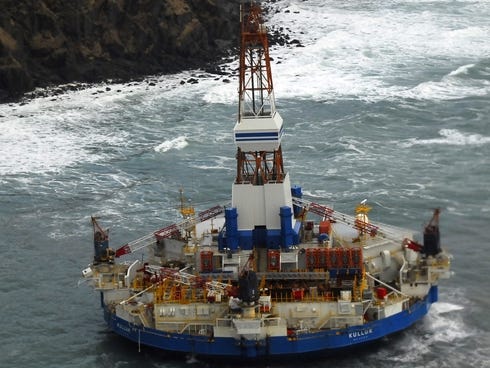
The conical drilling unit Kulluk sits grounded 40 miles southwest of Kodiak City

Federal agency dings Shell for oil rig mishap in Arctic


By DAN JOLING   Fire Engineering    05/28/15

ANCHORAGE, Alaska (AP) — As Royal Dutch Shell PLC seeks permits for exploratory oil drilling off Alaska's northwest coast, a federal agency has concluded the company underestimated risk the last time it moved drill rigs to Arctic waters.

A National Transportation Safety Board report issued Thursday said the probable cause of the grounding of the company's mobile drilling vessel, the Kulluk, in 2012 was "Shell's inadequate assessment of the risk for its planned tow" across the Gulf of Alaska.

Shell spokesman Curtis Smith said by email the company is reviewing the report but has already made changes and "engaged extensively with the regulators on that topic."

A revised operations plan provides more oversight of contractors and better access for contractor employees to tell Shell how to improve operations, he said.

The company also took the recommendation of the Interior Department and used a third-party auditor to review its 2015 operation plan, Smith said. An audit of operations in real time also is planned.

In 2013, NTSB representatives sat in on weeks of inquiry led by the Coast Guard, which concluded last year that poor risk assessment and management were among factors that led to the grounding of the rig.

Shell officials have regularly pointed out that the company's 2012 problems were tied to transportation issues, not drilling. The company hopes to resume exploratory offshore drilling this year in the Chukchi Sea.
The Interior Department is in the process of deciding whether to grant the necessary drilling permits to Shell. Smith says there is no correlation between the grounding of the Kulluk and the remaining permits needed by Shell for that drilling.

Arctic offshore drilling is strongly opposed by environmental groups in the region threatened my climate change. Critics say oil companies can't clean up major spills, especially in cold, dark, remote Arctic waters far from shore-based infrastructure common in offshore drilling areas such as the Gulf of Mexico.

Petroleum companies want to tap reserves estimated by the U.S. Geological Survey at 26 billion barrels of recoverable oil.

Shell in 2012 used the Kulluk to drill in the Beaufort Sea and the Noble Discoverer to drill in the Chukchi.

At the conclusion of the open water season, Shell towed the Kulluk, a conical barge 266 feet in diameter, to Dutch Harbor in the Aleutian Islands.

The Kulluk, behind the 360-foot Aiviq, on Dec. 21, 2012, departed Dutch Harbor for a Seattle shipyard. The tow plan called for staying within 200 miles of the coast, allowing for easier search and rescue, despite the potential for rougher water.

On Dec. 27, as sea swells reached 25 feet, the tow line broke. Within five hours, mechanical problems shut down the Aiviq's four engines.

Five days of attempting to corral the Kulluk with the repaired Aiviq, a Coast Guard cutter and hired tugs proved unsuccessful. The drill rig ran aground Dec. 31, 2012, off Sitkalidak Island near Kodiak. .....  more here 

Alberta Fire Threat Grows as It Moves Near Oil Sites


Smoke rises from a wildfire east of Slave Lake, Alberta May 25

Alberta Fire Threat Grows as It Moves Near Oil Sites


A Song of Oil, Ice and Fire

Shell could be drilling in the Arctic in less than 5 weeks. It’s a choice between our natural world and an oil slick. Which will you choose? 

Watch and share this video to expose Shell’s risky Arctic drilling plans.