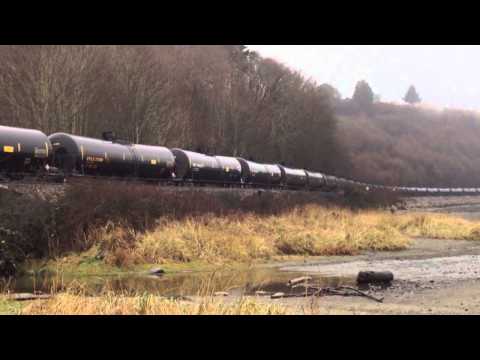
Kathleen Sloan | The Hawk Eye, Burlington, Iowa May 11, 2015 Bakken.com
BNSF Railway carried the Hess Corp.-owned rail car, which carried
highly volatile Bakken crude oil from North Dakota and appears to have
followed the law.
President Barack Obama weighed and rejected using executive authority
to curb the transport of this explosive crude oil, rich in butane and
propane, because he decided North Dakota state law should be the
controlling authority. But the law North Dakota passed in December and
went into effect just last month, only requires less than 13.7
pounds-per-square-inch vapor pressure inside the tanker, despite
explosions at lower pressures.
That’s almost 40 percent more than the average vapor pressure among
the 63 tanker cars that exploded July 6, 2013, at Lac-Megantic, Quebec.
That disaster killed 47 people, some of whom could not be found because
they were vaporized, and is driving recent federal and state rail car
regulations.
According to an Albany, N.Y., Times Union investigation, the average
vapor pressure among 72 tanker cars in the Lac-Megantic train was 10
psi.....
....
Experts in various news articles and public comment submitted during
the federal rule-making stated the way to make transport safe is to
refine the crude before shipping. That would involve building refineries
near the extraction point, which experts pointed out would be
expensive.
In a Sept. 26, 2014, story, Railway Age contributing editor David
Thomas applauded North Dakota for “using state jurisdiction over natural
resources to fill the vacuum created by the federal government’s
abdication of its constitutional responsibility for rail safety and
hazardous materials.”
But Thomas admitted the state law on crude treatment would reduce the danger only slightly.
“Simply put, North Dakotan crude will have to be lightly
pressure-cooked to boil off a fraction of the volatile ‘light ends’
before shipment,” Thomas said. “This conditioning lowers the ignition
temperature of crude oil — but not by much. It leaves in solution most
of the culprit gases, including butane and propane. Even the industry
itself says conditioning would not make Bakken crude meaningfully safer
for transportation, though it would make the state’s crude more
consistent from one well to another.”
“The only solution for safety is stabilization, which evaporates and
re-liquifies nearly all of the petroleum gases for separate delivery to
refiners,” Thomas said.
He points out owners and shippers in the Eagle Fork formation in
Texas, voluntarily stabilize their crude before shipping. It’s more
volatile than Bakken crude.....
more here
Kate Sheppard HuffPost 05/05/15
WASHINGTON -- The largest union representing firefighters in North America said Tuesday that a new Department of Transportation
rule for transporting oil by rail does not go far enough to enable firefighters to respond effectively in the case of an accident.
Released
on Friday, the new rule from the Department of Transportation's
Pipeline and Hazardous Materials Safety Administration and the Federal
Railroad Administration covers trains carrying oil and other highly
flammable liquids. It includes new standards for how tank cars used to
transport those liquids must be constructed, and it changes requirements
for routing and speed. The DOT's
description of the new rule
also notes that it requires railroads to provide state, local and
tribal governments with "a railroad point of contact for information
related to the routing of hazardous materials through their
jurisdictions."
It's that information-sharing part of the rule
that has the union concerned. Its general president, Harold
Schaitberger, wrote in an email that because time is so critical when
responding to accidents, emergency personnel need information about what
a train is carrying up front, instead of just having a point of contact
to find out later.
“Fire fighters depend on all available information to launch an
effective response to emergencies like oil explosions. They need to know
what trains are carrying and when," Schaitberger said. "These new rules
fall short of requiring rail operators to provide the information fire
departments need to respond effectively when the call arrives." .....
.....The DOT's
rule indicated
that such disclosure might have "negative security and business
implications." But Schaitberger said the lack of transparency could be
deadly.
“
Trains carrying combustible crude oil continue to move
regularly through populated communities and pose a serious and immediate
safety threat," said Schaitberger.....
more here