Showing posts with label Forest Ethics. Show all posts

Tuesday, September 8, 2015

Buffett Bluffs Feds- Threatens Shut-down


Regulators blink in standoff with Buffett over shipping oil by rail

Reuters    September 8, 2015

NTSB may let Buffett’s trains keep shipping oil after Jan. 1 deadline for installing better safety controls.


U.S. railroads may not be obligated under federal law to carry freight including crude oil and hazardous materials from Jan. 1 if they fail to meet a year-end deadline for implementing new train safety technology, according to a top federal regulator.

In a Sept. 3 letter to the Senate Commerce Committee, U.S. Surface Transportation Board Chairman Daniel Elliott says the common carrier obligation requiring freight railroads to honor reasonable requests for service from shippers “is not absolute, and railroads can suspend service for various reasons, including safety.”....

.....The approaching deadline has prompted at least one major railroad company to look seriously at suspending service: BNSF Railway Co, the No. 2 freight railroad operator and the leading carrier in the $2.8 billion U.S. crude-by-rail market, which is part of billionaire investor Warren Buffett’s Berkshire Hathaway Inc .

“BNSF confirmed that it will not meet the deadline and offered the possibility that neither passenger nor freight traffic would operate on BNSF lines,” Elliott said in the letter, which was addressed to the committee’s Republican chairman, Senator John Thune of South Dakota.

In a July 24 letter provided to Reuters by BNSF, railroad president and chief executive Carl Ice informed Elliott that BNSF is analyzing the possibility of a service shutdown and actively consulting with customers.....

.....Railroad officials in June raised the possibility of shutting down service as a way to avoid potential legal liabilities and fines for operating outside the law.....    

Railroad officials have complained about the cost and complexity of adopting PTC and have produced freight and commuter rail estimates showing full implementation could cost the industry nearly $13 billion.

A six-year transportation bill approved by the Senate last month would allow the Obama administration to extend the deadline for up to three years....  more here


Oil train risks affect many U.S. schools, group says

Reuters   Sept. 8, 2015

Thousands of U.S. schools sit along rail corridors used to carry toxic substances such as crude oil and would be at risk in the event of a derailment, an environmental group said on Tuesday as it called for a temporary halt on oil trains.

ForestEthics said its analysis of U.S. Department of Education data show nearly 15,000 schools with 5.7 million students sit inside the so-called 'blast zone', the one-mile area along railroad tracks the U.S. Department of Transportation (DoT) recommends be evacuated in case of crashes.....    more here


Update: better article here

Learning 'Inside the Blast Zone': Oil Trains Put Millions of Children at Risk

"Railroad disasters shouldn’t be one of the 'three Rs' on the minds of school kids and their parents."   - CommonDreams


Friday, May 15, 2015

Three Oil Projects Cost Taxpayers Almost $2 Billion in Subsidies; Oil Train Safety Rules Challenged

Three Oil Company Projects Cost Taxpayers Almost $2 Billion in Subsidies

It’s no secret that the fossil fuel industry and the government are horribly intertwined, but a recent investigation by The Guardian reveals just how codependent their relationship really is and just now much it’s costing American taxpayers.

The Guardian examined three specific projects — one each run by Shell, ExxonMobil, and Marathon Petroleum — and found that all three corporations benefited from huge tax subsidies granted, of course, “by politicians who received significant campaign contributions from the fossil fuel industry.

Specifically, the investigation found that:
  • A proposed Shell petrochemical refinery in Pennsylvania is in line for $1.6 billion in-state subsidy, according to a deal struck in 2012 when the company made an annual profit of $26.8 billion.
  • ExxonMobil’s upgrades to its Baton Rouge refinery in Louisiana are benefiting from $119 million of state subsidy, with the support starting in 2011, when the company made a $41 billion profit.
  • A jobs subsidy scheme worth $78 million to Marathon Petroleum in Ohio began in 2011, when the company made $2.4 billion in profit.
Overall, these three projects cost taxpayers nearly $2 billion. There is no reason the government should be giving these hugely successful corporations such huge tax breaks, especially when considering the amount of environmental damage oil production and consumption causes.

“Subsidies to fossil fuel companies are completely inappropriate in this day and age,” Oil Change International’s executive director Stephen Kretzmann. “Climate science is clear that the vast majority of existing reserves will have to stay in the ground, yet our government spends many tens of billions of our tax dollars – every year – making it more profitable for the fossil fuel industry to produce even more.”

Unfortunately for Kretzmann — and the Earth, the politicians doling out these gigantic tax subsidies deny climate change is real and man-made, or at least they publicly say they are. Admitting that it’s real and problem would definitely have an effect on campaign contributions from the fossil fuel industry.

“Big oil, gas, and coal have huge influence on politicians and governments and they get that influence the old fashioned way — they buy it,” said Kretzmann. “Through campaign finance, lobbying, advertising, and super [political action committee] spending, the industry has many ways to influence candidates and government officials seeking re-election.”

“Every single well, pipeline, refinery, coal and gas plant in the country is heavily subsidized. Big Fossil’s lobbyists have done their jobs well for the last century.”

Click here to read The Guardian’s full investigation.

U.S. green groups sue in challenge to oil train safety rules


Sunday, January 25, 2015

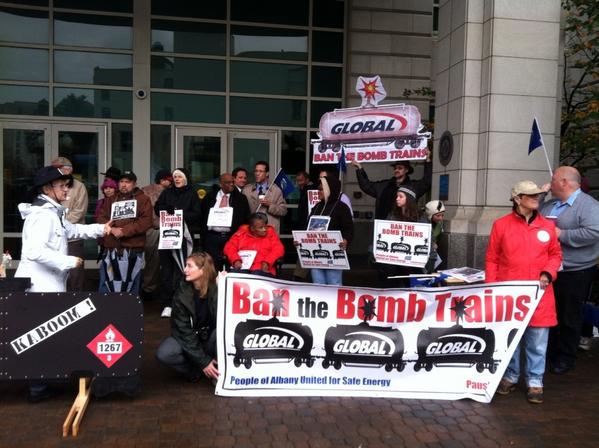
Court: 'Bomb Trains' Can Continue to Roll Through Neighborhoods

View image on Twitter
Local activist protest at DEC Building, Ban The Bomb Trains.

Court: 'Bomb Trains' Can Continue to Roll Through Neighborhoods

Patricia Guadalupe    Sputnik US  01/25/15


It’s a practice activists call extremely dangerous, but a judge said it can continue, at least for now. It’s the shipment of crude oil on railcars, or what critics label “bomb trains” because the highly volatile material can explode – and sometimes does.


This has wreaked havoc in residential communities they travel through.


In this particular case, the environmental groups Sierra Club and ForestEthics had petitioned the U.S. Department of Transportation to stop the practice of rolling oil-filled tanks on railroad tracks through populated areas, but the Ninth Circuit Court of Appeals has announced it would wait to see whether the federal government actually did so before continuing with the grievance.

“This appeal is stayed until May 12, 2015, or pending publication in the Federal Register of the final tank car standards and phase out of DOT-111 tank cars, whichever occurs first,” wrote court mediator Chris Goelz.

U.S. safety regulators say they are reviewing their policies, looking also at the design of the cars transporting the oil.  Both the U.S. and Canadian governments have determined that those cars are more prone to leaks and explosions than other types of railcars.

A fireball explodes into the air after two trains derailed outside Casselton, North Dakota, in December. One was carrying Bakken crude oil.

Transporting crude oil by rail has been increasing in the past few years, and it doesn’t appear it will disappear any time soon. An analysis last month by the research group IHS Energy Inc., which supports the practice, says it expects that by next year at least 10 percent of crude oil transported in North America will be done so by railways, with the United States alone producing nine million barrels of oil a day and using a pipeline network not large enough to handle all the volume.

“Rail transport of crude oil has become an enabler of growth in North America, playing a crucial role as pipeline capacity has struggled to keep pace with the rapid rise of North American oil production since 2008,” IHS Director Kevin Birn said in a statement.

Opponents say it raises real safety concerns, and they point to several catastrophic events as evidence that oil-by-rail should stop. For instance, more than 900 barrels of oil spilled two months ago when two trains derailed in North Dakota. ....  more here


Other news:

Oil Platform Ablaze in the Gulf of Mexico


Tuesday, September 16, 2014

Take Action to Stop Dangerous Oil by Rail - 24 hrs left

  
The Obama Administration recently released proposed regulations for transporting volatile crude by rail. Unfortunately, these new rules actually protect oil industry profits while sacrificing public safety and the environment.


Dear Friend,

Imagine learning your home or even your child's school could be incinerated by a train carrying highly flammable oil. For 25 million Americans this is a frightening daily reality.

Last month — after a record year of oil trains derailing, spilling, and exploding across the country — President Obama proposed new regulations for unsafe tank cars. [1] 

But shockingly, these new rules cater heavily to Big Oil, protecting industry profits while sacrificing public safety and the health of our air and water. [2]

This summer, thousands took a stand against dangerous oil by rail by attending rallies across the country and submitting more than 5,000 petition signatures. Now it's time for the next step in the fight as the Obama Administration accepts public comments on these new regulations.


Right now, oil companies are moving volatile crude through our backyards and over waterways in rail cars that are so notoriously unsafe the National Transportation Safety Board has declared them an "imminent hazard" to the public. [3]

But the oil industry has callously opposed a half-dozen life-saving measures like lowering train speeds and using safer tank car designs. [4] Their excuse? They cost too much. It's outrageous — how many lives is a tank car of crude worth to these wealthy oil companies?


With major oil train accidents happening across the country, from Alabama to North Dakota, it's no longer a question of if but when the next disaster will strike. Will you join us to stop explosive oil trains?

Thank you!

References:

1. Tate, Curtis (2014 January 20). "More oil spilled from trains in 2013 than in previous 4 decades, federal data show." McClatchy DC.
2. Krogh, Matt (2014 July 23). "Feeble, Fiery, and Frustrating: The Top 10 reasons to hate Obama's new standards for explosive oil trains." The Root Word: ForestEthics Blog.
3. Mouawad, Jad (2014 May 7). "U.S. issues safety alert for oil trains." The New York Times.
4. Mikulka, Justin (2014 August 4). "American Petroleum Institute Shaping Weak Oil-By-Rail Regulations."DailyKos.

thanks to Forest Ethics for this petition

Thursday, September 11, 2014

Groups file lawsuit against US-DOT for inadequate action on oil train risks

 Home

The Department of Transportation agrees these tank cars create an unacceptable public risk and need to be banned for shipping Bakken crude oil. But the department proposes to expose the public to these unacceptable risks for four more years.
Patti Goldman
Managing Attorney, Earthjustice

Administration Failing to Protect Public From Dangerous Crude Oil Trains

EarthJustice    September 11, 2014     

Washington, D.C. — Sierra Club, ForestEthics, and Earthjustice have filed a lawsuit against the Department of Transportation today for failing to respond to a legal petition filed on July 15, 2014 calling for an emergency order prohibiting the use of hazardous rail cars—known as DOT-111s—for shipping flammable Bakken crude oil. The Department of Transportation was required by law to respond to this petition. The groups have received no response.

The National Transportation Safety Board has repeatedly found that the DOT-111 tank cars are prone to puncture on impact, spilling oil and often triggering destructive fires and explosions. The Safety Board has made official recommendations to stop shipping crude oil in these hazardous tank cars.


The Department of Transportation agrees that DOT-111 tank cars need to be banned for shipping crude oil, but on July 25, the Department of Transportation introduced a proposal that gives these puncture-prone tankers three to six more years to roll through communities across the country and risk lives along the paths of these rail lines nationwide. Meanwhile, the department estimates there will 15 rail accidents next year and each year DOT-111s are still in crude transport service, and possibly disasters on the scale of Lac-Mégantic or larger. 

The following are statements from the groups filing the lawsuit:

Said Patti Goldman, Earthjustice attorney:
“The Department of Transportation agrees these tank cars create an unacceptable public risk and need to be banned for shipping Bakken crude oil. But the department proposes to expose the public to these unacceptable risks for four more years.  We can’t run the risk of another disaster like Lac-Mégantic, Quebec when 47 people died in a DOT-111 crude oil explosion.”

Said Matt Krogh, ForestEthics campaign director:

“Twenty-five million Americans live in the blast zone along the nation's rail lines. These oil tank cars have been called tin cans on wheels and the Pinto of the rails—we can’t wait years to protect our families and our drinking water, we need the Obama Administration to act right now.”


REPORTER RESOURCES


  • The mandamus petition, filed on September 11, 2014
  • The legal petition, filed on July 15, 2014
  • Press release from filing of petition on July 15, 2014
  • Maps of the nation’s oil rail lines:
    • Crude-by-Rail Across the United States: Railroad shipments of volatile crude oil into America's cities have dramatically increased, with explosive results. Find out where major crude-by-rail accidents have occurred—and the communities that are fighting back.
    • Oil Train Blast Zone: When oil trains derail we all pay the price. How close are you and your family to a disaster waiting to happen? Use ForestEthics' Blast Zone map to find out and take action.
  • Fact sheet of Q&As about today’s legal petition
  • Quote sheet: A compendium of public officials’ on-record statements about rail safety and oil

Thursday, August 21, 2014

Public Data Reveal Secret Rail Movements of Crude Oil

An oil train moves south of St. Paul on July 25


 Photograph by Connor Lake/The Star Tribune via AP Photo
Business Week 

It’s been almost four months since the Obama Administration ordered railroads to start giving state emergency officials details about their shipments of crude oil. The idea was that since these trains have a tendency to explode, and since they’re often rolling right through the middle of towns and cities, the least they could do would be to tell local firefighters when they’re coming. Not that municipal departments necessarily have the tools or resources to deal with 400-foot fireballs—but hey, knowing’s half the battle. Right, kids?

The railroads immediately tried to get states to sign nondisclosure agreements, arguing that information detailing the movements of oil trains is dangerous and needs to be kept out of the hands of terrorists. Some states agreed to sign the nondisclosure documents (Arkansas, Kansas, Louisiana), but a lot didn’t. Washington, California, and Wisconsin all refused, citing state sunshine laws that prohibit them from keeping public data secret.

Though some local officials say they’re still having a hard time getting the data, enough of the info is being collected and released to the public to piece together some details on where these trains are headed....[snip]

.... One environmental group, Forest Ethics, has used the data to figure out how many people are “in the blast zone” and at risk of exploding oil trains. The answer: 25 million. This week, Genscape, an oil surveillance business, released a white paper detailing the volumes of crude being railed around some of the most crowded corridors......  read more here