Showing posts with label urban casualties. Show all posts

Thursday, May 14, 2015

Train Deaths Rise Amid Energy-Driven Rail Transformation

Train Deaths Rise Amid Energy-Driven Rail Transformation 

Fatalities reach seven-year high as railroads embark on a record expansion 


By Marianne Lavelle and Daily Climate | March 16, 2015  Scientific American
This article is from the In-Depth Report Train Tragedies and Transformations

Every week in the United States in 2014, about 16 people were killed by trains—a 17 percent increase over the previous year and adding up to the highest number of rail casualties since 2007, federal government data shows.  

None of these victims died in fiery crude oil explosions like the ones visible for miles around train derailment sites this month in Illinois and Ontario. But in some regions, there are signs that the increasing deaths may be tied to a massive energy-driven transformation underway on U.S. railroads. (See sidebar, "Five ways energy is driving new railroad traffic.")

As the tracks become major conduits for oil, petroleum products, and—not as widely noticed—materials like industrial sand, pipe, and chemicals for the hydraulic fracturing of oil and natural gas wells, some states are grappling with changed train routes, speeds and traffic patterns that spell new hazards for pedestrians and motorists.

Ready for expansion?
Adding to risk are surging U.S. passenger railroads, which typically operate on the same tracks as freight. The number of people struck and killed by passenger trains last year, about 255, was the highest toll of non-passenger fatalities for those railroads in 40 years of record-keeping by the U.S. Department of Transportation's Federal Railroad Administration (FRA).

The increase in fatalities raises questions whether the nation is prepared for the massive rail expansion already underway. Railroads plan record capital spending of $29 billion this year. They'll lay new track, double existing track, buy locomotives and build terminals.

But the one job that won't get done is installation of a new high-tech integrated command and control safety system, Positive Train Control (PTC), even though Congress seven years ago mandated its deployment by the end of 2015. A bipartisan bill already has been introduced to extend the safety system deadline five more years. (See sidebar.)

The most populous states had the greatest number of train fatalities. California, with 141 deaths, and Texas, with 65, together accounted for 25 percent of the total. California was one of the few places that the majority of fatalities were due to passenger trains. Across the country, 70 percent of those who died on railroads in 2014, some 575 people, were killed by freight trains.

Freight rail traffic increased 4.5 percent last year, a substantial bump after two prior years of declining carloads. That drop-off was due mainly to falling demand for rail's longtime mainstay commodity—coal. But freight rebounded due to strong shipping of consumer goods and its single fastest-growing commodity, crude oil, up 20.1 percent over 2013 to 493,126 carloads in 2014, the Association of American Railroads reported.....   more here


Monday, April 27, 2015

Stop the Dangerous Oil Trains. Protect Our Communities and Climate


The Olympia Fellowship of Reconciliation’s May 2015 TV program examines the escalating epidemic of oil trains that have been exploding across the U.S. and Canada. Besides explaining why this is happening, we also explain what people can do about it.

Explosive oil trains roll through our local communities in Washington State – Spokane, the Columbia River Gorge, Vancouver, Longview, Chehalis, Centralia, Grays Harbor, Everett, Skagit County, and Bellingham. In fact, all five of us in this TV interview – and all of the volunteers serving on our TV crew – live in communities that are endangered by these explosive oil trains.

At a few points during this TV program we show video footage that Robert Whitlock recorded of an oil train SE of Olympia, and another one crossing the Nisqually River near the border between Thurston County and Pierce County.

All four of our TV guests have been working on the problems – and also the solutions – for several years. They are well informed and very active in several different organizations, especially:

• Matt Krogh works with ForestEthics
• Abby Brockway works with Earth Ministry and the Faith Action Network
• Carlo Voli co-founded and works with 350 Seattle and Rising Tide Seattle
• Rod Tharp is an active member of the Olympia Fellowship of Reconciliation’s “Confronting the Climate Crisis” group and is a lead organizer in the “People’s Climate Action Fleet.”

Tuesday, April 14, 2015

WSJ: Federal Worst Case Urban Disaster Planning for Oil Trains

Wall Street Journal: Federal Worst Case Urban Disaster Planning for Oil Trains

        Repost from The Wall Street Journal


Disaster Plans for Oil Trains


Federal officials devise scenario involving a train explosion to prepare officials for the worst

Oil trains traverse Jersey City, N.J., where officials are concerned about the potential for a spill. 
Photo: Joe Jackson/The Wall Street Journal

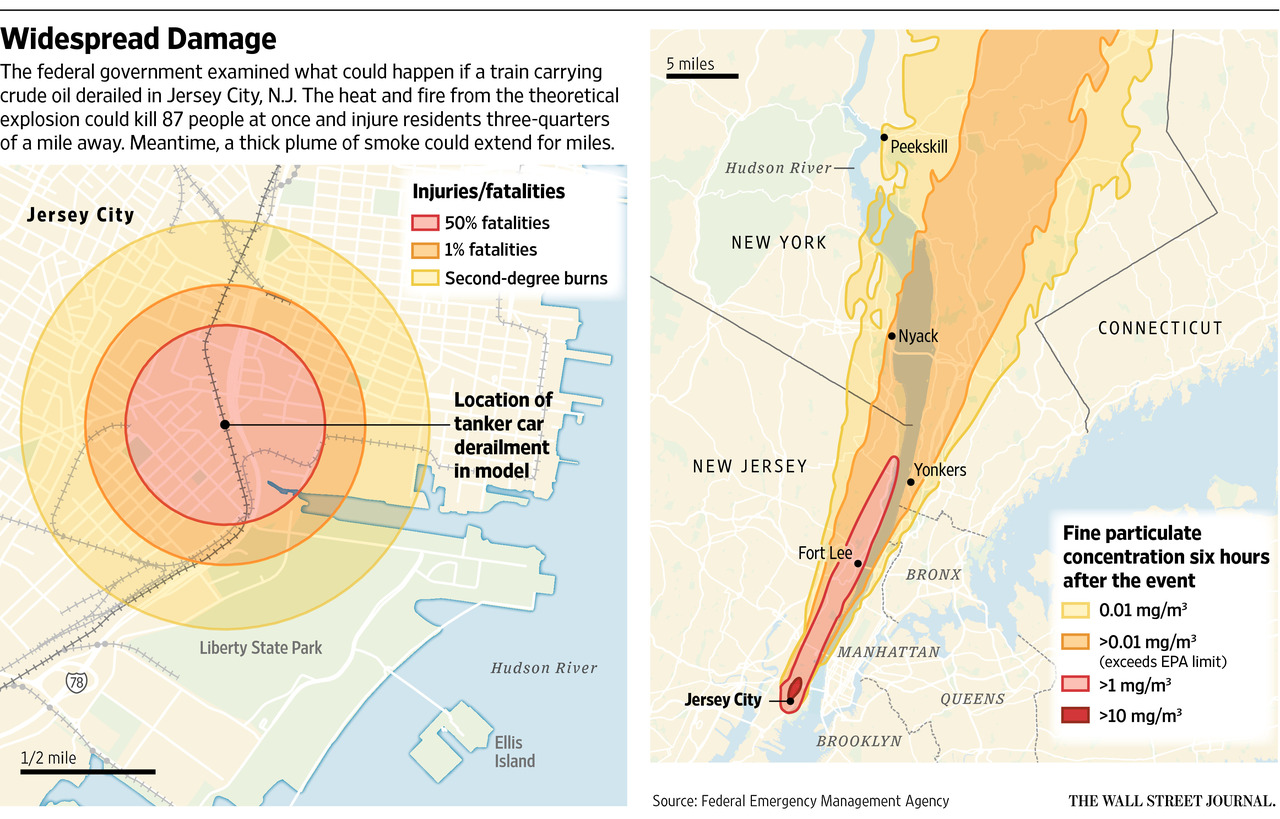
Imagine a mile-long train transporting crude oil derailing on an elevated track in Jersey City, N.J., across the street from senior citizen housing and 2 miles from the mouth of the Holland Tunnel to Manhattan.

The oil ignites, creating an intense explosion and a 300-foot fireball. The blast kills 87 people right away, and sends 500 more to the hospital with serious injuries. More than a dozen buildings are destroyed. A plume of thick black smoke spreads north to New York’s Westchester County.

This fictional—but, experts say, plausible—scenario was developed by the Federal Emergency Management Agency in one of the first efforts by the U.S. government to map out what an oil-train accident might look like in an urban area. Agency officials unveiled it as part of an exercise last month to help local firefighters and emergency workers prepare for the kind of crude-by-rail accident that until now has occurred mostly in rural locations.

“Our job is to design scenarios that push us to the limit, and very often push us to the point of failure so that we can identify where we need to improve,” said FEMA spokesman Rafael Lemaitre. He said a second planning exercise is scheduled in June in a suburban area of Wisconsin.

WSJ-Widespread_Damage

continued below

Wednesday, April 8, 2015

Seattle fire chief: Oil trains pose 'significant threat'

Seattle fire chief: Oil trains pose 'significant threat'

Dan Cassuto, KING 5 News        April 7, 2015       Video at site


SEATTLE - City officials are calling on BNSF railroad to provide more detailed information about disaster planning if an oil train should derail and explode in, or under, downtown Seattle.
 
Trains travel through a mile-long tunnel under downtown built in 1904.

"I believe the threat is so significant here in the heart of Seattle," said the city's new fire chief, Harold Scoggins, at a news conference, alongside Mayor Ed Murray and Sen. Maria Cantwell, among other local officials. "I'm not sure when you'd get to the point where it is enough."

Mayor Ed Murray said first responders would not enter the tunnel if an oil train were on fire, since the tunnel is not lit or ventilated.

BNSF, however, insists the tunnel is safe.

The railroad inspects the tracks daily and concluded the tunnel is strong enough to withstand even a terrible oil train explosion, says BNSF spokesman Gus Melonas.

Sen. Maria Cantwell, also at the news conference, was supporting her proposed bill to increase funding for local emergency responders and require more information and disaster plans from railroads.

Sen. Cantwell also called on oil producers to take steps to treat oil so it's less explosive.


 So what could happen in an oil train derailment and fire in a populated area?

Jersey City hosts workshop with FEMA, Homeland Security, to prepare for oil transport disaster

By The Jersey Journal    March 17, 2015  

Jersey City has been named as one of three sites in the nation to host a two-day workshop on safety preparedness in the case of a crude oil delivery disaster.

"Operation Safe Delivery," which is being conducted in partnership with Homeland Security officials and Federal Emergency Management Agency, got underway yesterday. Day Two, which includes response to a mock disaster, is set for Thursday.,,,,   more here

[Editor note: Scenario focuses on a catastrophic oil rail transportation incident in Jersey City, New Jersey.  


5 tank cars derail, spilling approximately 100,000 gallons of high vapor pressure/low flash point crude oil into dense urban area area.  Spilled oil ignites into a pool fire. 
  
Affected Population Estimates for Initial Pool Fire Damage Zones
1,923 individuals living within 472 yards could potentially receive second-and third-degree burns or fatal injuries 
3,954 individuals living within 631 yards could potentially receive second-and third-degree burns or fatal injuries 
9,299 individuals living within 887 yards could potentially receive second-degree burns  

Blast Injury Zones: 
287 people living within 200 yards of explosion could potentially be killed by blast 
830 people living within 340 yards of explosion could be injured or killed by blast 
7,485 people living within 859 yards of explosion could suffer skin lacerations from blast debris 
32,423 people living up to 1446 yards from explosion could suffer minor injuries from blast  

Data from Operation Safe Delivery Exercise Series power point presentation.]