Showing posts with label track defects. Show all posts

Friday, February 26, 2016

Rail Bridge Inspection Requests


FRA Launches Website for States and Municipalities to Request Bridge Inspection Reports

Agency also requests resources to double bridge safety staff, create national database of bridges
WASHINGTON – The Federal Railroad Administration today launched a new tool on its website that allows states and municipalities to request inspection reports for rail bridges in their communities. The tool is being launched following the passage of the Fixing America’s Surface Transportation (FAST) Act and is one of the first provisions FRA has implemented. FRA also announced today that it has requested additional resources as part of the President’s Fiscal Year 2017 budget to double its bridge specialist staff and create a national bridge inventory database and website.
“Communities across the country will now have access to information on the condition of railroad bridges in their area,” said U.S. Transportation Secretary Anthony Foxx. “These inspection reports will provide greater transparency between railroads and local leaders, which is an important cornerstone in our comprehensive safety efforts.”
A state or a political subdivision of a state, such as a city, county, town or municipality, can now use FRA’s website to request information from inspection reports for local bridges via https://www.fra.dot.gov/Page/P0922. Once FRA receives the request, the railroad that owns the bridge will have 30 days to respond to the request. FRA plans to provide a copy of the report to the requester within 45 days of the original request.
According to the FAST Act, the following information about the bridge will be included in the report: the date of the last inspection; length of bridge; location of bridge; type of bridge (superstructure); type of structure (substructure); features crossed by the bridge; railroad contact information; and a general statement on the condition of the bridge.
“The Federal Railroad Administration has repeatedly urged railroads to be more responsive and more transparent with state and local leaders concerned about the condition of their local railroad bridges. State and local officials will now be able to get more information from railroads on the infrastructure in their communities,” FRA Administrator Sarah E. Feinberg said. “Providing inspection reports to local leaders is a great first step, but more can—and must—be done. We hope Congress will provide the resources to double our bridge safety staff and create a national database.”
The FAST Act addressed the issue after months of Administrator Feinberg repeatedly urging railroads to be more transparent and respond to communities when they have questions and concerns about the condition of rail bridges.
Last September, the Administrator sent a letter to all railroads saying, “When a local leader or elected official asks a railroad about the safety status of a railroad bridge, they deserve a timely and transparent response. I urge you to engage more directly with local leaders and provide timely information to assure the community that the bridges in their communities are safe and structurally sound.” While addressing, the Railroad Safety Advisory Committee in November 2015, Administrator Feinberg again told railroads that, “When FRA is asked about bridge safety, it’s frequently because, again, the public or a member of Congress become concerned and has tried to get answers from a railroad, and they have been ignored or put off.”
###
Friday, February 26, 2016

Sunday, December 20, 2015

Broken rails, hidden data- and other links

 After the '64 quake in Alaska.   Cascadia's will be when?     

Broken rails: Track defects behind lethal blasts

BY LAURA ARENSCHIELD AND RICK ROUAN
COLUMBUS DISPATCH      12/20/15    

MOUNT CARBON, W.Va. — Track defects caused fiery crude-oil derailments that forced 1,100 people from their homes in this Appalachian village this year and killed 47 people in a Canadian town in 2013.

In fact, a Dispatch analysis of federal records shows that track defects and human error are to blame for most railway incidents.

Yet U.S. regulators focus on tanker cars instead of the rails that support the cars and millions of gallons of Bakken crude, a highly volatile oil from North Dakota and Montana that crisscrosses the country on the way to refineries each week.....    more here

States, feds keep train-derailment reports from public


By Laura Arenschield & Rick Rouan The Columbus Dispatch • Sunday December 20, 2015

Information that state and federal government agencies collect about train derailments, particularly those that cause crude-oil spills, is hard to find.

Huge amounts of data about collisions, derailments and other accidents that happen along railroads in the United States are collected every year.

Some of it is compiled by the industry and distributed directly to the public upon request. But some is buried in databases that government officials are slow to release, if at all.

For example, the U.S. Department of Transportation requires railroads to submit annual reports to state emergency-response officials estimating how many trains carrying crude oil from the Bakken shale region pass through each county.

Yet in many states, the public is not allowed to see those reports.

A request by The Dispatch to see reports for Ohio went unanswered for months.....

.... Final reports reveal that what railroads initially tell the Federal Railroad Administration doesn’t always hold up in an investigation. Many underestimate damages and list causes that are later changed. more here


Lifting oil-export ban unlikely to affect WA state right away


By Hal Bernton Seattle Times Dec. 19, 2015

The lifting of the national ban on crude-oil exports is unlikely to trigger a rush to send oil to Asia from Washington state terminals, but that could change over the longer term.

With a 40-year oil-export ban lifted Friday by Congress, Washington terminals that receive Bakken shale crude by rail will be able to send unrefined product to Asia.


In the years ahead, that might be an attractive option. But current market conditions make the West Coast terminals an unlikely launching point for major overseas shipments, according to industry analysts..... more here

Obama vetoes GOP push to kill climate rules 

-Benicia Independent   12/19/15

Monday, December 7, 2015

Why no Rail track wear standards for hauling hazardous materials?

Broken Rails 

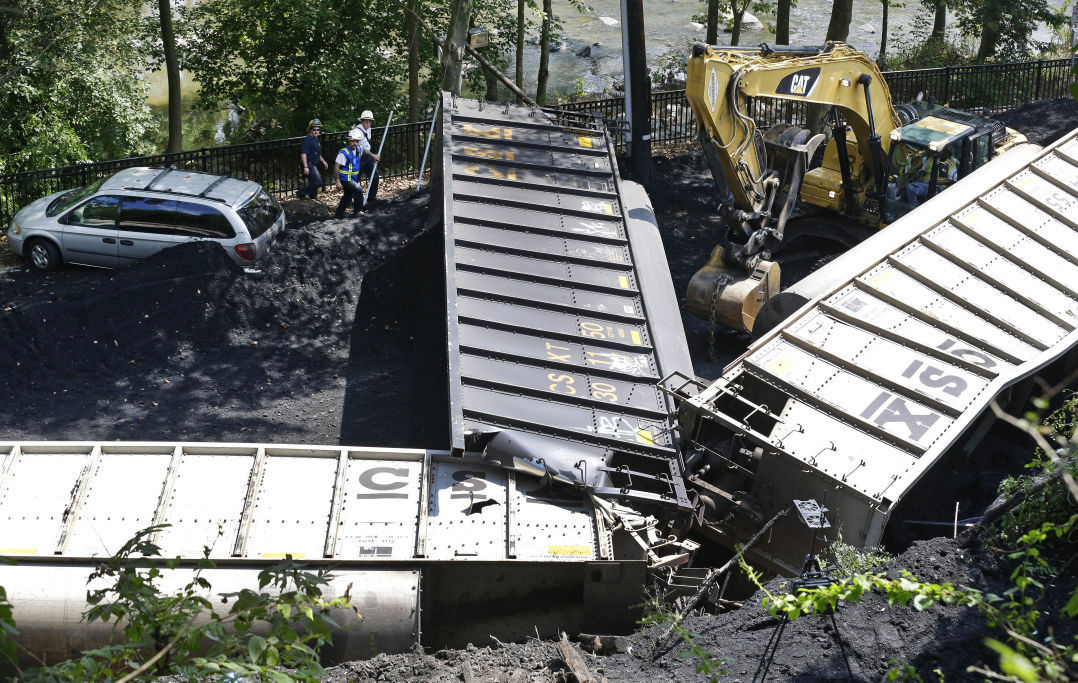
Derailed freight train. Elliott City MD, 2012.

Rail track wear standards elude agreement

MATTHEW BROWN and MICHAEL KUNZELMAN Associated Press Writers

A pair of train derailments in 2012 that killed two people in Maryland and triggered a fiery explosion in Ohio exposed an unsettling truth about railroads in the U.S. and Canada: No rules govern when rail becomes too worn down to be used for hauling hazardous chemicals, thousands of tons of freight or myriad other products on almost 170,000 miles of track.

U.S. transportation officials moved to establish universal standards for when such steel gets replaced, but resistance from major freight railroads killed that bid, according to Associated Press interviews with U.S. and Canadian transportation officials, industry representatives and safety investigators.

Now, following yet another major accident linked to worn-out rails — 27 tanker cars carrying crude oil that derailed and exploded in West Virginia earlier this year — regulators are reviving the prospect of new rules for worn rails and vowing they won't allow the industry to sideline their efforts.

"We try to look at absolutely every place where we can affect and improve safety," said Federal Railroad Administrator Sarah Feinberg. "Track generally is the place that we're focusing at the moment, and it's clearly overdue. Rail head wear is one place in particular that we feel like needs to be addressed as soon as possible."

An official announcement on the agency's intentions to revisit rail wear is expected by the end of the year.

In the meantime, federal regulators haven't taken the positive steps that they need to, said Ronald Goldman, an attorney for the families of the two 19-year-old women who died in a 2012 derailment outside Baltimore.

"It's a lack of will, not a lack of ability, in my opinion," he added.

Industry supporters argue that the seven major freight railroads in the U.S. and Canada are in the best position to know what is going on with their lines, including when they need to be replaced or have the maximum speeds for trains traveling on them lowered.....   more here


Monday, October 12, 2015

Oil hauls thought to be overtaxing rail system

Oil hauls thought to be overtaxing rail system

The only sign of trouble aboard a Norfolk Southern train hauling roughly 9,000 tons of Canadian crude in western Pennsylvania last year was a moderate sway in the locomotive as it entered a bend on the Kiskiminetas River.

The first 66 cars had passed safely around the curve when the emergency brakes suddenly engaged, slamming the train to a stop. The conductor trudged back nearly a mile through newly fallen snow to see what had happened.

Twenty-one cars had derailed, one going through the wall of a factory. Four tank cars were punctured, sending 4,300 gallons of crude pouring out of the wreckage.

The cause of the accident in North Vandergrift was identified as a failure in the rails -- not aging or poorly maintained tracks, but a relatively new section laid less than a year earlier.

The February 2014 crash fits into an alarming pattern across North America that helps explain the significant rise of derailments involving oil-hauling trains over the last three years, even as railroads are investing billions of dollars in improving the safety of their networks. A review of 31 crashes that have occurred on oil trains since 2013 puts track failure at the heart of the growing safety problem.

Track problems were blamed in 59 percent of the crashes, more than double the overall rate for freight-train accidents, according to a Los Angeles Times analysis of accident reports. Investigators and rail-safety experts are looking at how the weight and movements of oil trains may be causing higher-than-expected track failures.

The growing number of trains hauling crude oil from Canada and the Northern Plains are among the heaviest on the rails today, many extending more than 100 cars in length and weighing 19,000 tons or more.....

.... Of the 31 crashes involving crude or ethanol since 2013, 17 were related to track problems and 12 a mix of other causes. The cause of the two other crashes remains unclear. The count is based on final or preliminary government and railroad investigations that were collected by the Times under the Freedom of Information Act or in U.S., Canadian and railroad company filings.

Weight, oil sloshing and cold temperatures are among the issues that might be exacerbating the problem, according to rail-safety experts.

Investigators at Safety Transportation Board Canada, which is examining the eight accidents that have occurred in that country, are beginning to suspect that the oil trains are causing unusual track damage.

Sunday, July 5, 2015

The ties that bind: A special report two years after the Lac-Mégantic tragedy

Lucas Oleniuk/Getty Images

The ties that bind: A special report two years after the Lac-Mégantic tragedy

Jesse Feith, Montreal Gazette    July 3, 2015

Two years after the train derailment that killed 47 people, Lac-Mégantic’s relationship with the railroad it was built around is complicated.
The town’s fate has always been intertwined with that of the railroad. Lac-Mégantic was founded after the tracks were put down in the late 1880s, and has relied on the rails for survival ever since.

Families moved ever closer to the railroad, and grew to trust it. Even as town officials lodged complaints about the decaying tracks over the last 20 years, that trust remained.

The importance of the tracks to this Eastern Townships municipality is such that they were repaired before many of the buildings that were destroyed when the crude-carrying tank cars exploded in the heart of town.

Despite the destruction now associated with the railroad, when the first train came through town five months after the disaster, many people saw it as the beginning of Lac-Mégantic’s rebirth.

Residents knew they had to set aside their fear and anger if the town was to survive economically. One out of six jobs in town still has ties to the railroad.

“We had no choice, really,” town councillor Richard Michaud says. “Hundreds of jobs depend on (the railroad) here, and we couldn’t risk losing them.”

But the trust is gone.

........Montreal Gazette reporter Jesse Feith and photojournalist John Kenney visited towns along the route linking the Bakken oil formation and Lac-Mégantic to explore the relationships between people and their railroads. Here are the stories they’ve brought back.....   more here


Sunday, May 10, 2015

Train derailments: often a failure to see and fix track defects

Investigators gather Friday, May 8, 2015, at the site of the oil train derailment and fire near Heimdal, N.D.

Train derailments: Looking at track defects

In derailments, often a failure to see and fix internal track defects


By Daniel Moore / Pittsburgh Post-Gazette

On a snowy morning in February 2014, a Norfolk Southern freight train snaked east through rural Westmoreland County with 83 of its cars loaded with crude oil.

It was cruising at about 30 mph near Vandergrift when it hit a section of track where the rail was slightly too far apart. The spikes designed to hold the rails in place were missing or defective, according to preliminary company-reported federal data. 

The train derailed, violently tossing 21 cars — 19 carrying crude oil, two carrying propane — from the tracks. The force punctured four cars and spilled 4,300 gallons of oil across the banks of the Kiskiminetas River.

All told, Pennsylvania’s largest crude oil spill since 1990 caused more than $2 million in damage....

...The U.S. Department of Transportation in April released long-anticipated rules that would phase out older tank cars and require electronically controlled brakes for trains carrying crude oil and ethanol.

Largely escaping scrutiny, however, has been a key factor in derailments and one almost exclusively outside government control: the track itself. Track defects are the leading cause of derailments and internal rail flaws account for the most damaging of them, according to an analysis of government data and academic reports. Those tasked with identifying and fixing track flaws say more needs to be done to improve track inspection, including more frequent checks.

But with the rise in crude shipments by rail has come added pressure on company-employed inspectors who are — much like construction workers on a busy highway — disruptors of traffic. 

Richard Inclima has been focused on the issue of rail inspections for years, pushing in countless negotiations, testimonies and meetings for more federal oversight. 

“The key to this whole puzzle is keeping the trains upright and on the track, and nobody in this country is talking about the foundation of the railroad,” said Mr. Inclima, a former track inspector in New England and the longtime director of safety and education for the Brotherhood of Maintenance of Way Employees, a union representing company-employed track inspectors....

Incipient flaws

Despite the spate of high-profile derailments, the 140,000-mile U.S. freight railroad system statistically is safer than it’s ever been, thanks largely to the rapid development of better inspection practices and technology. 

Derailment rates nationwide have dramatically decreased since the 1980s, and government data last month confirmed 2014 was the safest year on record. The track-caused accident rate last year has more than halved since 2000. 

Still, there were nearly 9,000 derailments on U.S. railroads in the last 10 years totaling nearly $2 billion in damage. 

And on Pennsylvania’s more than 5,000 miles of track, about 300 freight trains have derailed during that same time, causing more than $31 million in damage.

More than half of those derailments were caused by track defects, according to a Post-Gazette analysis of accident data collected by the Federal Railroad Administration, an arm of the U.S. Department of Transportation. About 24 percent were attributed to human error, and the rest were listed as a result of equipment, systems and miscellaneous failures.

The Federal Railroad Administration employs roughly six dozen track inspectors — enough to inspect less than 1 percent of track — and it expects 30 percent of its field safety staff to retire in the next few years, according to a 2013 report from the Government Accountability Office. Though all track is subject to the agency’s regulation, its oversight in the field, the report suggested, amounts to little more than cursory checks for compliance and civil penalties for only the most serious of offenses.

This has left an estimated 2,500 inspectors employed by large rail companies as the gatekeepers of rail safety......   more here


Track was inspected day before derailment, FRA says